


Cheapest Airport Transfer
- Sydney airport transfer costs compared
- What changes the cheapest airport transfer option?
- Public transport: usually the cheapest option
- Direct Airport Link train: pay more to save time
- Shared airport shuttles: cheaper door-to-door travel for some solo travellers
- Rideshare: compare the live price before booking
- Taxi: the A$60 CBD fixed fare changes the group calculation
- Private airport transfers: compare the complete fixed quote
- CBD vs outer suburbs: the cheapest option can change
- Which option is cheapest for different travellers?
- How to calculate the real cheapest airport transfer
- How to compare airport transfer quotes properly
- The cheapest Sydney airport transfer depends on the trip
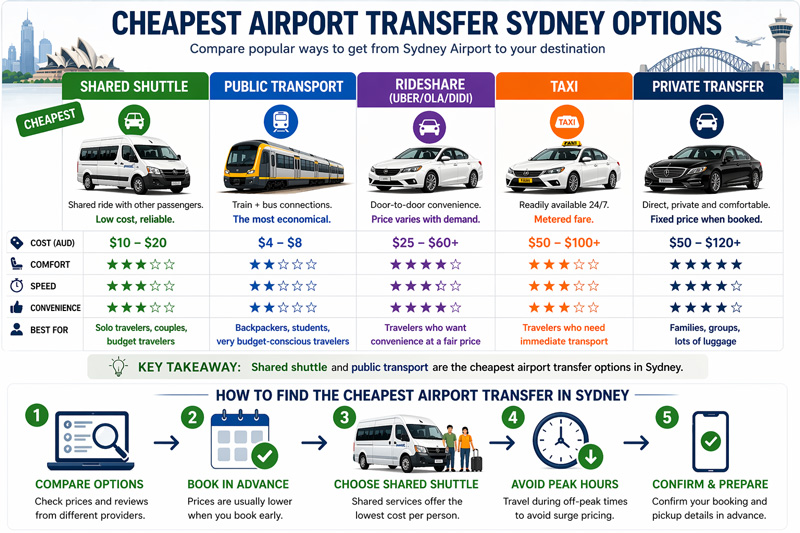
A bus connection to the suburban rail network can avoid that airport station fee. Current Sydney travel comparisons put a bus-and-train trip toward the CBD at roughly A$5 – 8 per person, compared with a much higher total for the direct airport train. The trade-off is additional travel time, a transfer and more handling of luggage.
The cheapest choice is different for every trip, however. Passenger numbers, destination, luggage, time of travel and whether a fare is charged per passenger or per vehicle can completely change the calculation.
Sydney airport transfer costs compared
For a journey between Sydney Airport and the CBD, these indicative costs and travel times provide a useful starting point:
| Option | Indicative cost | Typical travel time | Pricing basis | Main trade-off |
|---|---|---|---|---|
| Bus plus suburban train | About A$5–8 | About 35–45 min | Per passenger | Lowest cost but requires a transfer |
| Direct Airport Link train | Normal rail fare + A$18.61 adult airport station fee | About 13–20 min | Per passenger | Fast and predictable but airport access fee raises the price |
| Shared airport shuttle | About A$22–28 | About 40–60 min | Usually per passenger | Door-to-door potential but multiple stops |
| Rideshare | Often about A$35–55 | About 20–35 min | Per vehicle | Direct but price can vary with demand |
| Standard taxi to eligible CBD area | A$60 | About 15–35 min depending on traffic | Per vehicle | Direct and fixed-price for eligible airport-to-CBD trips |
| Private transfer | Provider-specific quote | Commonly similar to other direct road transfers | Usually per vehicle | Pre-arranged and direct but normally costs more than public transport |
Published competitor comparisons consistently identify the bus-and-train combination as the lowest-cost CBD option, while also showing why journey time and passenger count need to be considered alongside price.
These figures are useful benchmarks, not universal Sydney-wide fares. Once the destination moves away from the CBD, the cheapest option can change substantially.
What changes the cheapest airport transfer option?
A headline fare does not tell you whether a transfer is actually the cheapest for your journey. Five variables have the greatest effect on the final comparison.
Destination and distance
The CBD is only one possible destination. A transfer to Parramatta, the Northern Beaches, Western Sydney or another outer suburb creates a different cost comparison because road distance, tolls and the usefulness of public transport all change.
Competitor pricing guides consistently treat destination as one of the main inputs when calculating airport-transfer prices.
For that reason, a CBD fare should not be used to estimate a transfer to an outer suburb.
Number of passengers
Public transport and most shared shuttles are priced per passenger. Taxis, rideshare and many private transfers are priced primarily per vehicle.
This creates an important crossover.
A A$7 public-transport journey may be clearly cheapest for one person. For four passengers, the same journey becomes about A$28 in total. A direct vehicle costing A$50–60 is still more expensive overall, but the difference per passenger becomes much smaller.
The same logic works in the other direction with shared shuttles. Four A$25 shuttle seats equal A$100, so a single vehicle can become the cheaper option.
Luggage and required vehicle size
A low fare loses value if your group cannot fit into the vehicle or if a transport change is difficult with luggage.
Large groups, oversized luggage, prams and multiple suitcases can require an XL rideshare, maxi taxi, SUV, people mover or larger private vehicle. Vehicle size is therefore a genuine cost factor rather than simply a comfort upgrade. Airport-transfer providers commonly ask for passenger and luggage information before confirming the appropriate vehicle and quote.
Time of travel
Public transport prices are relatively predictable, but availability and frequency change late at night.
Rideshare pricing can vary with demand, while road journey times change with traffic. By contrast, a genuine fixed-price transfer should remain at the agreed price provided its booking terms do not add time-based charges.
This means “rideshare is cheaper” may be true when demand is low but false when a live app quote rises significantly.
Fees that are not obvious in the headline price
Depending on the service, the final amount may include:
-
Airport or station access charges
-
Road tolls
-
Waiting or parking charges
-
Larger-vehicle charges
-
Luggage-related extras
-
Child-seat charges
-
Card-payment fees
-
Late-night or special-period charges
Competitor pricing guides repeatedly emphasise the importance of checking inclusions rather than comparing only the advertised base fare.
Public transport: usually the cheapest option
Use an airport bus connection to avoid the train station access fee
Sydney Airport is connected to the surrounding public-transport network by bus.
Transport for NSW currently lists Route 420 as serving both the International and Domestic terminals on its service between Burwood and Mascot Station. Route 350 serves the Domestic Terminal and connects through Mascot toward Bondi Junction.
For a CBD-bound traveller, using an airport bus to connect with the suburban rail network can avoid entering the Domestic or International Airport train station and therefore avoid the A$18.61 adult station access fee.
Published comparisons estimate this type of bus-and-train journey toward central Sydney at around A$5–8 and roughly 35–45 minutes.
Who benefits most from the cheapest public transport route?
It works particularly well for:
-
Solo travellers
-
Couples focused primarily on price
-
Travellers with light luggage
-
Passengers comfortable making a transfer
-
People whose destination is well connected to the rail or bus network
It is less attractive for someone carrying several suitcases, travelling with small children or mobility needs, or heading to a destination that requires several additional connections.
Direct Airport Link train: pay more to save time
Sydney Airport’s direct train is convenient, but it is not normally the absolute cheapest option.
The Domestic and International stations charge the A$18.61 adult access fee in addition to the regular rail fare for Opal and contactless users. Transport for NSW also lists an A$19.00 airport station access fee for an adult single-trip ticket.
What the extra cost buys is simplicity.
Both airport terminals have access to train stations, and the service runs directly into the city rail network. Current Sydney travel guides estimate roughly 13–20 minutes to major CBD stations, compared with around 35–45 minutes for the cheaper bus-and-train combination.
For a solo traveller, the decision is therefore often straightforward:
Lowest fare → bus plus suburban train
Faster public transport with no bus-to-train change → direct Airport Link train
For a family or group, however, multiply the train fare by every passenger before comparing it with a per-vehicle road transfer.
Shared airport shuttles: cheaper door-to-door travel for some solo travellers
A shared shuttle distributes the vehicle cost across several unrelated passengers.
That can make it particularly useful for a solo traveller who wants hotel or door-to-door transport without paying for an entire private vehicle.
Current Sydney comparisons put many shared airport-to-CBD shuttle fares around A$22–28 per passenger, with trips commonly taking about 40–60 minutes because passengers may be collected or dropped off at several locations.
The pricing structure matters.
One passenger paying A$25 may get reasonable door-to-door value. Four passengers paying A$25 each are spending A$100 collectively, at which point rideshare, taxi or a private transfer may be cheaper.
Always compare:
Shared shuttle price × number of passengers
against:
Total price of one suitable private vehicle
Rideshare: compare the live price before booking
Rideshare provides direct transport without a fixed timetable or shared-shuttle route.
Its major advantage is flexibility. Its weakness for budget planning is variable pricing.
Current Sydney guides commonly estimate a standard airport-to-CBD rideshare at around A$35–55 under typical conditions, with a travel time of roughly 20–35 minutes depending on traffic.
Those numbers should be treated as benchmarks rather than guaranteed fares. Booking.com also notes that rideshare prices depend on demand, route and traffic and that toll-road charges can affect the total.
For a couple or small group, calculate the per-person cost of the live vehicle quote.
For example:
A$48 rideshare ÷ 4 passengers = A$12 per person
That may still cost more than the cheapest public-transport route, but the price difference can be small enough that direct door-to-door travel becomes worthwhile.
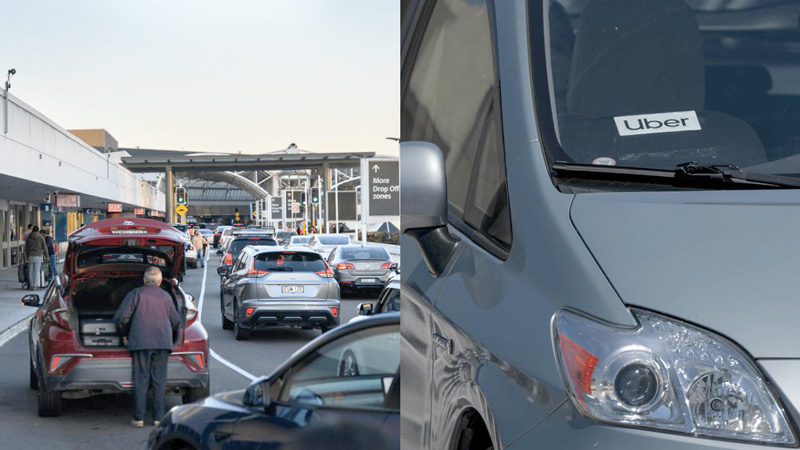
Taxi: the A$60 CBD fixed fare changes the group calculation
Sydney Airport currently operates a fixed-fare trial for uninterrupted taxi journeys from an airport taxi rank to the designated Sydney CBD area.
The fares are:
-
A$60 for a standard or wheelchair-accessible taxi
-
A$80 for a maxi taxi when requested or when five or more passengers are travelling
Sydney Airport states that these fixed fares include taxes, fees, levies and road tolls, although applicable card-payment and cleaning charges can still be additional. The arrangement does not apply to rideshare or privately booked airport-transfer services.
Trips outside the designated CBD area remain subject to the applicable metered fare rather than the A$60 airport-to-CBD fixed fare.
For a solo traveller, A$60 is clearly not the cheapest option.
For four people:
A$60 ÷ 4 = A$15 per person
That illustrates why a vehicle that looks expensive at first can become competitive once several passengers share the cost.
Private airport transfers: compare the complete fixed quote
A private airport transfer is unlikely to beat public transport on absolute price for a solo CBD traveller.
Its cost advantage appears in different circumstances: a larger group, an inconvenient destination, substantial luggage or a situation in which the traveller wants to lock in the entire road-transfer cost before travelling.
When asking for a private-transfer price, provide:
-
Exact pickup terminal
-
Exact destination address
-
Passenger count
-
Number and size of bags
-
Child-seat requirements if relevant
-
Any oversized luggage
-
Pickup time
-
Any requested additional stops
Competitor guides specifically identify exact destination, passenger numbers, vehicle size, terminal and special requirements as factors that can affect the quote.
Then confirm whether the quoted total includes:
-
Airport pickup charges
-
Tolls
-
GST
-
Waiting time
-
Flight-delay allowance
-
Parking
-
Luggage extras
-
Child seats
-
Card-payment charges
-
Late-night fees
-
Additional stops
Some transfer operators advertise all-inclusive rates covering items such as tolls, airport fees, waiting time and flight monitoring. Those inclusions are operator-specific and should be confirmed for the actual booking rather than assumed.
CBD vs outer suburbs: the cheapest option can change
The A$5–8 bus-and-train example is useful for understanding a CBD journey, but it should not be treated as the cheapest answer for every Sydney destination.
CBD and rail-connected destinations
Public transport tends to be strongest when:
-
Only one or two people are travelling
-
The destination is near a station
-
Luggage is manageable
-
The traveller can accept a transfer
This is where avoiding the airport train station fee produces the clearest saving.
Outer suburbs
For outer-suburban destinations, consider the whole trip rather than only the first journey from the airport.
A cheap public-transport fare can involve several changes plus a final bus, train or rideshare segment. Booking.com specifically notes that transport economics can change outside the city centre and that other options may become more practical for outer-suburban travel.
Likewise, private-transfer pricing generally rises with distance, while tolls and larger vehicle requirements can increase road costs. Competitor transfer guides show destination as a primary pricing variable.
The correct comparison for an outer suburb is therefore:
Total public-transport journey to the final address
versus:
One complete vehicle quote to the same final address
Which option is cheapest for different travellers?
Solo traveller with light luggage
The bus-plus-suburban-train strategy is usually the strongest choice when the objective is simply to spend as little as possible.
If carrying luggage through a transfer is undesirable, compare a shared shuttle next.
Solo traveller who wants door-to-door service
A shared shuttle can offer better value than reserving an entire private vehicle. Check the exact per-passenger fare and how many stops the service may make.
Couple travelling to the CBD
Public transport remains difficult to beat on absolute price, especially using the cheaper bus connection.
However, compare the combined fare for two people with a live rideshare quote. The convenience premium may be relatively modest during periods of low demand.
Family or group of three or four
Do not compare one public-transport ticket with one vehicle quote.
Calculate:
Public transport fare × everyone travelling
and compare that total with:
One rideshare, taxi or private vehicle
This is the situation in which per-vehicle pricing becomes increasingly competitive.
Traveller with several suitcases
The bus-to-train option may remain cheapest in dollars, but the transfer itself can become difficult.
A solo traveller should compare a shared shuttle, while a family or group should compare one suitably sized rideshare, taxi or fixed-price transfer.
Family with young children
The cost comparison should include any vehicle or child-restraint requirement rather than assuming the cheapest standard vehicle will meet the trip's needs.
Some private operators provide child seats by arrangement, while conditions and charges vary by provider. Confirm the requirement before comparing final prices.
Late-night arrival
Transport for NSW lists the N20 late-night bus via the International Terminal between midnight and 4am. Route 420 operates through the airport during its daytime operating period, while airport rail services operate from early morning until around midnight.
When fewer public-transport services are practical, the cheapest realistic choice may shift to rideshare, taxi or a pre-booked transfer.
How to calculate the real cheapest airport transfer
The most reliable comparison is not the advertised base price. It is the final amount your travelling party will actually pay.
A useful model is:
Final trip cost = base fare + airport or station charges + tolls + waiting or time-based charges + required vehicle or luggage extras + other compulsory fees
Then calculate:
Cost per traveller = final trip cost ÷ number of passengers
This exposes differences that headline fares hide.
For example, a cheap per-person fare can become expensive for a four-person family, while an apparently expensive vehicle fare becomes cheaper per person when it is shared.
How to compare airport transfer quotes properly
Use the same trip details for every option.
-
Enter the exact destination address
-
Use the correct terminal
-
Enter the real passenger count
-
Include luggage and special vehicle requirements
-
Check whether the price is per passenger or per vehicle
-
Confirm whether tolls and airport charges are included
-
Check waiting, parking and card-payment charges
-
Compare the final payable total rather than the starting fare
-
Divide vehicle fares by passenger numbers when comparing per-person value
-
Compare journey time and number of transfers alongside the saving
Competitor pricing guides specifically recommend using an exact destination and checking whether a quote is fixed or estimated and whether airport fees, tolls and taxes are included.
This process is especially important when comparing a fixed-price private transfer against an app estimate or a per-person shuttle fare.
The cheapest Sydney airport transfer depends on the trip
For a solo traveller or couple heading toward central Sydney and willing to make a transfer, public transport that avoids the Airport Link station access fee is generally the cheapest practical choice.
The direct airport train costs more but saves time and removes the bus-to-train change.
A shared shuttle can offer low-cost door-to-door travel for a solo passenger, but its economics weaken as more passengers pay separate fares.
Rideshare becomes more competitive for couples and groups when demand is low, while Sydney Airport’s A$60 standard taxi fare to the designated CBD area can work out to A$15 per person for four travellers.
For private transfers, the key question is not whether the advertised starting price is lowest. It is whether an all-inclusive vehicle quote is cheaper for your group after accounting for the exact destination, luggage, tolls, airport charges and any other compulsory costs.
The cheapest airport transfer in Sydney is therefore best identified by comparing final trip cost, cost per passenger and travel time for the same journey, rather than choosing whichever service displays the lowest headline fare.
Latest Insights
- Is There a Free Bus from Sydney Domestic to International?
- Can You Walk from Domestic to International at Sydney Airport?
- How Far Apart Are Sydney Airport’s International and Domestic Terminals?
- How Long Does a Domestic to International Transfer Take at Sydney Airport?
- Is There a Free Shuttle at Sydney Airport?
- Airport Transfer With Luggage
