


How Far Apart Are Sydney Airport’s International and Domestic Terminals?
- Where Are Sydney Airport’s International and Domestic Terminals?
- Can You Walk From Sydney Domestic to International?
- How Long Does It Take to Get From the Domestic Terminal to the International Terminal?
- Why Does a 4 km Terminal Transfer Need Extra Connection Time?
- What Is the Most Practical Way to Transfer Between the Terminals?
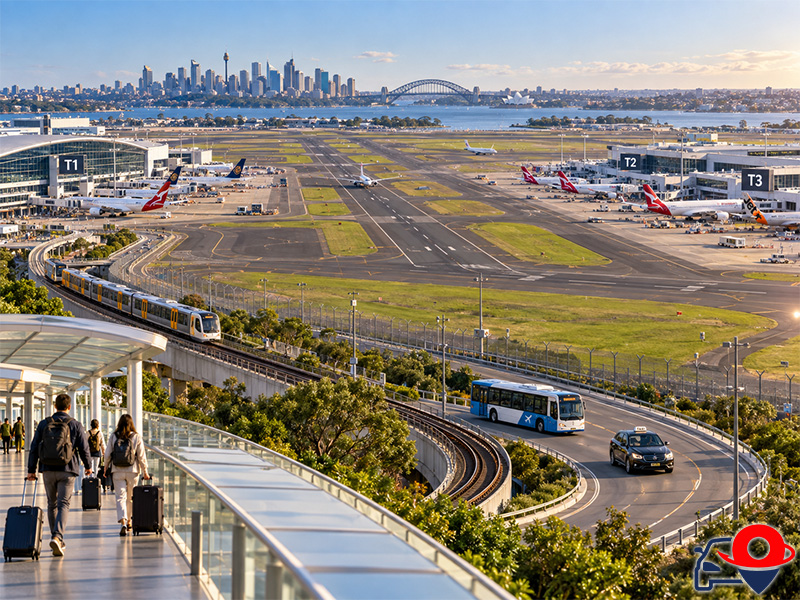
The practical Sydney Airport domestic to international distance is therefore better understood by transfer time rather than straight-line distance. The train journey between the terminal precincts takes about 2 minutes, while the complimentary Terminal Transfer Bus takes about 10 minutes.
Where Are Sydney Airport’s International and Domestic Terminals?
Sydney Airport has three passenger terminals. T1 is the International Terminal, while T2 and T3 form the domestic terminal precinct. T2 is a domestic terminal used by carriers including Virgin Australia and Jetstar, while T3 serves domestic operations including Qantas.
T2 and T3 are beside each other, but T1 is on a separate part of the airport. The runways and operational areas between the two precincts are what turn a relatively short geographic separation into a roughly 4 km road journey.
This distinction matters when reading an itinerary. A connection shown simply as “Sydney Airport” may still require passengers to move from T2 or T3 to T1, or in the opposite direction.
Can You Walk From Sydney Domestic to International?
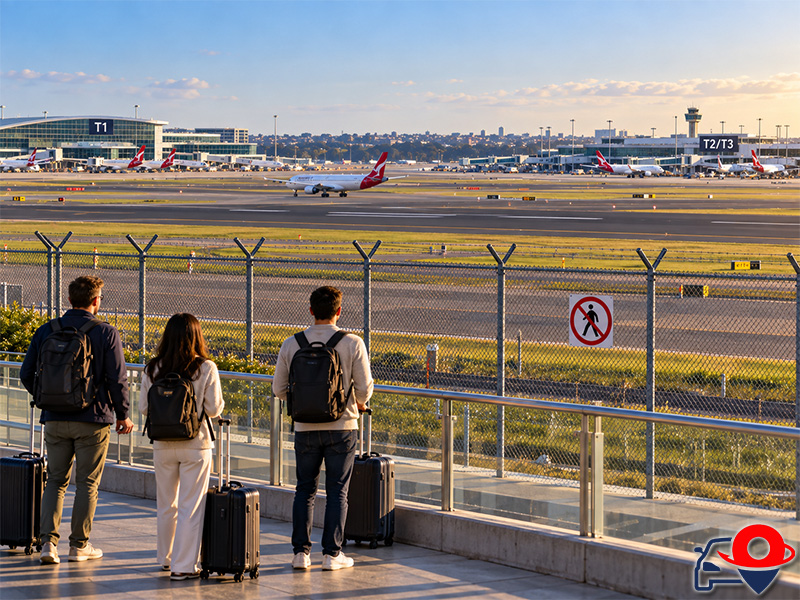
No. Passengers cannot walk between T1 International and the T2/T3 Domestic terminals.
The issue is not that the airport is geographically enormous. The terminal precincts are separated by the active airfield, so there is no normal public pedestrian route directly across it. A map may make T1 and the domestic terminals look relatively close, but the usable route must go around the restricted airport area.
T2 and T3 are different. Passengers can walk between these two domestic terminals using the pedestrian path through the P1 car park, with the walk taking approximately 5 minutes.
How Long Does It Take to Get From the Domestic Terminal to the International Terminal?
The actual transfer time depends on the mode of transport. The quickest scheduled journey is generally the train, but the total time needed for a flight connection is longer than the vehicle journey itself.
Train: About 2 Minutes
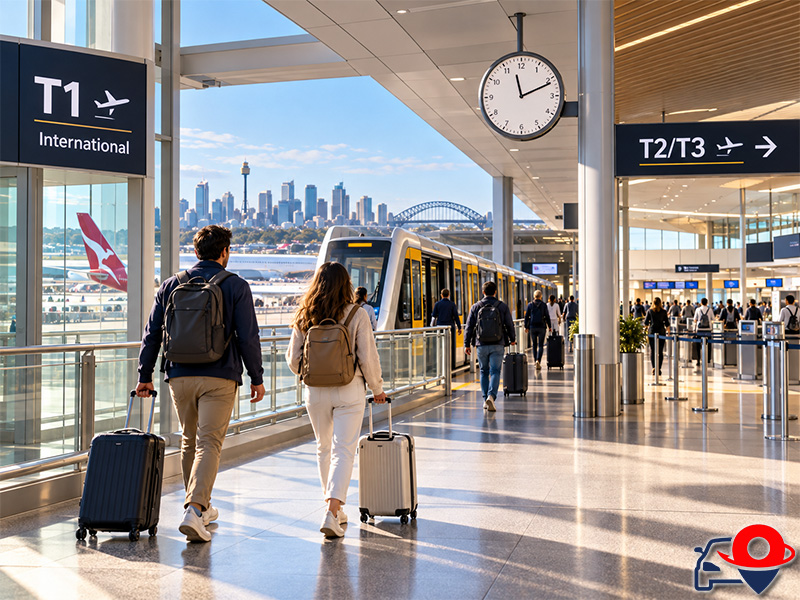
Airport Link trains connect the International Airport and Domestic Airport stations. The train ride between T1 and T2/T3 takes approximately 2 minutes, with services operating frequently between about 5:00 a.m. and midnight.
The two-minute figure refers to the train journey itself. Passengers must still reach the station, wait for a service, leave the station at the other terminal and continue to the appropriate check-in, security or departure area.
Terminal Transfer Bus: About 10 Minutes
Sydney Airport also operates a complimentary Terminal Transfer Bus between T1 and the domestic terminals. The bus normally operates every 15 minutes between 5:30 a.m. and 10:30 p.m., and the trip takes approximately 10 minutes.
Because the bus travels by road, its journey illustrates why the practical separation between the terminals is greater than their straight-line distance.
Taxi or Rideshare: Usually a Short Road Transfer
Taxi and rideshare services can also move passengers between the terminal precincts. A taxi journey between T1 and T2/T3 can take up to about 10 minutes depending on the time of day.
Traffic conditions and waiting time can make the total transfer longer, so the driving time should not be treated as the complete time required for a connecting flight.
Why Does a 4 km Terminal Transfer Need Extra Connection Time?
The Sydney Airport domestic to international distance is only one part of a connection. Moving between terminal buildings does not mean a passenger is immediately ready to board the next flight.
For an international-to-domestic connection, passengers may need to complete arrival formalities, collect baggage where required, follow their airline’s transfer procedure and travel to the domestic precinct. For a domestic-to-international connection, they may need to reach T1, complete international check-in or bag-drop requirements and proceed through departure processing and security.
This is why a two-minute train ride does not translate into a two-minute flight connection. Transfer procedures can vary according to the flights and airlines involved.
Passengers travelling on eligible Qantas or Virgin Australia itineraries may also have access to airline-specific transfer arrangements, so it is worth confirming the procedure directly with the operating airline rather than automatically choosing a public transfer option.
What Is the Most Practical Way to Transfer Between the Terminals?
For passengers focused on travel time, the train is the fastest scheduled terminal-to-terminal ride at about two minutes. The free Terminal Transfer Bus avoids the train fare but has a longer journey time and requires passengers to account for the interval between buses.
Taxi or rideshare can be convenient for passengers with substantial luggage or particular mobility needs, although road conditions can affect journey time. Eligible connecting passengers should first check whether their airline provides a dedicated transfer service.
The important point is to choose based on the whole connection, not just the 4 km road distance. Walking between T1 and the domestic precinct is not an available shortcut.
Sydney Airport’s International and Domestic terminals are relatively close geographically but function as separate terminal precincts. T1 International is about 4 km by road from T2/T3 Domestic, and passengers cannot walk directly between them. The train covers the terminal-to-terminal journey in about two minutes, while the airport’s free transfer bus takes around ten minutes.
When planning a connection, allow for more than the transport ride itself. Reaching the transfer point, waiting for transport, handling baggage and completing the procedures required for the next flight can all take considerably longer than simply travelling the distance between the terminals.
