


How to Arrange a Maxi Taxi or Minibus at Sydney Airport
- Two ways to arrange a group transfer at Sydney Airport
- Choose the vehicle around passengers and luggage
- How to book a maxi taxi or minibus before your flight
- Where to meet your vehicle after landing
- How much do maxi taxis and minibuses cost?
- Extra arrangements for children and accessible travel
- What if the flight is delayed or your group cannot find the driver?
- Conclusion
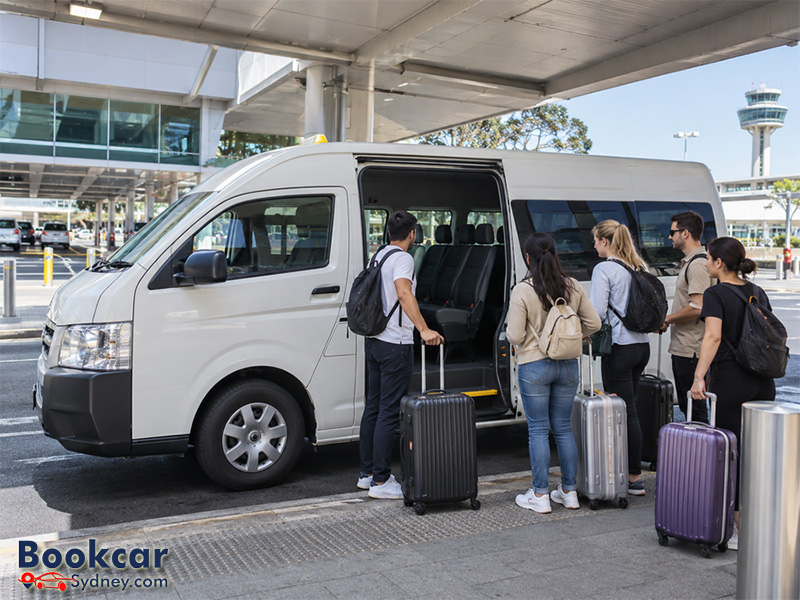
Two ways to arrange a group transfer at Sydney Airport
Ask for a maxi taxi at the airport taxi rank
Sydney Airport has a sheltered taxi rank at each passenger terminal: T1 International, T2 Domestic and T3 Domestic. After collecting your bags, follow the taxi signs and tell the kerbside supervisor that you need a maxi taxi. The airport says its supervisors can help arrange maxi taxis for larger groups, as well as five-seaters, vehicles with extra baggage space and accessible taxis.
This option works when your group is ready to leave and can be flexible about the vehicle and any wait. A maxi taxi may not be waiting at the front of the queue, particularly if your group needs a specific seating configuration. Do not assume that every large taxi can accommodate your entire group and its suitcases.
Pre-book a maxi taxi or a private minibus
For a larger party, substantial luggage or a scheduled arrival, contact a taxi network or private group-transfer operator before travelling. Some taxi networks allow you to select a maxi taxi through their website or app; specialist requirements may need a phone booking. A pre-booked minibus is a separate group-transfer arrangement rather than an ordinary taxi-rank pick-up.
Ask the operator to confirm the exact type of vehicle, its permitted passenger capacity, usable luggage space, the total fare and the meeting instructions. Sydney Airport provides dedicated collection zones for registered minibuses, buses and coaches. A driver collecting passengers there must use the approved arrangement, so the meeting point for a booked minibus may differ from the regular taxi rank.
Choose the vehicle around passengers and luggage
A maxi taxi is a higher-occupancy taxi, but the term does not describe one universal vehicle size. Depending on the taxi network and the booking, the vehicle may be an SUV or a larger minivan. A minibus may be more suitable when a single taxi cannot carry everyone and their bags safely.
|
Group situation |
Likely starting point |
What to confirm |
|
Five or more people with modest luggage |
Maxi taxi |
Enough passenger seats and boot space for all bags |
|
Family or small group with several large suitcases |
Larger maxi taxi or minivan |
Actual vehicle layout and usable luggage capacity |
|
Group too large for one taxi |
Pre-booked minibus or multiple vehicles |
Seat count, luggage storage and one agreed meeting point |
|
Passenger using a wheelchair |
Accessible taxi or suitably equipped group vehicle |
Wheelchair position, access equipment and booking confirmation |
Count every passenger, including children, then make a separate list of large suitcases, carry-on bags, prams, mobility equipment and oversized items. Passenger seats and baggage space compete for room; a vehicle advertised with a high seat count will not necessarily carry that many passengers plus a full load of large suitcases.
For example, 13cabs advises customers booking its maxi-taxi vehicles to account for luggage when selecting the required capacity. It also explains that its maxi category can include different vehicle types; selecting a larger-capacity option is important if a minivan is specifically needed. Vehicle categories and booking controls differ between operators, so confirm the arrangement rather than relying on a generic “maxi” label.
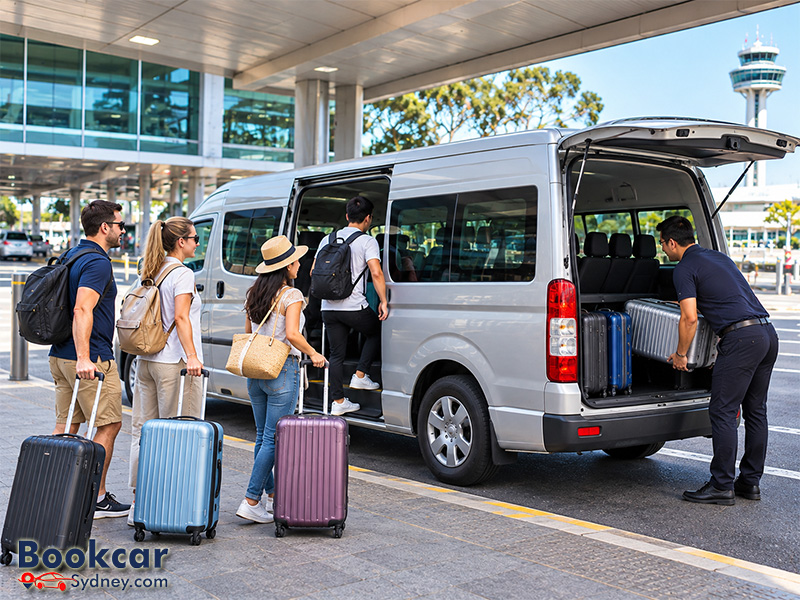
How to book a maxi taxi or minibus before your flight
Give the operator enough information to assign a suitable vehicle and explain where the driver can legally collect your group.
- Confirm the terminal and flight. Provide your flight number, arrival date, whether you land at T1, T2 or T3, and a contact number that will work in Australia.
- State the group size. Include the number of adults and children and identify any passengers who need a child restraint, wheelchair access or other assistance.
- Describe every bag. Count checked suitcases, hand luggage and bulky items; mention unusual equipment before accepting the vehicle.
- Confirm the destination and fare. Give the full drop-off address and ask whether the price is quoted or metered, and whether waiting, parking, tolls, airport access or additional stops are included.
- Get the meeting instructions in writing. Check the terminal-specific pick-up zone, what to do if the flight is delayed, and how you will identify or contact the driver.
If the group is arriving on separate flights, tell the operator whether everyone will be ready together. A single booking may involve extra waiting if one flight is late or passengers clear baggage collection at different times.
Where to meet your vehicle after landing
T1 International arrivals
After immigration, biosecurity and baggage collection, follow signs to the official taxi rank if you are requesting a maxi taxi on arrival. For a pre-booked minibus or larger vehicle, follow the location named in your booking confirmation rather than joining the taxi queue. Arrange a single meeting point that everyone in the group can find after clearing the terminal.
T2 and T3 Domestic arrivals
T2 and T3 each have an official taxi rank outside the arrivals area. If you are taking a rank taxi, follow the terminal taxi signs and ask the supervisor for the right vehicle. If you have reserved a minibus or private transfer, check the operator’s instructions for the applicable authorised pick-up area; do not assume a driver can stop at any convenient kerb.
Sydney Airport restricts passenger collections to designated areas. For larger pre-booked commercial vehicles, the airport uses dedicated collection zones. Terminal layouts and access arrangements can change, so the operator’s current pick-up instructions are more useful than an informal meeting point sent without confirmation.
How much do maxi taxis and minibuses cost?
The fare depends on how the journey is arranged. A taxi hired directly from an airport taxi rank is not priced in the same way as a transfer booked in advance.
A maxi taxi hired at an airport taxi rank
Under the Sydney Airport fixed-fare arrangement introduced on 3 November 2025, the fare for a non-booked maxi taxi to the specifically designated Sydney CBD trial area is AU$80 when there are five or more passengers or when a maxi taxi is specifically requested at the airport taxi rank, subject to the wheelchair-accessibility exception. This is a defined geographic area, not every destination described generally as “Sydney CBD”. The fixed fare includes road tolls, airport charges, taxes and levies; an allowable non-cash payment surcharge or cleaning charge may still apply.
For a trip outside the designated trial area, the usual taxi fare rules apply instead. Depending on the circumstances, the fare is calculated using the meter and permitted extra charges. NSW rules allow a maxi-cab fare of up to 150% of the otherwise applicable rank-taxi fare when five or more passengers travel, or when a maxi-cab is specifically requested at an airport taxi rank, except for qualifying wheelchair-accessible journeys. Confirm the applicable arrangement before departure.
A pre-booked maxi taxi or minibus
The airport taxi-rank fixed fare does not apply to booked passenger services. Instead, use the fare quoted and agreed with the operator. A private minibus quote may reflect vehicle size, journey length, waiting arrangements, multiple drop-offs and airport collection costs. Compare like with like: a lower initial quote may exclude extras that another operator includes.
Extra arrangements for children and accessible travel
When young children are travelling, specify their ages and the type of restraint required before booking. In NSW, children under 12 months need an appropriate child restraint when travelling in a taxi, while the requirements for older children in taxis differ from those for private hire vehicles. Child seats are not guaranteed in every ordinary taxi. Ask for an appropriate restraint in advance and confirm it is available for your specific service.
For wheelchair access, do not treat the words “maxi taxi” as proof that a vehicle is accessible. Request a wheelchair-accessible service or an appropriately equipped minibus, describe the mobility requirements, and confirm loading arrangements and space for other passengers and luggage. Sydney Airport recommends pre-booking accessible taxis where possible.
What if the flight is delayed or your group cannot find the driver?
For a pre-booked transfer, follow the operator’s agreed delay and waiting-time policy. Share your flight number, keep a phone available after landing and contact the driver or dispatcher if baggage collection takes longer than expected. Do not leave the agreed collection area without updating the operator.
If you did not pre-book, ask a taxi-rank supervisor about the next suitable maxi taxi. If no single vehicle has enough seats or luggage room, request a larger vehicle through a booking service or consider splitting the group between appropriately sized vehicles. Never overload a vehicle or travel without an individual, usable seatbelt for each passenger.
Conclusion
For a flexible group, the official taxi rank is the simplest place to request a maxi taxi after landing. For a bigger party, heavy luggage, child restraints or accessibility requirements, pre-booking gives you a clearer way to confirm the vehicle and pick-up arrangements. In either case, verify capacity, the exact terminal, the collection zone and the applicable fare before travelling.
