


Airport Transfer Booking Options
- Main airport transfer booking options in Sydney
- How the booking process should work
- Understand when your airport transfer is actually confirmed
- Direct booking or third-party platform: who controls the reservation?
- Advance booking versus booking after arrival
- Information to provide when booking
- Booking requirements for different travellers
- Payment and billing options
- What to check before confirming an airport transfer
- Can arrival and return airport transfers be booked together?
- How to compare airport transfer booking options
- Common airport transfer booking mistakes

The most useful way to compare booking options is therefore to look beyond the booking channel itself. Check who is responsible for the reservation, what counts as a confirmed booking, what the quoted price includes, how changes are handled, and whether the service can accommodate the passengers and luggage actually travelling.
Sydney Airport also provides designated arrangements for taxis and rideshare pickups, and T1 International currently has an airport-based WeKnow service through which arriving passengers can arrange and prepay selected taxi or Uber journeys at kiosks or staffed desks.
Main airport transfer booking options in Sydney
Direct online booking with a transfer provider
Booking through a transfer company's own website creates a direct relationship between the traveller and the operator managing the reservation.
A typical online booking process may ask for:
-
Pickup and destination addresses
-
Travel date and pickup time
-
Flight number for an airport arrival
-
International or domestic terminal
-
Passenger count
-
Luggage requirements
-
Vehicle category
-
Contact information
-
Child seat, meet-and-greet or other special requirements
The main advantage is direct control over the booking details. If the provider itself operates or manages the transfer, questions about changes, pickup instructions, pricing and special requirements can normally be handled through the same company.
However, an online form does not automatically mean the reservation is confirmed. Depending on the provider, submitting the form may generate an instant confirmed booking, a quote requiring acceptance, or a request that remains subject to vehicle availability.
For example, Sydney transfer providers currently advertise combinations of direct booking, fixed or itemised quotes, flight tracking and advance vehicle arrangements.
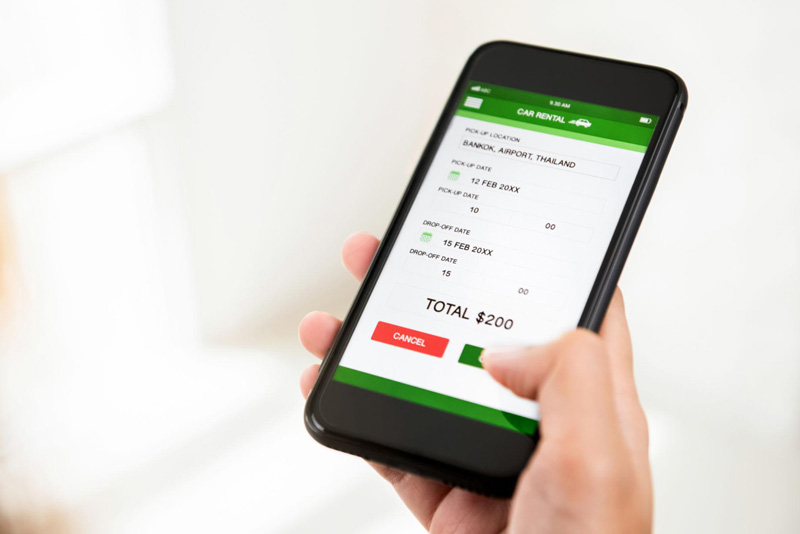
Mobile app booking
Mobile apps are useful when travellers want digital booking, electronic payment, driver information and live trip updates in one place.
App-based airport transport generally falls into two models:
-
On-demand booking, where the traveller requests a vehicle close to the required pickup time
-
Advance reservation, where the trip is scheduled before the travel date
These models should not be treated as identical. An advance request may still depend on later driver assignment or availability, while an on-demand fare and waiting time can reflect conditions when the request is made.
For airport pickups, passengers should also follow the collection instructions associated with the service. Sydney Airport directs rideshare passengers to designated pickup areas rather than treating every terminal kerb as a rideshare collection point.
Phone-assisted booking
Phone booking remains valuable when the trip is difficult to describe through a standard form.
It is particularly useful for:
-
Larger groups
-
Multiple vehicles
-
Significant or oversized luggage
-
Child seats
-
Accessibility requirements
-
Multiple pickup points
-
Corporate arrangements
-
Unusual flight schedules
-
Last-minute changes
The value of phone booking is the ability to clarify requirements before the vehicle is allocated. The limitation is that a verbal conversation can leave important details difficult to verify later.
Where possible, obtain written confirmation containing the agreed date, pickup point, destination, vehicle category, price or pricing basis and booking reference.
Email or assisted enquiry booking
Email can be appropriate when a booking contains several requirements that need to be documented in writing.
This method is commonly suited to:
-
Corporate itineraries
-
Group movements
-
Multiple passenger names
-
Multiple transfers
-
Special vehicle requests
-
Written quotations
-
Billing instructions
The important distinction is between an enquiry and a confirmed reservation.
A reply acknowledging an email does not necessarily mean that a vehicle has been reserved. Look for an explicit confirmation, booking reference or other indication that the provider has accepted the trip.
Third-party transfer platforms
Third-party platforms allow travellers to search or reserve transfers supplied by other transport operators.
Depending on the platform, users may be able to compare:
-
Shared and private transfers
-
Standard and premium vehicles
-
Passenger capacity
-
Luggage capacity
-
Meet-and-greet services
-
Cancellation terms
-
Pickup arrangements
-
Prices
-
Confirmation status
The important issue is booking ownership.
When booking directly, the transport operator and the company accepting the reservation may be the same business. Through a marketplace, one company can process the reservation while another company performs the journey.
That affects practical questions such as:
-
Who can change the pickup time
-
Who processes a cancellation
-
Who issues a refund
-
Who should be contacted if the driver cannot be found
-
Which company's terms apply
Some transfer marketplaces also advertise instantly confirmed bookings, licensed partners, flight tracking and 24/7 support, demonstrating why the platform's actual booking terms matter more than simply whether it is a third-party service.
Airport-based booking after arrival
Travellers do not always need to arrange a transfer before flying.
Sydney Airport provides taxi ranks at its passenger terminals and designated rideshare pickup arrangements. At T1 International, the WeKnow service also allows arriving travellers to arrange selected taxi and Uber journeys through self-service kiosks in baggage reclaim or staffed desks in the arrivals hall. The service was introduced in March 2026 and allows journeys to be arranged and prepaid at the airport.
This can be useful if you arrive without a reservation, but it is different from arranging a specific private-transfer vehicle before travel.
How the booking process should work
Regardless of the channel used, a reliable booking process should move from journey requirements to an identifiable reservation.
A practical sequence is:
-
Enter the journey details
-
Specify passengers, luggage and special requirements
-
Choose the appropriate service or vehicle category
-
Review the price and what it includes
-
Check the pickup procedure and booking conditions
-
Complete payment or accept the quote where required
-
Receive confirmation that identifies the reservation
The final step matters because different systems use terms such as request, quote, reservation, confirmed booking and driver assigned differently.
Do not assume these stages mean the same thing.
Understand when your airport transfer is actually confirmed
Confirmation is one of the most important differences between airport transfer booking options.
Booking request
A booking request tells the provider what journey you want. It may still require availability to be checked.
Quote
A quote gives you a price or proposed service. In some systems, you must accept the quote before the reservation becomes active.
Reservation
A reservation normally indicates that the journey has been entered into the booking system, but the exact commitment depends on the provider's terms.
Confirmed booking
A confirmed booking should provide clear evidence that the reservation has been accepted.
Useful confirmation information includes:
-
Booking reference
-
Pickup date and time
-
Pickup location
-
Destination
-
Passenger details
-
Service or vehicle category
-
Pricing information
-
Contact or support details
Driver assignment
Driver assignment can happen at the time of confirmation or closer to pickup. It should not automatically be treated as the point at which every type of airport transfer becomes confirmed.
The practical rule is simple: check what the provider means by "confirmed" rather than relying on the wording of the booking button.
Direct booking or third-party platform: who controls the reservation?
This distinction becomes important when something changes.
Direct booking
With a direct booking, you normally deal with the provider accepting or operating the transfer.
This can simplify:
-
Booking changes
-
Special requests
-
Vehicle questions
-
Flight updates
-
Billing queries
-
Pickup communication
Direct Sydney providers commonly promote their ability to manage airport transfers around captured flight information, fixed quotations and specific pickup arrangements.
Third-party booking
A third-party platform can offer wider comparison and access to several vehicle or provider options through one system.
The trade-off is that responsibility can be divided between the platform and the local operator.
Before booking, establish:
-
Who operates the vehicle
-
Who confirms the reservation
-
Who takes payment
-
Who handles modifications
-
Who provides support on the travel day
-
Who is responsible for refunds
Neither model is inherently suitable for every traveller. The better choice depends on whether you value direct control or the ability to compare multiple transfer products through one booking interface.
Advance booking versus booking after arrival
When advance booking is useful
Advance booking is especially valuable when the journey has requirements that should not be left to real-time availability.
Examples include:
-
A larger vehicle
-
A group transfer
-
Several large suitcases
-
Child restraints
-
Accessible transport requirements
-
Meet-and-greet service
-
Corporate billing
-
A very early or late pickup
-
Multiple vehicles
-
A return transfer
Advance booking also gives you time to verify the price, cancellation terms and meeting instructions before travelling.
During busy travel periods, a suitable vehicle category can be more important than simply finding any available vehicle. Booking earlier gives the operator more opportunity to match the requested capacity and equipment, although availability is never universal across providers.
When booking after arrival can make sense
Booking after landing provides flexibility when:
-
Arrival plans are uncertain
-
You do not require a specific vehicle
-
You prefer an on-demand ride
-
You have not booked transport in advance
The trade-off is that current vehicle availability, waiting time and price may matter more at the moment of travel.
For an airport arrival, also check the pickup zone before leaving the terminal. Taxi, rideshare and pre-booked transfer arrangements can use different meeting procedures.
Information to provide when booking
Flight number and terminal
For airport pickups, provide the flight number when the system supports flight tracking.
Flight information can allow a transfer provider to monitor the aircraft rather than relying exclusively on the scheduled arrival time. Current Sydney transfer services advertise flight-tracked airport pickups as part of their booking models.
Also confirm whether the flight arrives at T1 International or the domestic precinct. Pickup procedures differ by terminal and service.
Passenger count and luggage
Do not choose a vehicle using seat count alone.
A vehicle may have enough passenger seats but insufficient boot space for the group's bags.
When comparing booking options, check both:
-
Passenger capacity
-
Luggage allowance or usable luggage capacity
This is particularly important for families, groups, travellers with several large cases, and passengers carrying equipment.
Special requirements
Requirements that depend on a particular vehicle or piece of equipment should be declared before confirmation.
These can include:
-
Child seat or booster seat
-
Wheelchair or accessible vehicle requirement
-
Oversized luggage
-
Sports equipment
-
Multiple stops
-
Meet-and-greet service
-
Additional passenger assistance
Do not assume a note entered during checkout automatically guarantees the requested feature. Check whether the provider has specifically accepted it.
Booking requirements for different travellers
| Travel situation | Booking priority | What to confirm |
|---|---|---|
| Solo traveller with standard luggage | Simple website or app booking may be sufficient | Pickup location, price and confirmation |
| Family with children | Advance booking is useful | Child restraint availability, passenger and luggage capacity |
| Large family or group | Direct or assisted booking may reduce uncertainty | Exact vehicle capacity and total luggage allowance |
| Traveller with accessibility requirements | Arrange requirements before travel | Appropriate accessible vehicle and assistance |
| Business traveller | Direct or account-based booking may be useful | Reliability, invoice or billing arrangement and modification process |
| Corporate travel coordinator | Provider account or managed reservation can simplify repeat bookings | Centralised billing, passenger management and support |
| Traveller with oversized baggage | Vehicle choice should be confirmed in advance | Space for the specific items being carried |
| Traveller needing a premium arrival service | Pre-booked transfer may provide more certainty | Meet-and-greet procedure, waiting terms and vehicle class |
| Traveller arriving without a booking | Taxi, rideshare or eligible airport booking service | Current availability, price and pickup zone |
Payment and billing options
Payment arrangements can differ just as much as booking channels.
Depending on the provider, options may include:
-
Online card payment
-
Payment through an app
-
Prepayment through a booking platform
-
Payment under provider-specific terms
-
Corporate account billing
-
Periodic invoicing for approved business accounts
For example, current Sydney operators advertise both cashless individual booking models and separate arrangements for corporate-account travellers.
Do not assume that a payment method available from one provider is standard across the market.
For business travel, the useful question may be less about whether a transfer can be booked and more about who can make the booking, who pays, and whether several journeys can be managed under one account.
What to check before confirming an airport transfer
Is the price fixed, estimated or variable?
"Price shown" can describe different pricing models.
A transfer may use:
-
A fixed quoted fare
-
An upfront app price
-
An estimated fare
-
A metered fare
-
A price affected by current demand
-
A base price with additional charges
Before confirming, check whether the displayed amount includes applicable items such as:
-
Airport access charges
-
Tolls
-
Waiting time
-
Parking where relevant
-
Extra stops
-
Requested equipment
-
Booking fees
Several current Sydney airport-transfer providers prominently advertise fixed pricing as part of the reservation, but that is a provider-specific feature rather than a universal rule for every booking channel.
Who will actually provide the journey?
This is especially important when using a comparison or marketplace platform.
Identify:
-
The company taking the reservation
-
The company operating the vehicle where disclosed
-
The support contact for the travel day
-
The party responsible for changes and refunds
A broad marketplace can still be a useful booking option, but the traveller should understand the chain of responsibility.
What happens if the flight is delayed?
Do not stop at asking whether the service offers flight tracking.
Check:
-
Whether pickup time adjusts automatically
-
When the waiting period starts
-
How much waiting time is included
-
What happens after included waiting time expires
-
Whether you need to contact the provider after a major schedule change
Flight tracking is only useful when you understand what operational action the provider takes after detecting the change.
What if you cannot find the driver?
Before travelling, identify the escalation path.
A practical sequence is:
-
Check the confirmed meeting point
-
Check messages or driver details supplied with the booking
-
Contact the driver if direct contact information is provided
-
Contact the booking provider or platform support if the issue is unresolved
This is particularly important for marketplace bookings because the company providing customer support may be different from the local operator performing the journey.
Can you change or cancel the booking?
Cancellation and modification rules can differ substantially between providers.
Check:
-
Free-cancellation deadline
-
Late-cancellation charge
-
No-show policy
-
Modification procedure
-
Whether changing the trip affects the fare
-
Refund process
-
Whether changes go through the operator or platform
Do not rely on a generic statement such as "flexible booking" without reviewing the conditions that apply to the selected service.
Can the provider be verified?
For a pre-booked transfer, useful trust signals can include clearly identified operator details, professional-driver requirements, appropriate licensing or accreditation where applicable, insurance information, transparent terms and accessible customer support.
Some transfer marketplaces specifically promote licensed, vetted and insured local partners as part of their booking proposition.
Reviews can provide additional context about punctuality, pickup communication and vehicle condition, but reviews should complement rather than replace basic provider verification.
Can arrival and return airport transfers be booked together?
Some providers and booking platforms allow an arrival transfer and return airport journey to be arranged within the same booking process or customer account.
This can be useful because both journeys can be planned using:
-
Separate flight details
-
Separate pickup times
-
Appropriate vehicles
-
Consistent passenger information
-
One booking or account history
However, do not assume that booking the inbound journey automatically creates the return transfer. Confirm that both legs appear in the final reservation.
For a departure transfer, the key timing consideration is different from an arrival pickup. The booked collection time must provide enough time for the road journey and the passenger's required airport check-in, security and other departure procedures.
How to compare airport transfer booking options
The most useful comparison is not simply website versus app versus phone.
Compare each option across the same decision points:
| Decision point | What to establish |
|---|---|
| Booking channel | Website, app, phone, platform or airport-based service |
| Availability | Advance reservation, on-demand request or both |
| Booking ownership | Direct provider or third-party intermediary |
| Confirmation | Request, quote, confirmed reservation or later driver assignment |
| Pricing | Fixed, upfront, estimated, metered or demand-sensitive |
| Payment | Prepaid, app payment, provider-specific payment or corporate billing |
| Vehicle | Whether the required category is actually confirmed |
| Luggage | Whether capacity covers both passengers and bags |
| Flight handling | Whether flight details are monitored and how delays change pickup |
| Pickup | Terminal, meeting point, rideshare zone, kerbside or meet-and-greet |
| Support | Driver contact, provider support or platform support |
| Changes | How modifications and cancellations are submitted |
| Special requirements | Child seat, accessible vehicle, oversized baggage or other request |
| Return travel | Whether both airport journeys can be reserved together |
This framework reveals why two bookings made online can provide very different levels of certainty.
Common airport transfer booking mistakes
Many airport-transfer problems begin with the reservation rather than the drive itself.
Avoid these common mistakes:
-
Assuming a quote is already a confirmed booking
-
Selecting a vehicle from passenger capacity while ignoring luggage capacity
-
Entering an arrival time without the flight number when flight tracking is available
-
Selecting the wrong Sydney Airport terminal
-
Assuming every displayed price includes the same charges
-
Failing to confirm a requested child seat or accessibility requirement
-
Not checking whether a marketplace or the transport operator manages changes
-
Assuming the driver will meet you at any terminal kerb
-
Leaving group or oversized-luggage requirements until pickup
-
Ignoring waiting-time and no-show conditions
-
Assuming the return journey is included because the arrival transfer was booked
-
Failing to save the booking reference and support contact
The available airport transfer booking options Sydney travellers can use include direct provider websites, mobile apps, phone and email-assisted reservations, third-party booking platforms, and airport-based arrangements for eligible services.
The channel itself is only the first part of the decision. A useful booking should make it clear who controls the reservation, when it becomes confirmed, how the price is calculated, what vehicle capacity has been secured, how airport pickup works, and what happens when the flight or travel plan changes.
For a simple journey with flexible requirements, on-demand booking may be sufficient. For a family, group, corporate traveller, passenger with accessibility requirements, or anyone requiring a particular vehicle or meet-and-greet arrangement, booking in advance provides more opportunity to document and confirm those needs.
Before completing any reservation, verify the booking status, terminal and pickup point, passenger and luggage capacity, pricing basis, payment arrangement, flight-delay procedure, cancellation conditions and support contact. Those checks make the differences between Sydney airport transfer booking options much more meaningful than simply choosing between a website, app or phone call.
Latest Insights
- Is There a Free Bus from Sydney Domestic to International?
- Can You Walk from Domestic to International at Sydney Airport?
- How Far Apart Are Sydney Airport’s International and Domestic Terminals?
- How Long Does a Domestic to International Transfer Take at Sydney Airport?
- Is There a Free Shuttle at Sydney Airport?
- Airport Transfer With Luggage
