


How Long Does a Domestic to International Transfer Take at Sydney Airport?
- How much connection time should you allow at Sydney Airport?
- Why does a domestic-to-international connection take longer than the terminal transfer?
- How long does each stage of the transfer take?
- Does having one ticket make the transfer faster?
- How much time do you need with separate tickets?
- Is a 90-minute domestic-to-international connection enough at Sydney?
- Is 2 hours enough to transfer from domestic to international at Sydney?
- When should you allow 3 hours?
- Should you take the bus or train between the terminals?
- Does it matter whether your domestic flight arrives at T2 or T3?
- What can make the connection take longer?
- What is the safest Sydney domestic-to-international transfer time?
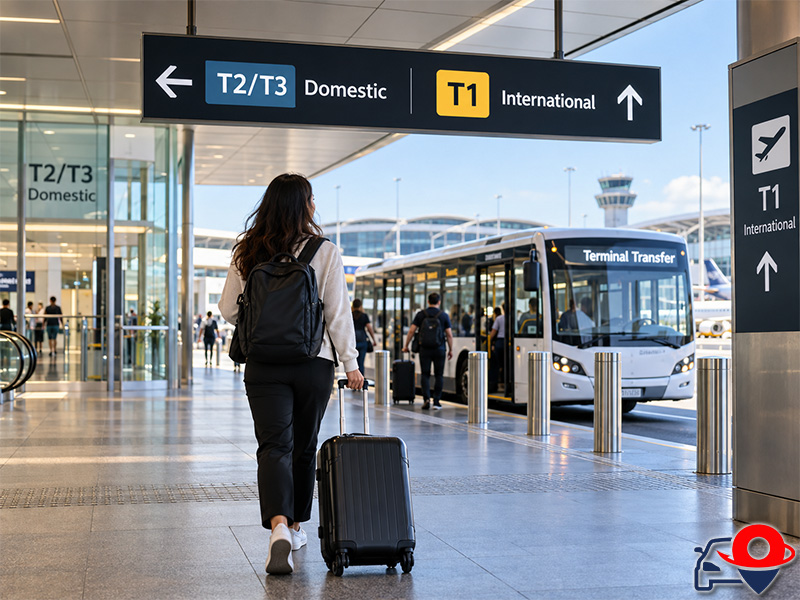
If your flights are on separate tickets, or you need to collect and recheck checked baggage, around 3 hours is a much safer target.
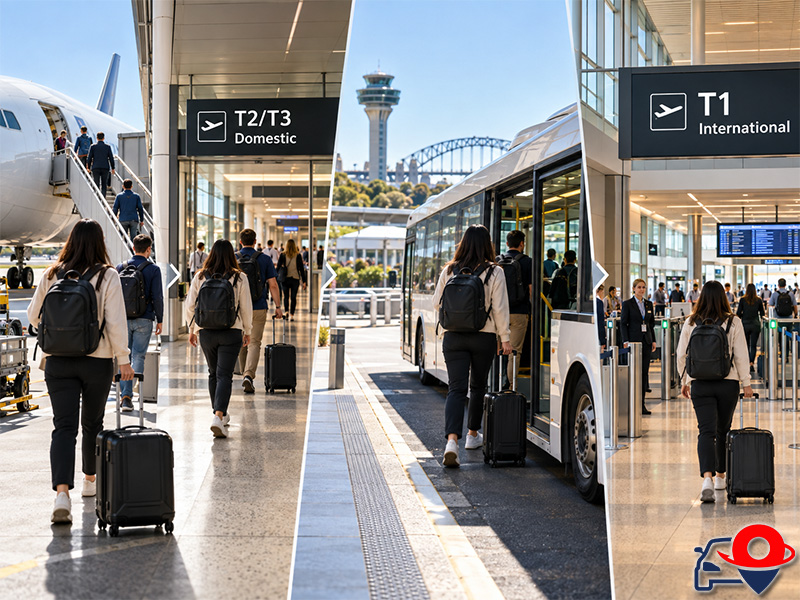
The important distinction is that the terminal journey itself is short. Sydney Airport's T1 International terminal is physically separate from the T2 and T3 Domestic terminals, and passengers cannot walk between them. The airport's complimentary Terminal Transfer Bus takes about 10 minutes and normally operates every 15 minutes, while the Airport Link train journey between the domestic and international stations takes about 2 minutes.
How much connection time should you allow at Sydney Airport?
A useful planning range is:
| Connection situation | Time to allow |
|---|---|
| Protected through-ticket, baggage checked through | 90 minutes minimum to about 2 hours |
| Comfortable domestic-to-international connection | About 2 hours |
| Separate tickets or baggage must be rechecked | Around 3 hours |
| Peak period, mobility needs, children or unfamiliar airport | 2.5–3 hours where possible |
These figures describe practical planning time, not a universal Sydney Airport minimum connection time. Sydney Airport itself does not publish one minimum that applies to every domestic-to-international itinerary; it directs passengers to their airline because connection requirements depend on the carriers and booking.
That distinction matters. An itinerary sold by an airline as one connection may have transfer arrangements that make a relatively short connection valid. The same amount of time can be risky when the flights were booked separately.
Why does a domestic-to-international connection take longer than the terminal transfer?
The physical ride from the domestic precinct to T1 is only one part of the connection.
After your domestic aircraft reaches Sydney, you still need to:
-
Disembark and make your way through T2 or T3
-
Reach the appropriate terminal-transfer pickup point or train station
-
Wait for the next service
-
Travel to T1 International
-
Obtain an international boarding pass or visit check-in if required
-
Complete outbound immigration and security procedures
-
Walk through T1 to the international departure gate
Sydney Airport identifies T1 as its International Terminal and T2/T3 as the Domestic terminals. Because T1 is separate from the domestic precinct, there is no pedestrian transfer between them.
This is why a 10-minute bus journey does not mean a 10-minute connection.
How long does each stage of the transfer take?
The actual time varies substantially, but breaking the transfer into stages shows where the buffer is needed.
Getting off the domestic flight
Even when an inbound flight lands on schedule, its scheduled arrival time is not necessarily the moment you enter the terminal. Taxiing, obtaining a gate and disembarking can consume part of the connection window.
A passenger near the front of the aircraft with only cabin baggage may leave considerably faster than someone seated at the rear or travelling with children or mobility requirements.
Getting from T2 or T3 to T1
Sydney Airport provides a complimentary Terminal Transfer Bus connecting T1 with T2 and T3. The airport currently states that the service operates approximately every 15 minutes between 5:30 am and 10:30 pm, with a journey time of about 10 minutes.
The practical bus transfer can therefore be much longer than ten minutes. If you reach the pickup point just after a bus leaves, waiting for the next service becomes part of your connection.
The Airport Link train is faster in motion: Sydney Airport lists the train journey between the domestic and international stations at approximately 2 minutes. You must still allow time to reach the station, wait for a train, travel between the platform and terminal, and pay the transfer fare.
Completing international departure formalities
On arrival at T1, passengers without the required boarding pass may need to visit the international airline's check-in desk.
Passengers who are already checked in can proceed toward outbound processing, but they still need sufficient time for immigration, security screening and the walk to their gate.
Sydney Airport's general passenger guidance recommends being at an international departure gate substantially earlier than for a domestic flight, illustrating why the entire connection cannot be planned around the inter-terminal journey alone.
Does having one ticket make the transfer faster?
It can make a major difference.
With a single through-booking, the airlines may be able to:
-
Check your luggage through to the international destination
-
Issue the onward boarding pass at your original airport
-
Recognise the itinerary as an official connection
-
Provide an airline-specific transfer service where eligible
-
Assist with rebooking when disruption causes a protected connection to be missed, subject to the ticket and airline's conditions
For example, eligible domestic-to-international connecting passengers may have their bags checked through and receive onward boarding passes at their point of origin. At Sydney, those passengers can then use the terminal transfer to T1 and proceed toward international departure processing.
The exact procedure depends on the airlines involved. Do not assume that two flights appearing on the same travel plan automatically mean baggage will be transferred through.
How much time do you need with separate tickets?
Separate tickets require a larger buffer because the second airline may treat you as an ordinary departing passenger rather than a connecting passenger.
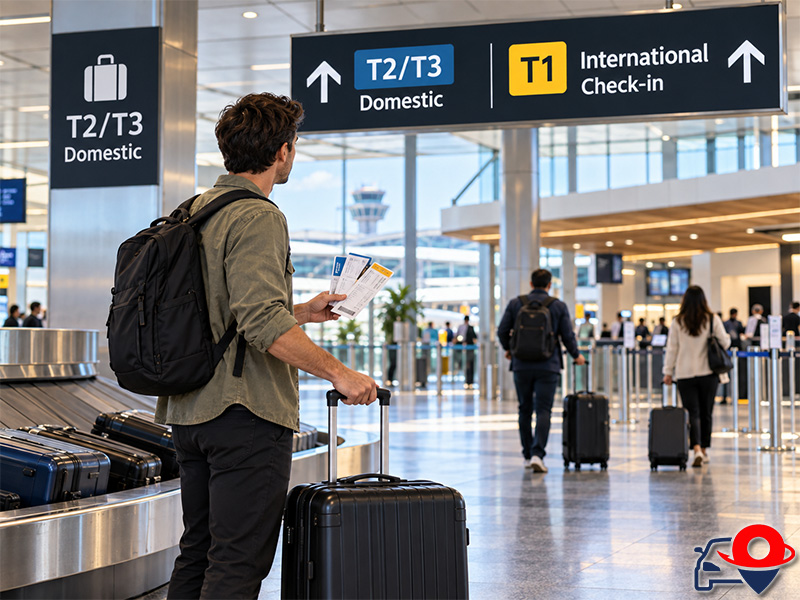
If your checked baggage is not through-checked, you may need to wait for it at the domestic baggage carousel, travel to T1, check in again and deposit the bag before the international airline's check-in or bag-drop deadline.
That changes the risk calculation substantially.
A two-hour gap that might be reasonable for a protected, through-checked connection can become risky when you must wait for baggage and complete international check-in yourself. Around 3 hours is a more appropriate planning target for a self-transfer, with additional time advisable when the international flight is expensive or difficult to replace.
Separate tickets also expose you to another problem: if the domestic flight is delayed and you miss the international departure, the international airline is not necessarily responsible for accommodating you without additional cost.
Is a 90-minute domestic-to-international connection enough at Sydney?
It can be, but only in favourable circumstances.
A 90-minute connection is most defensible when:
-
The itinerary was sold as a valid connection on one booking
-
The domestic flight arrives on time
-
Your baggage is checked through
-
You already have the international boarding pass
-
You qualify for the relevant airline transfer process
-
Immigration and security queues are manageable
It becomes much less attractive when any of those conditions disappear.
Sydney Airport specifically tells passengers to check connection requirements with their airline rather than relying on a single airport-wide minimum.
Therefore, a 90-minute itinerary offered by an airline should be interpreted differently from two independently booked flights that happen to be 90 minutes apart.
Is 2 hours enough to transfer from domestic to international at Sydney?
Two hours is a reasonable target for many domestic-to-international connections, particularly when the flights are connected on one ticket and checked baggage is transferred automatically.
It provides substantially more resilience than a 90-minute connection while avoiding an unnecessarily long layover.
However, two hours should not be treated as a guarantee. A delayed domestic arrival can quickly remove the extra margin, and passengers who have to collect baggage, check in again or travel during a busy departure period may need more.
For a self-transfer, two hours should generally be viewed as tight rather than comfortable.
When should you allow 3 hours?
A three-hour connection is particularly sensible when:
-
Your domestic and international flights are on separate tickets
-
Checked baggage is not tagged through to the international destination
-
You need to complete international check-in at T1
-
You are changing between unrelated airlines
-
You are travelling during a busy airport period
-
You are travelling with small children or substantial luggage
-
You require mobility or other airport assistance
-
Missing the international flight would cause a major disruption
The additional hour is not primarily for the drive between terminals. It is protection against variability elsewhere in the transfer.
Should you take the bus or train between the terminals?
For many connecting passengers, the free Terminal Transfer Bus is the simplest option.
Sydney Airport states that the bus connects T1 with both domestic terminals, normally runs every 15 minutes during its operating period and takes approximately 10 minutes for the journey.
The Airport Link train can be useful when time is particularly important because the rail journey itself takes about two minutes. It is a paid service, however, and total transfer time still includes reaching the station and waiting for a train.
Eligible Qantas or Virgin Australia passengers may also have airline-specific transfer arrangements, so check the instructions associated with your booking before automatically choosing public transport. Sydney Airport notes that airline transfer services may be available for qualifying passengers.
Does it matter whether your domestic flight arrives at T2 or T3?
The basic connection problem is the same: both domestic terminals are separate from T1 International.
T2 handles domestic services including Virgin Australia, while T3 is associated primarily with Qantas domestic operations. Both are part of the domestic precinct.
Your airline matters more than the small difference between starting at T2 and T3 because the airline determines whether baggage is through-checked, whether you already receive an international boarding pass and whether an airline-specific transfer service is available.
Always follow the transfer instructions supplied for your actual itinerary rather than assuming every T2-to-T1 or T3-to-T1 connection follows the same process.
What can make the connection take longer?
The biggest variables are not the few minutes spent travelling between terminals.
The connection becomes vulnerable when the domestic flight arrives late, disembarkation takes longer than expected, you narrowly miss a transfer bus, baggage must be collected, international check-in is still required, or queues build at outbound processing.
Checked baggage is particularly important. Passengers should confirm baggage-transfer procedures with their airline because baggage handling depends on the itinerary.
This is why connection planning should focus on the whole chain of required steps, rather than simply adding the advertised bus or train journey time to the domestic arrival time.
What is the safest Sydney domestic-to-international transfer time?
For straightforward planning, use this rule:
Aim for about 2 hours when travelling on a protected through-ticket with baggage checked through. Aim for around 3 hours when self-transferring on separate tickets or when baggage needs to be collected and checked in again.
A shorter connection can be valid, particularly when an airline has sold the itinerary and provides an efficient transfer process, but it gives you less tolerance for disruption.
The difference between a workable connection and a comfortable connection is therefore not simply another 30 or 60 minutes. It is whether those extra minutes protect you from the specific steps your itinerary requires.
For most passengers, the best answer to the Sydney Airport domestic to international transfer time question is about 2 hours. The physical terminal transfer may take only a few minutes in transit, but the complete connection includes leaving the domestic flight, moving from T2 or T3 to T1, completing international departure procedures and reaching the gate.
If your itinerary is protected and baggage is checked through, 90 minutes may be workable when permitted by your airline. If you have separate tickets, must reclaim baggage or want a stronger buffer against delays, plan around 3 hours instead.
Q&A about How Long Does a Domestic to International Transfer Take at Sydney Airport?
Can you walk from Sydney Domestic Airport to the International Terminal?
No. Passengers cannot walk between T1 International and T2/T3 Domestic. You need to use a terminal-transfer service such as the complimentary bus, train, taxi or rideshare.
How long does the Sydney Airport terminal shuttle take?
The complimentary Terminal Transfer Bus journey takes approximately 10 minutes. Services typically operate approximately every 15 minutes between 5:30 am and 10:30 pm.
How long is the train from Sydney Domestic to International?
The Airport Link train ride between the domestic and international airport stations takes approximately 2 minutes, although you also need to account for walking to the station and waiting for the train.
Is 1 hour enough to transfer from domestic to international at Sydney Airport?
One hour is too tight for most travellers to plan independently. Sydney Airport does not prescribe a universal minimum and instructs connecting passengers to confirm requirements with their airline. If an airline has specifically issued a protected itinerary with a short connection, follow that airline's transfer instructions.
Do I need to collect my luggage when connecting from domestic to international in Sydney?
Not always. On eligible through-bookings, an airline may check the luggage through to the international destination. With separate tickets or airlines without a through-check agreement, you may need to collect it and check it in again. Travellers should confirm baggage-transfer procedures directly with their airline or travel agent.
