


Airport Transfer Price Guide
- Sydney airport transfer prices at a glance
- What affects the cost of a Sydney Airport transfer?
- A simple way to calculate the real transfer cost
- How destination and vehicle size change the price
- What does “from A$49” actually mean?
- Fixed-price transfer vs taxi vs rideshare
- Which option gives better value for your situation?
- How group size changes the per-person cost
- What are you actually paying for?
- How to compare Sydney airport transfer quotes accurately
- How much should you budget from Sydney Airport to the CBD?
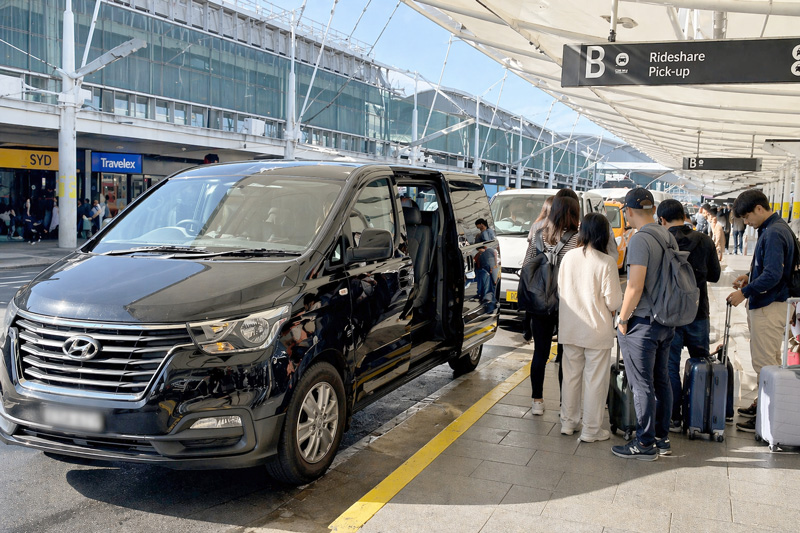
The most useful comparison is therefore the final payable price for the same destination, vehicle capacity and inclusions. A “from A$49” fare and a A$120 premium chauffeur fare may both be accurate while representing different vehicle classes, service levels and inclusions. Published rates from current Sydney operators illustrate that spread rather than establishing a market-wide tariff.
Sydney airport transfer prices at a glance
For the common Sydney Airport–CBD journey, current benchmarks include:
| Transport option | Current price indication | Pricing basis |
|---|---|---|
| Standard private transfer | From about A$49 per vehicle with some operators | Usually fixed when booked |
| Premium private chauffeur | From about A$120 per vehicle with some operators | Fixed premium vehicle fare |
| Standard taxi to the designated CBD fixed-fare zone | A$60 | Official airport taxi fixed fare |
| Maxi taxi to the designated CBD zone | A$80 when the fixed-fare conditions apply | Official airport taxi fixed fare |
| Rideshare | Live app quote | Variable according to platform, vehicle and demand |
| Airport train | A$18.61 adult station access fee plus the applicable train fare | Public transport fare |
Sydney Airport's current taxi trial applies to uninterrupted non-booked taxi trips from the airport precinct to the designated Sydney CBD zone. The official fare is A$60 for a standard or wheelchair-accessible taxi and A$80 for a maxi taxi when requested or when five or more people travel, subject to the trial rules. Those fares include taxes and tolls, apart from permitted non-cash payment or cleaning charges.
The airport train works differently. An adult using Opal or contactless payment currently pays an A$18.61 station access fee in addition to the normal train fare.
Private-transfer prices are commercial rates rather than regulated Sydney-wide fares. Current providers publish CBD examples from about A$49 for standard sedan transfers to A$120 for premium executive chauffeur services.
What affects the cost of a Sydney Airport transfer?
Distance and destination
Destination is one of the largest price variables. A CBD trip covers a relatively short distance, while transfers to western Sydney, the Northern Beaches, the Blue Mountains, Wollongong or Newcastle require more driving time and distance.
Current published private-transfer rates demonstrate the difference. One Sydney operator lists a sedan at A$49 for the CBD, A$99 for Parramatta and A$149 for Penrith.
The relationship is not perfectly linear because each provider may use its own zones, route assumptions or fare formula. An exact street address is more useful than a suburb name when requesting a final quote.
Vehicle size and luggage capacity
Passenger count does not tell the whole story. The amount and size of luggage can force a vehicle upgrade even when every passenger would technically fit into a smaller car.
One current provider describes its entry-level “from” price as the sedan rate for one or two passengers. Larger groups move into an SUV, people mover or minibus and pay for the larger vehicle class rather than simply adding a per-person charge.
Before comparing prices, match the quote to:
-
Number of passengers
-
Number of large suitcases
-
Carry-on bags
-
Prams or mobility equipment
-
Golf bags, surfboards or other oversized items
-
Child restraints
-
Required luggage trailer, if applicable
A cheap sedan quote has little value if the vehicle cannot safely carry the group and its luggage.
Airport pickup charges
Commercial vehicles pay Sydney Airport to use designated passenger pickup areas.
As of August 2026, Sydney Airport lists a A$11.77 limousine charge for the first 15 minutes at the domestic terminals and A$15.44 for the first 55 minutes at the international terminal. A A$6.43 taxi access fee applies from 14 August 2026.
A private-transfer provider may include its airport access cost in the quoted fare or treat it separately. That difference matters when two headline prices appear similar.
Road tolls
Sydney routes can involve toll roads. Whether tolls change the amount you ultimately pay depends on the provider's pricing policy.
Several current private-transfer operators advertise toll-inclusive fixed fares, but that should not be assumed for every quote.
Compare the total payable fare, not the vehicle base price alone.
Waiting time
Airport pickups need a waiting policy because flight arrivals, immigration and baggage collection are not perfectly predictable.
Published private-transfer policies vary. Current operators advertise allowances such as 60 minutes for international arrivals and 30–40 minutes for domestic arrivals before additional waiting conditions may apply.
Check both the included allowance and when the clock starts. Providers may define waiting time differently.
Additional stops and requested extras
A standard airport-to-address fare can change when the booking includes services beyond the direct journey.
Possible additions include:
-
Extra pickup or drop-off stops
-
Waiting beyond the included allowance
-
Luggage trailers
-
Oversized luggage arrangements
-
Vehicle upgrades
-
Child restraints where not already included
-
Meet-and-greet where separately charged
-
Card payment surcharges
These items should be confirmed before comparing the final cost.
A simple way to calculate the real transfer cost
For comparison purposes, think of the total cost as:
Quoted vehicle fare + charges not already included + requested extras − confirmed discounts = final payable price
This is a comparison model, not a universal Sydney pricing formula. Private companies use their own pricing systems, taxis operate under regulated fare rules, and rideshare platforms generate their own app-based prices.
For example, one chauffeur operator publishes its own formula for destinations not listed in its fare table, while another maintains fixed fares for hundreds of suburbs and asks customers to request an address-specific quote. Those are provider-specific systems rather than a common Sydney fare formula.
The practical result is simple: if your exact destination does not appear in a published table, request an exact-address quote rather than estimating the fare from another suburb.
How destination and vehicle size change the price
Distance and vehicle class can affect the fare at the same time. The following published rates from one Sydney private-transfer operator show that interaction. They are examples from that provider, not standard Sydney-wide fares.
| Destination | Sedan | Large SUV | People mover | Mini bus |
|---|---|---|---|---|
| Sydney CBD | A$49 | A$69 | A$79 | A$120 |
| Parramatta | A$99 | A$119 | A$129 | A$170 |
| Penrith | A$149 | A$169 | A$179 | A$219 |
| Wollongong | A$160 | A$190 | A$210 | A$280 |
Two conclusions follow from the table.
First, moving farther from Sydney Airport raises the fare even when the vehicle remains the same. Second, carrying a larger group can raise the total fare because a larger vehicle is required.
This is why a single headline such as “Sydney Airport transfers from A$49” cannot predict every booking.
What does “from A$49” actually mean?
A “from” price is normally the lowest qualifying price under the provider's stated conditions, not a guarantee that every passenger travelling to that general area will pay the same amount.
For example, Prime Rider states that its displayed “from” fare is the sedan price for one or two passengers and that larger groups move to higher-priced vehicle classes.
A headline price may therefore depend on:
-
Exact pickup and destination
-
Smallest qualifying vehicle
-
Passenger count
-
Luggage volume
-
Requested extras
-
Provider-specific fare conditions
When comparing advertisements, look for the vehicle, route and inclusions attached to the “from” price.
Fixed-price transfer vs taxi vs rideshare
The main difference between these options is not simply which headline fare is lowest. It is also how the final fare is determined and how much uncertainty remains after booking.
Private airport transfer
Private airport transfers are commonly quoted before travel. Several current Sydney operators publish fixed fares that do not change with normal traffic or demand after booking.
The key question is what the fixed fare includes.
A strong comparison confirms whether the price covers:
-
Airport access charges
-
Road tolls
-
GST
-
Waiting allowance
-
Flight tracking
-
Child restraints where required
-
Luggage assistance
-
Meet-and-greet
-
Payment surcharges
A fixed fare provides genuine price certainty only when its inclusions and exclusions are clear.
Taxi
For the designated Sydney Airport-to-CBD fixed-fare zone, the current trial sets the fare at A$60 for a standard taxi and A$80 for an applicable maxi taxi.
For destinations outside the trial area, the normal regulated taxi rules apply and the meter must be used.
That distinction is important because older Sydney guides that describe every airport taxi trip as a conventional metered CBD fare no longer reflect the current fixed-fare trial.
Rideshare
Rideshare should be compared using the live price displayed in the app for the required pickup time and service level.
Sydney Airport confirms that the airport taxi fixed-fare trial does not apply to booked passenger services such as rideshare or pre-booked airport transfers. For those services, passengers pay the fare quoted and agreed when the booking is made.
A static rideshare figure can therefore become outdated quickly and should be treated as an estimate rather than a guaranteed fare.
Shared shuttle
Shared services are commonly priced per passenger rather than per vehicle. This can reduce the cost for one person, but the economics change as more passengers travel together.
The main trade-off is journey structure: shared passengers may have additional pickups or drop-offs, while a private vehicle normally travels directly to the booked destination.
Airport train
The train uses public-transport pricing rather than a private vehicle fare. An adult currently pays the A$18.61 airport station access fee plus the normal train fare when using Opal or contactless payment.
For a solo passenger travelling light and staying near a convenient station, that can create a very different cost profile from a door-to-door vehicle.

Which option gives better value for your situation?
The cheapest headline fare changes meaning once passenger count, luggage, travel time and price certainty are considered.
| Travel situation | Cost comparison that matters most | Practical pricing implication |
|---|---|---|
| Solo traveller with light luggage | Per-person fare | Train, shuttle or an off-peak rideshare quote may have the lowest cash cost |
| Couple | Total vehicle fare vs two public-transport fares | A standard private car or taxi can become more competitive when the fare is shared |
| Family with luggage | Vehicle capacity plus total fare | A larger private vehicle may avoid splitting the group across multiple cars |
| Group of 4–6 | Per-person cost of one larger vehicle | One people mover or maxi vehicle can cost less per person than several separate rides |
| Business traveller | Final fixed cost plus waiting and flight handling | A higher quoted fare may include flight tracking, waiting and meet-and-greet |
| Late-night or early-morning arrival | Guaranteed fare vs live availability and variable pricing | A pre-booked fixed fare removes uncertainty about the final vehicle price |
| Premium travel | Vehicle and service inclusions | Higher prices may reflect premium vehicles, meet-and-greet and longer waiting allowances |
This framework avoids treating one transport type as universally “cheapest.” The correct comparison depends on how many people are sharing the fare and what services the trip actually requires.
How group size changes the per-person cost
A vehicle fare can become cheaper per passenger as more people share it, provided the vehicle has enough seating and luggage capacity.
Sydney Airport's current CBD taxi fare gives a simple example:
-
A$60 divided between two passengers = A$30 each
-
A$60 divided between three passengers = A$20 each
-
A$60 divided between four passengers = A$15 each
-
A$80 divided between five passengers = A$16 each
The same principle applies to private transfers.
Using one provider's published CBD fares as an example, a people mover priced at A$79 may cost more in total than its A$49 sedan but can reduce the per-person cost when several passengers share the vehicle.
The calculation fails if the luggage does not fit. Passenger capacity and luggage capacity must be checked together.
What are you actually paying for?
Two private-transfer quotes can differ substantially because the services included in the price are different.
The inclusions are easier to compare when separated into three groups.
Direct cost components
These affect the monetary total of the journey:
-
Airport access charges
-
Road tolls
-
GST
-
Payment surcharge
-
Additional stops
-
Excess waiting
-
Larger vehicle requirements
A fare that includes airport fees and tolls cannot be compared directly with a base fare that adds them later.
Operational protection
These services reduce uncertainty around an airport arrival:
-
Flight monitoring
-
Pickup adjustment after a delay
-
Included waiting time
-
Confirmed vehicle allocation
-
Written fixed-fare confirmation
Several current transfer providers bundle flight tracking and an arrival waiting allowance into the fixed fare.
Service extras
These change the level of service rather than simply the road cost:
-
Meet-and-greet
-
Luggage assistance
-
Child restraints
-
Premium vehicle category
-
Additional passenger assistance
One provider may advertise these inside the fare while another charges separately.
This explains why the lowest quoted number is not necessarily the lowest like-for-like price.
How to compare Sydney airport transfer quotes accurately
Use the same booking information for every provider.
Provide:
-
Exact airport terminal or pickup address
-
Exact destination address
-
Travel date and pickup time
-
Flight number for an arrival
-
Number of adults and children
-
Number of large and small bags
-
Child-restraint requirements
-
Oversized luggage or mobility equipment
-
Additional stops
-
Required vehicle type, if known
Then compare the quote itself.
Confirm whether it includes:
-
GST
-
Airport pickup fees
-
Road tolls
-
Waiting time
-
Flight monitoring
-
Luggage handling
-
Child restraints
-
Meet-and-greet
-
Card surcharges
-
Extra stops
-
Cancellation or no-show charges
A quote is not truly comparable if one operator supplies a final all-inclusive fare while another supplies only a base vehicle rate.
Check whether the price is fixed or estimated
“Fixed” and “estimated” are not interchangeable.
A fixed private-transfer fare should identify the agreed amount and the conditions under which additional charges could still arise. An estimate can change if the pricing method allows time, distance, demand or another variable to alter the final amount.
For the current Sydney Airport-to-CBD taxi trial, the official A$60/A$80 fare is fixed under the stated trial conditions.
Check the meaning of unusually low quotes
An exceptionally low advertised fare may simply represent:
-
A smaller vehicle
-
A limited route
-
A price before airport charges or tolls
-
A per-passenger rather than per-vehicle figure
-
A “from” rate rather than your final address-based fare
The useful comparison is a written total for the same journey and passenger requirements.
Ask for an exact-address quote
A suburb-level price table is useful for budgeting, but the final address may sit at a different distance or fare zone.
Current Sydney providers handle unlisted destinations in different ways: some maintain large suburb-based fixed-fare databases, while others apply their own published distance formula.
The provider's exact quote should therefore take priority over a generic suburb example.
Compare return pricing separately
If both an arrival transfer and a departure transfer are required, compare:
Two separate one-way bookings
versus
A return booking quoted together
Some current Sydney operators publish return-booking discounts, but these are company-specific offers rather than an industry rule. Hi Airport, for example, currently advertises a 10% return-booking discount.
Only count the saving when it appears in the actual quote.
How much should you budget from Sydney Airport to the CBD?
For a standard CBD journey, current published data gives several useful benchmarks.
A standard private sedan can start around A$49 per vehicle with some private-transfer providers. Premium chauffeur services can start around A$120 per vehicle.
A taxi from Sydney Airport to the designated CBD trial area currently costs A$60 for a standard taxi, or A$80 for a maxi taxi when the applicable conditions are met.
For public transport, an adult using an airport train station pays A$18.61 in station access fees plus the relevant train fare when using Opal or contactless payment.
Those figures should be treated as different products rather than interchangeable prices. A train fare is per passenger and station-to-station. A private car is typically priced per vehicle and provides door-to-door service. A premium chauffeur fare may include services that a basic transport fare does not.
Sydney airport transfer prices depend primarily on where you are going, how large a vehicle you need and what the quoted fare includes. For Sydney Airport to the CBD, current private-transfer examples begin around A$49 for a standard sedan, while premium chauffeur services can start around A$120; the current official standard taxi fare to the designated CBD fixed-fare zone is A$60.
The most reliable way to compare prices is to obtain a total quote for the same exact address, passenger count and luggage requirement, then check airport fees, tolls, waiting time and requested extras. That reveals whether a cheaper headline fare is genuinely cheaper or simply covers less.
Latest Insights
- Is There a Free Bus from Sydney Domestic to International?
- Can You Walk from Domestic to International at Sydney Airport?
- How Far Apart Are Sydney Airport’s International and Domestic Terminals?
- How Long Does a Domestic to International Transfer Take at Sydney Airport?
- Is There a Free Shuttle at Sydney Airport?
- Airport Transfer With Luggage
