


Airport Transfer vs Uber
- What is airport transfer vs Uber Sydney comparison?
- Airport transfer vs Uber Sydney cost comparison
- Airport transfer vs Uber Sydney service comparison
- Airport transfer vs Uber Sydney reliability comparison
- Airport transfer vs Uber Sydney convenience comparison
- Airport transfer vs Uber Sydney safety comparison
- Pros and cons airport transfer vs Uber Sydney
- Which is better airport transfer vs Uber Sydney?
- When to choose airport transfer or Uber Sydney?
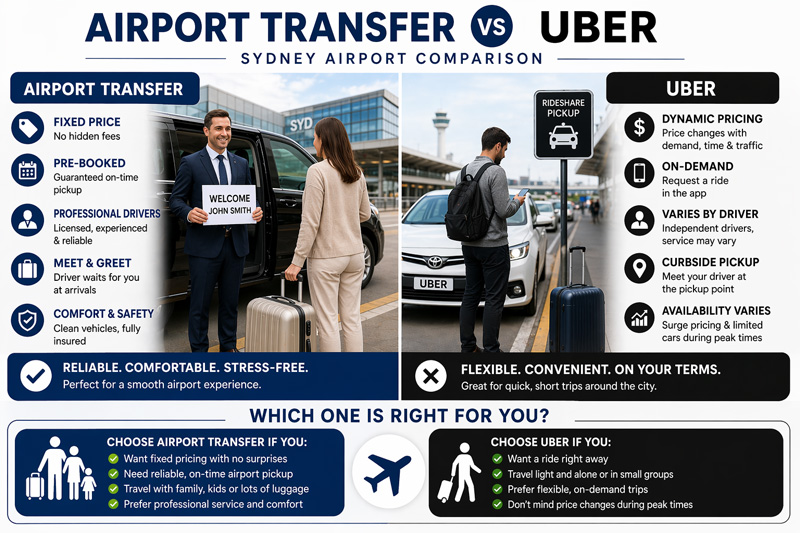
What is airport transfer vs Uber Sydney comparison?
Airport transfer service sydney
An airport transfer service in Sydney is a pre-booked transportation solution designed specifically for airport travel. It typically includes professional drivers, scheduled pickup times, and fixed routes between Sydney Airport and your destination. These services are often operated by licensed companies and focus on reliability, comfort, and a structured travel experience.
Unlike on-demand transport, airport transfers are arranged in advance, ensuring that a driver is waiting for you at the exact time of arrival or departure. This makes them particularly suitable for business travelers, families, and anyone carrying heavy luggage who wants a predictable journey.
Uber ride service sydney
Uber in Sydney is an on-demand rideshare service accessed through the Uber app. Users can request a ride instantly, track driver arrival, and pay digitally. Uber operates with independent drivers using their own vehicles, offering flexible transportation across the city.
Compared to airport transfer services, Uber is more spontaneous and flexible. However, availability depends on nearby drivers, and wait times can vary—especially during peak hours or late-night travel periods.
Private airport transfer sydney
Private airport transfer is a premium version of airport transport, where a dedicated vehicle is reserved exclusively for you or your group. This service often includes luxury sedans, SUVs, or vans, along with features like meet-and-greet, luggage assistance, and personalized routes.
It differs from Uber in that the experience is highly controlled and customized. There is no ride-sharing with other passengers, and the driver is assigned in advance. This ensures a higher level of comfort, privacy, and service consistency.
Rideshare platform uber sydney
Uber operates as a rideshare platform connecting passengers with nearby drivers. The system uses algorithms to match supply and demand in real time, which directly impacts pricing and availability.
In Sydney, Uber offers multiple service tiers such as UberX, Comfort, and larger vehicles for groups. While this provides flexibility, it also introduces variability in vehicle quality, driver experience, and pricing depending on demand conditions.
Airport pickup vs city transport
Airport pickup differs significantly from standard city transport. Airport transfers are designed around flight schedules, including buffer times for delays, terminal navigation, and luggage handling. Many services monitor flights to adjust pickup times automatically.
City transport, including Uber, is more general-purpose. It does not inherently account for flight tracking or airport-specific logistics unless manually coordinated. This distinction is critical when comparing reliability and convenience for airport travel scenarios.
Airport transfer vs Uber Sydney cost comparison
Airport transfer fixed price sydney
Airport transfer services in Sydney typically use fixed pricing. The cost is agreed upon at the time of booking and remains unchanged regardless of traffic conditions or route variations.
This pricing model provides transparency and eliminates uncertainty. Travelers know exactly how much they will pay before the journey begins, making it ideal for budgeting and avoiding unexpected charges.
Uber pricing structure sydney
Uber uses a dynamic pricing model based on distance, time, and demand. Fares can fluctuate depending on traffic, driver availability, and surge pricing during peak periods.
While Uber can sometimes be cheaper during off-peak times, prices may increase significantly during busy hours, bad weather, or major events. This variability makes it less predictable compared to fixed-price airport transfers.
Airport transfer cost per trip
The cost of an airport transfer is usually calculated per trip rather than per kilometer. Factors influencing the price include vehicle type, distance from Sydney Airport, and additional services such as child seats or extra luggage handling.
Because the pricing is bundled, travelers benefit from an all-inclusive rate that covers the entire journey without incremental charges.
Uber fare calculation distance time
Uber calculates fares using a combination of base fare, distance traveled, and time spent in transit. Traffic congestion can significantly increase the total cost, as longer travel times result in higher fares.
Additionally, surge pricing can multiply the base fare during periods of high demand, making the final price unpredictable until the ride is confirmed or completed.
Additional fees tolls airport charges
Both airport transfer services and Uber may include additional fees, but the way they are applied differs.
- Airport transfer services often include tolls and airport pickup fees in the quoted price.
- Uber may add tolls, airport surcharges, and booking fees separately, depending on the route and service type.
This difference can lead to situations where Uber appears cheaper initially but becomes more expensive after all fees are added. Understanding these hidden costs is essential when comparing the true value of each option.
Airport transfer vs Uber Sydney service comparison
Airport transfer booking system
Airport transfer services in Sydney operate on a pre-booking system designed for structured travel planning. Passengers typically reserve their ride in advance through a website or booking platform, selecting pickup time, location, vehicle type, and any special requirements.
Once confirmed, the booking is fixed, and the driver is assigned ahead of time. This system reduces uncertainty and ensures that the service is tailored to the traveler’s itinerary, especially for trips involving Sydney Airport.
Uber app booking process
Uber uses an on-demand booking model through the Uber app. Users input their pickup and drop-off locations, view estimated fares, and request a ride instantly.
The process is fast and convenient, but it depends heavily on real-time driver availability. Unlike airport transfers, there is no guaranteed driver until the request is accepted, which can lead to delays during busy periods.
Driver professionalism comparison
Airport transfer drivers are usually licensed professionals trained in customer service, airport procedures, and route planning. They often wear uniforms, assist with luggage, and maintain a consistent service standard.
Uber drivers, on the other hand, vary in experience and professionalism. While Uber has rating and feedback systems, service quality can differ significantly from one driver to another due to the decentralized nature of the platform.
Vehicle types and comfort level
Airport transfer services offer a wide range of vehicle options, including sedans, SUVs, vans, and luxury cars. Vehicles are typically well-maintained and selected based on passenger needs, ensuring comfort for long or luggage-heavy trips.
Uber provides multiple categories such as UberX, Comfort, and larger vehicle options, but the actual vehicle condition depends on the individual driver. This can lead to inconsistencies in comfort and cleanliness.
Luggage handling capacity
Airport transfers are designed with luggage in mind. When booking, passengers can specify the number and size of bags, and the provider assigns a suitable vehicle accordingly. Drivers often assist with loading and unloading luggage.
Uber rides may have limitations depending on the vehicle type. If the assigned car is too small, passengers may need to cancel and rebook, which can cause inconvenience and additional waiting time.
Airport transfer vs Uber Sydney reliability comparison
Airport transfer scheduling reliability
Airport transfer services are built around reliability. Since bookings are made in advance, drivers follow a fixed schedule aligned with the passenger’s travel plans.
This structured approach minimizes the risk of last-minute cancellations or delays, making airport transfers a dependable option for time-sensitive journeys such as flights.
Uber driver availability sydney
Uber availability in Sydney depends on the number of active drivers in a given area. In central locations, finding a ride is usually quick, but availability can drop during peak hours, late nights, or in less populated areas.
This variability can lead to longer wait times or higher prices, especially when demand exceeds supply.
Flight tracking airport transfer
Many airport transfer services include flight tracking as part of their offering. Drivers monitor flight status and adjust pickup times automatically in case of delays or early arrivals.
This feature ensures that passengers are picked up at the right time without needing to manually update their booking, adding a significant layer of convenience and reliability.
Waiting time and delays handling
Airport transfer providers typically include a waiting time allowance, especially for airport pickups. Drivers wait at the terminal with clear instructions or meet-and-greet services, reducing stress for arriving passengers.
Uber drivers may also wait, but only for a limited time. If the passenger is delayed beyond the allowed window, additional charges may apply or the driver may cancel the ride.
Peak hour service stability
During peak hours, airport transfer services maintain stable operations because vehicles and drivers are scheduled in advance. Pricing remains fixed, and service availability is not directly affected by demand fluctuations.
In contrast, Uber experiences dynamic changes during peak periods. High demand can result in surge pricing, longer wait times, and reduced driver availability, making the service less predictable for airport travel.

Airport transfer vs Uber Sydney convenience comparison
Door to door airport transfer
Airport transfer services provide true door-to-door convenience. The driver picks you up directly from your specified location and drops you off at the exact terminal at Sydney Airport or vice versa.
This eliminates the need for navigation, parking, or walking long distances with luggage. The entire journey is pre-planned, making it ideal for travelers who value a seamless experience.
App based booking uber
Uber offers strong convenience through app-based booking via the Uber platform. Users can request a ride within seconds, track the driver in real time, and manage payments digitally.
This flexibility is useful for spontaneous trips or last-minute travel, but it relies on driver availability and may involve waiting during busy periods.
Meet and greet airport service
Airport transfer services often include meet-and-greet options. Drivers wait inside the terminal with a name sign, assist with luggage, and guide passengers to the vehicle.
This feature is especially valuable for international travelers, first-time visitors, or business clients who require a professional arrival experience. Uber typically does not provide this level of personalized service.
Pickup location flexibility
Uber offers high flexibility in pickup locations. Passengers can request rides from almost anywhere in Sydney, making it suitable for urban travel and short-distance trips.
Airport transfers are more structured, with predefined pickup points and schedules. While less flexible, this ensures accuracy and reduces confusion during airport pickups.
Ease of communication driver passenger
Airport transfer services usually provide direct communication with the driver or company, including contact details and clear instructions. This allows for smoother coordination, especially in complex travel scenarios.
Uber communication is handled through in-app messaging or calls, which is convenient but limited. Miscommunication can occur if instructions are unclear or if there are language barriers.
Airport transfer vs Uber Sydney safety comparison
Licensed airport transfer drivers
Airport transfer drivers are typically licensed professionals who meet strict regulatory requirements. They undergo background checks, training, and must comply with transport authority standards.
This structured system ensures a consistent level of safety and accountability for passengers.
Uber driver verification system
Uber uses a digital verification system to onboard drivers, including identity checks, vehicle inspections, and background screening.
While these measures provide a baseline level of safety, the decentralized nature of the platform means that service quality and compliance can vary between drivers.
Passenger safety standards
Airport transfer companies often follow standardized safety protocols, including vehicle maintenance schedules, insurance compliance, and professional conduct guidelines.
Uber also implements safety features such as trip tracking, driver ratings, and emergency assistance within the app. However, these are dependent on user interaction and platform enforcement.
Insurance coverage comparison
Airport transfer services usually include comprehensive commercial insurance as part of their operations. This coverage is clearly defined and applies throughout the journey.
Uber provides insurance coverage as well, but it may vary depending on the stage of the trip (waiting, en route, or with a passenger). Understanding these differences is important when evaluating risk.
Late night travel safety
For late-night airport travel, airport transfers offer higher predictability. Drivers are scheduled in advance, reducing the risk of unavailability or long wait times.
Uber can still be used at night, but availability may decrease, and surge pricing may apply. Passengers may also need to wait longer or face cancellations during off-peak hours.
Pros and cons airport transfer vs Uber Sydney
Advantages airport transfer private service
- Fixed pricing with no unexpected charges
- Professional drivers and consistent service quality
- Pre-scheduled pickup aligned with flight times
- Better handling of luggage and group travel
- Meet-and-greet and premium service options
Advantages uber rideshare service
- Instant booking through mobile app
- Flexible pickup and drop-off locations
- Often cheaper during off-peak periods
- Wide availability in central areas
- Multiple service tiers for different budgets
Disadvantages airport transfer service
- Requires advance booking and planning
- Less flexibility for last-minute changes
- Higher upfront cost compared to some Uber rides
- Limited availability for spontaneous trips
Disadvantages uber service
- Price variability due to surge pricing
- Inconsistent driver and vehicle quality
- Limited luggage capacity in some vehicles
- Possible delays during peak hours
- No guaranteed availability at specific times
Overall service trade offs
Airport transfer services prioritize reliability, comfort, and predictability, while Uber emphasizes flexibility, accessibility, and convenience. Choosing between them depends on whether the traveler values certainty or spontaneity more.
Which is better airport transfer vs Uber Sydney?
Best option for business travelers
Airport transfer is generally better for business travelers due to its reliability, professionalism, and punctuality. Fixed schedules and meet-and-greet services ensure a smooth and stress-free experience.
Best option for family with luggage
Airport transfer is the preferred choice for families or groups with luggage. Larger vehicles and pre-arranged space eliminate the risk of insufficient capacity.
Best option for budget travelers
Uber can be a better option for budget-conscious travelers, especially during off-peak times when fares are lower. However, costs may increase during high-demand periods.
Best option for late night airport travel
Airport transfer offers more reliability for late-night travel, as the service is pre-booked and does not depend on driver availability at the time of request.
Best option for comfort and reliability
For maximum comfort and reliability, airport transfer services are superior. They provide a controlled, predictable environment with consistent service standards.
When to choose airport transfer or Uber Sydney?
Choose airport transfer fixed schedule
Choose airport transfer when you need a guaranteed pickup time, especially for flights. This ensures punctuality and reduces travel stress.
Choose uber for flexible booking
Choose Uber when flexibility is important. It is ideal for spontaneous trips or when plans may change at short notice.
Choose based on distance and route
For longer distances or airport routes, airport transfer may offer better value and stability. For short city trips, Uber is often more convenient.
Choose based on luggage needs
If you have multiple or large pieces of luggage, airport transfer is the safer choice. It ensures adequate vehicle space and assistance.
Choose based on travel scenario
Your choice should depend on the situation—business travel, family trips, late-night arrivals, or budget considerations all influence the best option.
Conclusion
Choosing between airport transfer and Uber in Sydney depends on your priorities and travel context. If you value reliability, fixed pricing, and a smooth airport experience, airport transfer services are the better choice. They are especially suitable for business travelers, families with luggage, and late-night arrivals where timing and comfort are critical.
On the other hand, Uber is ideal for travelers who prioritize flexibility and convenience. It works well for short trips, spontaneous travel, and situations where budget is a key concern—particularly during off-peak hours.
In reality, there is no one-size-fits-all answer. The best approach is to evaluate your specific needs—such as schedule, luggage, distance, and budget—and choose the option that aligns with your travel scenario. A smart traveler often uses both services strategically depending on the situation.
Q&A about Airport Transfer vs Uber
Is airport transfer cheaper than uber sydney?
Airport transfer can be cheaper for longer distances or during peak times because of fixed pricing. Uber may be cheaper during off-peak periods but can become more expensive with surge pricing.
Is uber reliable for airport pickup sydney?
Uber can be reliable in central areas, but availability and wait times vary. For guaranteed pickup at specific times, airport transfer is more dependable.
Which is safer airport transfer or uber?
Airport transfer is generally considered safer due to licensed drivers and regulated services. Uber also offers safety features but with more variability in execution.
Can uber handle large luggage sydney?
Uber can handle luggage if the correct vehicle type is selected. However, there is no guarantee unless a larger vehicle is specifically booked.
Should i pre book airport transfer sydney?
Yes, pre-booking an airport transfer is recommended for reliability, fixed pricing, and a smoother travel experience—especially for airport trips.
Latest Insights
- Is There a Free Bus from Sydney Domestic to International?
- Can You Walk from Domestic to International at Sydney Airport?
- How Far Apart Are Sydney Airport’s International and Domestic Terminals?
- How Long Does a Domestic to International Transfer Take at Sydney Airport?
- Is There a Free Shuttle at Sydney Airport?
- Airport Transfer With Luggage
