


Airport Transfer vs Uber Differences
What is the difference between airport transfer and Uber in Sydney?
Airport transfer service definition and scope
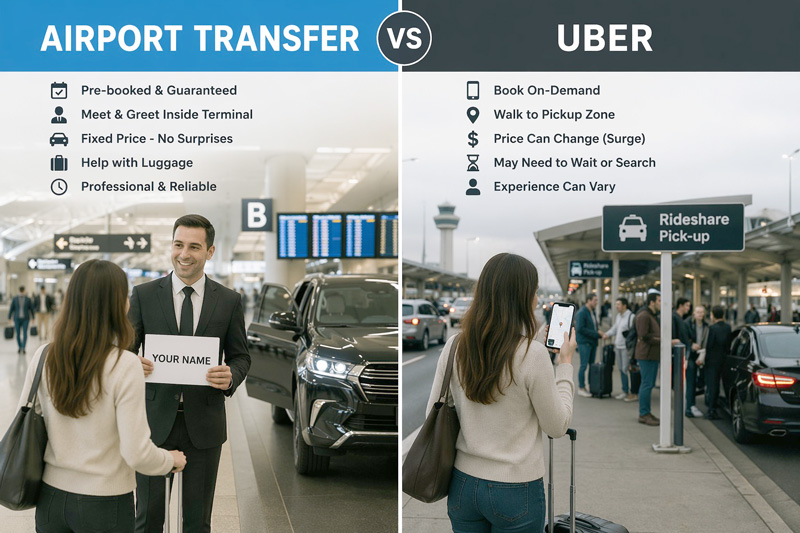
Airport transfer is a pre-booked private transportation service designed specifically for travel between the airport and a fixed destination such as a hotel, home, or office. In Sydney, this service typically includes door-to-door pickup, professional drivers, and a guaranteed vehicle reserved in advance.
The scope of airport transfer goes beyond just transportation. It often includes features such as flight tracking, meet-and-greet service inside the terminal, luggage assistance, and a fixed itinerary with no unexpected stops. This makes it a structured and reliable transport solution, especially for travelers who prioritize comfort, punctuality, and peace of mind.
Uber ride sharing service definition and operation
Uber is a ride-sharing platform that connects passengers with nearby drivers through a mobile app. Unlike airport transfer, Uber operates on an on-demand basis, meaning users request a ride in real time rather than booking far in advance.
In Sydney, Uber drivers are independent contractors who use their own vehicles. The system automatically assigns the nearest available driver, and pricing is calculated based on distance, time, and demand. While Uber offers convenience and flexibility, the service experience can vary depending on driver availability, vehicle condition, and traffic conditions at the time of booking.
Key service model differences private vs on demand
The most fundamental difference between airport transfer and Uber lies in their service models.
- Airport transfer operates as a private, pre-arranged service
- Uber operates as an on-demand, real-time ride-sharing service
With airport transfer, everything is confirmed before arrival, including the driver, vehicle type, and pickup time. This ensures a seamless experience with minimal uncertainty. In contrast, Uber relies on availability at the moment of request, which may lead to waiting time, price changes, or even difficulty securing a ride during peak periods.
This distinction directly impacts reliability, service consistency, and overall travel experience.
Transport ecosystem at Sydney Airport
Sydney Airport has a well-developed transport ecosystem that includes taxis, trains, buses, Uber, and private airport transfer services. Each option operates under different regulations and logistical conditions.
Airport transfer services typically have designated pickup arrangements and often include meet-and-greet inside terminals, making them more convenient for international arrivals. Uber, on the other hand, operates through specific rideshare pickup zones, which may require passengers to walk to designated areas outside the terminal.
Understanding this ecosystem is essential because it influences waiting time, ease of pickup, and overall convenience—especially for first-time visitors or travelers with heavy luggage.
Pricing comparison airport transfer vs Uber Sydney
Fixed price airport transfer structure
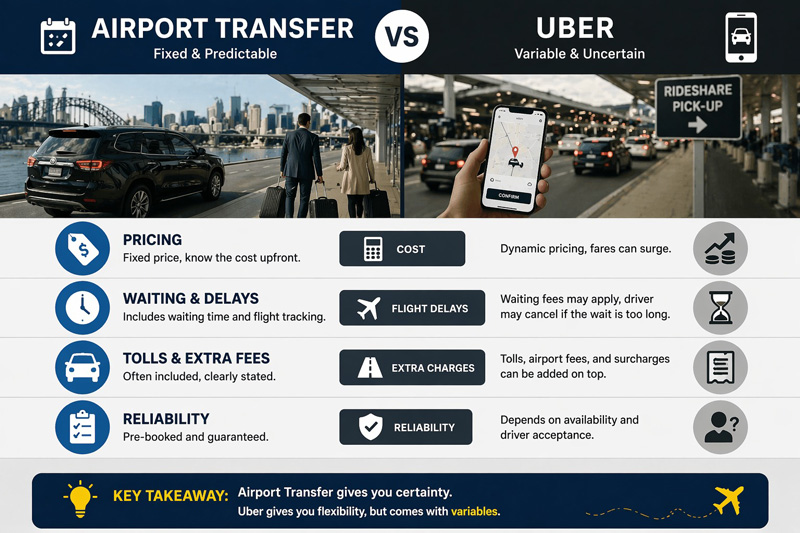
Airport transfer services in Sydney usually operate on a fixed pricing model. The total cost is agreed upon at the time of booking and does not change regardless of traffic conditions or minor delays.
This pricing structure typically includes:
- Vehicle and driver service
- Standard waiting time allowance
- Toll roads (in many cases)
- Airport pickup coordination
Because the price is fixed, travelers can plan their budget with confidence and avoid unexpected expenses. This is particularly valuable for business travelers or families who prefer cost certainty.
Uber dynamic pricing and surge pricing
Uber uses a dynamic pricing system, where fares fluctuate based on real-time demand and supply. During peak hours, bad weather, or high-demand periods such as holidays, Uber applies surge pricing, which can significantly increase the cost of a trip.
While Uber may appear cheaper during off-peak times, prices can quickly rise during busy periods at Sydney Airport, especially when multiple flights arrive simultaneously. This makes Uber pricing less predictable compared to airport transfer services.
Hidden costs tolls waiting fees airport charges
When comparing airport transfer and Uber, it is important to consider hidden or additional costs.
For airport transfer:
- Most services include tolls and basic waiting time
- Extra charges may apply only if waiting exceeds the included allowance
For Uber:
- Tolls are usually added to the fare
- Waiting time fees may apply if the driver is delayed
- Airport pickup surcharges may be included
- Surge pricing can significantly increase total cost
These additional factors mean that the final Uber fare may be higher than initially estimated, especially in busy airport scenarios.
Cost predictability vs price fluctuation
One of the most critical differences is cost predictability.
- Airport transfer offers stable and predictable pricing
- Uber involves variable pricing with potential fluctuations
For travelers who value financial control and transparency, airport transfer provides a clear advantage. On the other hand, Uber may be suitable for those willing to trade predictability for flexibility, particularly when traveling during low-demand periods.
Ultimately, the choice depends on whether the traveler prioritizes certainty and planning or flexibility and real-time convenience.
Service experience and comfort differences
Private vehicle comfort and cleanliness
Airport transfer services in Sydney typically provide dedicated private vehicles that are professionally maintained and cleaned to a high standard. These vehicles are often part of a managed fleet, which means they follow strict quality control in terms of hygiene, interior condition, and overall presentation.
Passengers can expect features such as spacious seating, air conditioning, smooth suspension, and sufficient luggage capacity. Because the vehicle is reserved exclusively for the traveler, there are no shared rides or unexpected stops, ensuring a consistent and comfortable journey from pickup to destination.
Uber vehicle variability and driver quality
Uber operates on a decentralized model where drivers use their personal vehicles, leading to significant variability in both vehicle condition and service quality. While many Uber drivers maintain clean and comfortable cars, the experience can differ depending on the driver, vehicle type, and service tier selected (e.g., UberX, Uber Comfort).
Driver professionalism also varies, as Uber drivers are independent contractors rather than formally trained chauffeurs. This means passengers may encounter differences in driving style, communication, and overall service experience. As a result, Uber offers flexibility but less consistency compared to airport transfer services.
Professional chauffeur vs gig driver experience
A key distinction lies in the level of professionalism between airport transfer chauffeurs and Uber drivers.
Airport transfer drivers are often professionally trained chauffeurs who follow service standards such as punctuality, courteous behavior, formal attire, and customer assistance. They are trained to handle airport logistics, assist with luggage, and provide a smooth, customer-focused experience.
In contrast, Uber drivers operate within a gig economy model, where service quality depends on individual performance rather than standardized training. While many drivers provide excellent service, the lack of uniform standards can result in a less predictable experience.
Privacy quiet ride and premium service level
Airport transfer services are designed to offer a private and premium travel environment. Passengers benefit from a quiet, uninterrupted ride, making it ideal for business travelers who need to work, take calls, or relax after a flight.
There is no need to interact extensively unless desired, and the overall atmosphere is tailored for comfort and discretion. In contrast, Uber rides may vary in terms of noise level, conversation, and overall environment, depending on the driver and vehicle conditions.
For travelers who prioritize privacy, tranquility, and a premium feel, airport transfer services generally provide a superior experience.
Reliability and availability comparison
Pre booked airport transfer guaranteed pickup
One of the strongest advantages of airport transfer services is guaranteed pickup through pre-booking. Once a reservation is confirmed, the vehicle and driver are assigned in advance, ensuring that transportation is ready at the scheduled time.
This eliminates uncertainty, particularly for airport arrivals where timing is critical. Travelers can rely on a seamless transition from flight to ground transport without the need to search for available vehicles.
Uber availability peak time and shortages
Uber availability in Sydney depends heavily on real-time supply and demand. During peak travel periods—such as early mornings, late nights, or when multiple flights arrive—there may be a shortage of available drivers.
This can result in longer waiting times, higher fares due to surge pricing, or even difficulty securing a ride altogether. While Uber is generally accessible in urban areas, its reliability can decrease during high-demand situations at the airport.
Flight tracking airport transfer advantage
Airport transfer services often include flight tracking technology, allowing drivers to monitor flight status in real time. If a flight is delayed or arrives early, the pickup time is automatically adjusted without additional effort from the passenger.
This feature significantly enhances reliability, as travelers do not need to worry about coordinating changes or missing their ride due to unforeseen delays. Uber, by comparison, does not inherently provide flight tracking, requiring passengers to manually request a ride after landing.
Risk of cancellation delay and driver mismatch
With airport transfer, the risk of cancellation is minimal because the service is pre-arranged and professionally managed. The assigned driver is committed to the booking, reducing the likelihood of last-minute changes.
In contrast, Uber rides may be subject to driver cancellations, delays in driver arrival, or mismatches between expected and actual service quality. Drivers can cancel trips due to traffic, distance, or personal preference, which may force passengers to rebook and wait again.
This difference highlights a key trade-off: airport transfer offers stability and assurance, while Uber provides flexibility with a higher degree of uncertainty.
Pickup process at Sydney Airport comparison
Meet and greet airport transfer process
Airport transfer services in Sydney often include a meet and greet service inside the terminal, where the driver waits at the arrival hall holding a name sign. This process is designed to eliminate confusion, especially for international travelers unfamiliar with the airport layout.
The driver monitors the flight, arrives on time, and assists the passenger from the terminal to the vehicle. This creates a seamless, guided pickup experience with minimal stress, making it ideal for first-time visitors, families, or business travelers.
Uber pickup zones and airport restrictions
Uber operates under designated rideshare pickup zones at Sydney Airport. After requesting a ride, passengers must walk to specific pickup areas outside the terminal, which may vary depending on the terminal (domestic or international).
There are also airport regulations that control where rideshare vehicles can stop, which can sometimes lead to confusion or longer walking distances. During busy periods, these zones can become crowded, adding to the complexity of the pickup process.
Waiting time coordination and communication
Airport transfer services offer pre-arranged coordination, where the driver is already scheduled and waiting based on the flight arrival time. Communication is typically proactive, with confirmation messages and direct contact if needed.
With Uber, the process is reactive. Passengers must request a ride after landing, wait for driver assignment, and then coordinate pickup through the app. Waiting time can vary depending on driver availability and airport traffic conditions.
Luggage handling and assistance differences
Airport transfer drivers usually provide full luggage assistance, helping passengers carry bags from the terminal to the vehicle and ensuring proper storage. This is particularly beneficial for travelers with heavy or multiple pieces of luggage.
Uber drivers may assist with luggage, but this is not guaranteed and depends on individual willingness. Additionally, vehicle size may not always match the passenger’s luggage needs, which can create inconvenience if not carefully selected in advance.
Use cases when to choose airport transfer or Uber
Airport transfer for business travelers and VIP
Airport transfer is the preferred option for business travelers and VIP clients who require punctuality, professionalism, and a premium travel experience. The structured nature of the service ensures timely pickups, a quiet environment, and high service standards, which are essential for corporate travel.
Airport transfer for families groups and luggage
Families and groups benefit significantly from airport transfer services due to larger vehicle options, child seat availability, and luggage capacity. The convenience of door-to-door service and assistance with bags reduces stress, especially when traveling with children or bulky items.
Uber for short trips and flexible travel
Uber is well-suited for short-distance trips and flexible travel needs, particularly within the city. It allows users to request rides instantly and adjust plans on the go without prior booking.
For travelers who value convenience and are comfortable with some variability in service, Uber provides a practical and often cost-effective solution during off-peak times.
Late night early morning transport decision
During late-night or early-morning travel, the choice becomes more critical. Airport transfer offers guaranteed availability regardless of time, ensuring that a driver is ready even during low-demand hours.
Uber, while available 24/7 in theory, may face limited driver availability during these periods, potentially leading to longer wait times or higher fares. For time-sensitive travel, airport transfer is generally the more reliable option.
Pros and cons airport transfer vs Uber Sydney
Advantages of airport transfer service
- Fixed pricing with no unexpected changes
- Guaranteed pickup with pre-booking
- Professional drivers and consistent service quality
- Comfortable private vehicles with sufficient space
- Meet and greet service and luggage assistance
Advantages of Uber ride sharing
- On-demand convenience without advance booking
- Wide availability in urban areas
- Potentially lower cost during off-peak times
- Flexible travel options for short distances
- Easy booking through a mobile app
Limitations of airport transfer
- Requires advance booking and planning
- Less flexible for last-minute changes
- May have higher upfront cost compared to Uber in low-demand periods
Limitations of Uber service
- Price fluctuations due to surge pricing
- Inconsistent vehicle quality and driver experience
- Possible delays or driver cancellations
- Limited luggage capacity depending on vehicle type
- Pickup process may be less convenient at the airport
Which is better airport transfer or Uber in Sydney
Decision based on budget and cost control
If budget certainty is a priority, airport transfer is the better choice due to its fixed and transparent pricing. Uber may be cheaper at times, but fluctuating fares can make it difficult to control costs, especially during peak hours.
Comfort vs flexibility trade off
Airport transfer offers higher comfort and consistency, while Uber provides greater flexibility and spontaneity. Travelers must decide whether they value a premium, predictable experience or the ability to book rides on demand.
Travel purpose business family or tourist
- Business travelers: airport transfer for reliability and professionalism
- Families and groups: airport transfer for space and convenience
- Tourists and solo travelers: Uber for flexibility and budget options
Choosing the right service depends heavily on the purpose of the trip and individual expectations.
Final recommendation for different traveler types
There is no one-size-fits-all answer, but clear patterns emerge:
- Choose airport transfer for reliability, comfort, and a stress-free experience
- Choose Uber for flexibility, quick booking, and potentially lower costs in non-peak times
For airport travel in Sydney, where timing and convenience are critical, airport transfer is often the more dependable option, while Uber remains a versatile alternative for less structured travel needs.
Conclusion
In summary, the difference between airport transfer and Uber in Sydney comes down to certainty vs flexibility. Airport transfer provides a structured, reliable, and premium experience with fixed pricing and guaranteed service, making it ideal for business travelers, families, and anyone who values peace of mind.
Uber, on the other hand, offers convenience and adaptability, allowing users to book rides instantly and adjust travel plans on the go. However, this flexibility comes with trade-offs such as price fluctuations, variable service quality, and potential availability issues during peak times.
For airport travel—where timing, coordination, and comfort are critical—airport transfer is generally the more dependable option. Uber remains a practical alternative for short trips or when flexibility is the top priority.
Latest Insights
- Is There a Free Bus from Sydney Domestic to International?
- Can You Walk from Domestic to International at Sydney Airport?
- How Far Apart Are Sydney Airport’s International and Domestic Terminals?
- How Long Does a Domestic to International Transfer Take at Sydney Airport?
- Is There a Free Shuttle at Sydney Airport?
- Airport Transfer With Luggage
