


Airport Transfer With Child Seats
- Sydney airport transfers that provide child seats
- Which child restraint should you request?
- Travelling with two or three children changes the vehicle requirement
- What information should you provide when booking?
- Child-seat fees differ between providers
- Flight tracking and airport pickup arrangements also matter
- How far ahead should you reserve a child seat?
- Do Sydney taxis have to provide child seats?
- Can you bring your own child seat?
- How to choose between Sydney airport transfers with child seats
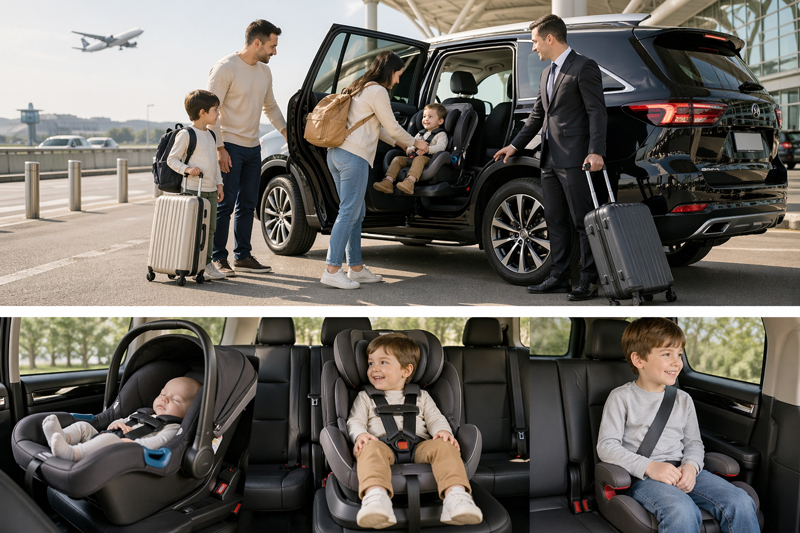
NSW child-restraint rules also depend on the type of vehicle. In ordinary private, hire and rideshare vehicles, children under 7 generally require an approved restraint appropriate for their age and size. Taxis have specific exemptions, but children under 12 months still require a suitable approved child restraint. Approved restraints must comply with AS/NZS 1754.
Sydney airport transfers that provide child seats
The following Sydney operators advertise child-seat transport suitable for airport journeys. Published services vary, so a seat should be specifically confirmed as part of the booking rather than assumed from a general family-transfer description.
| Provider | Published child-seat options | Multiple-seat capability | Published booking advantage |
|---|---|---|---|
| Book Car Sydney | Infant, forward-facing and booster restraints described on its child-seat transfer page | Family and larger-vehicle configurations discussed | Child-seat requirement can be included with the airport transfer booking |
| BabyGo Taxi | Infant carrier, convertible rear/forward-facing seat, forward-facing seat and booster | Maxi taxi advertised for up to 3 approved baby seats with luggage | Child seats advertised at no extra cost and 24/7 airport availability |
| Ram’s Airport Transfers | Infant capsule, rear-facing convertible, forward-facing and booster options | Up to 2 seats in a large SUV and up to 3 in a minivan; larger configurations are also advertised | Child seats advertised free with advance notice; around 24 hours is recommended |
| Sydney Baby Seat Taxi | Infant, forward-facing and booster seats | Family transport is configured around the requested child seats and luggage | Real-time flight tracking and pre-booked fitted restraints are advertised |
| Bub Cabs | Baby capsule, rear-facing seat, forward-facing seat and booster | More than one restraint can be requested, subject to vehicle configuration | Booking considers adults, children, luggage, prams, flight and terminal details |
| Prime Maxi Cabs | Infant, convertible and booster seats | Maxi Cabs advertise capacity for up to 3 child seats | Child age and weight can be supplied so the required seat is prepared before pickup |
Published information can change, and the exact vehicle or restraint may depend on availability. For that reason, the final confirmation should identify the seat requirement for every child rather than merely state “baby seat requested.”
Which child restraint should you request?
For NSW road travel, age and size determine the appropriate restraint.
-
Under 6 months: Approved rear-facing child restraint
-
6 months to under 4 years: Approved rear-facing restraint or forward-facing restraint with an inbuilt harness
-
4 years to under 7 years: Approved forward-facing restraint with an inbuilt harness or approved booster seat
Children aged 7 or older who are still too small for an adult seatbelt may continue to need a booster. NSW guidance suggests 145 cm as the minimum height at which an adult lap-sash belt is generally suitable.
Parents do not necessarily need to determine the exact commercial model of seat themselves. A practical booking approach is to provide the child's age and relevant size information and ask the operator to confirm the appropriate approved restraint.
This is particularly important for children close to a transition between restraint types. Age establishes the legal category, but the restraint also needs to be suitable for the child's size.
Travelling with two or three children changes the vehicle requirement
The number of passengers alone is not enough to select an airport-transfer vehicle.
Every installed child restraint occupies a seating position, while prams, portacots, suitcases and carry-on bags use luggage space. A vehicle advertised for a particular passenger count may therefore be unsuitable once several restraints and bulky baby equipment are added.
This is one area where provider specifications can help.
BabyGo states that its maxi taxi vans can accommodate up to three approved baby seats together with luggage.
Ram’s publishes more detailed examples:
-
Sedan: One child seat plus a parent and umbrella-fold pram
-
Large SUV: Up to two child seats, a full-size pram and several suitcases
-
Minivan: Up to three child seats, a full-size pram, portacot and additional luggage
-
Minibus: Intended for larger groups and multiple child-seat configurations
Prime Maxi Cabs also states that its Maxi Cabs can accommodate up to three child seats in combination.
Bub Cabs does not publish one universal capacity for every booking; instead, it asks customers to provide the number of adults, children, restraints, bags and prams so an appropriate vehicle can be reviewed.
For a family requiring two or three restraints, confirming this complete configuration is more useful than simply reserving a “7-seater.”
What information should you provide when booking?
A child-seat airport booking should contain enough information for the operator to prepare both the restraint and the vehicle.
Provide:
-
Number of adults
-
Number of children
-
Age of each child
-
Height or weight if requested
-
Number and type of child restraints required
-
Number of suitcases and carry-on bags
-
Pram or stroller details
-
Other bulky equipment such as a portacot
-
Flight number
-
Sydney Airport terminal
-
Pickup and destination addresses
-
Arrival or departure date and time
Providing these details together reduces two common problems: receiving the wrong restraint and receiving a vehicle that technically has enough seats but not enough usable space once the restraints and luggage are loaded.
Bub Cabs specifically asks airport passengers to provide flight, passenger, child-seat, luggage and pram information, while Ram’s requests child details and seat requirements in advance.
Child-seat fees differ between providers
There is no universal Sydney airport-transfer child-seat fee.
BabyGo advertises fitted baby seats at no extra cost.
Ram’s also advertises its child restraints free of charge when requested with advance notice.
Other operators may price the complete journey according to vehicle type, destination, travel time, seat requirements and family configuration rather than publishing a standalone child-seat fee. Bub Cabs, for example, says its fare depends on factors including vehicle requirements and requested child seats.
For a meaningful price comparison, request a quote for the complete family configuration. A lower base fare is not necessarily the lower final fare if several child seats force an upgrade to a larger vehicle.
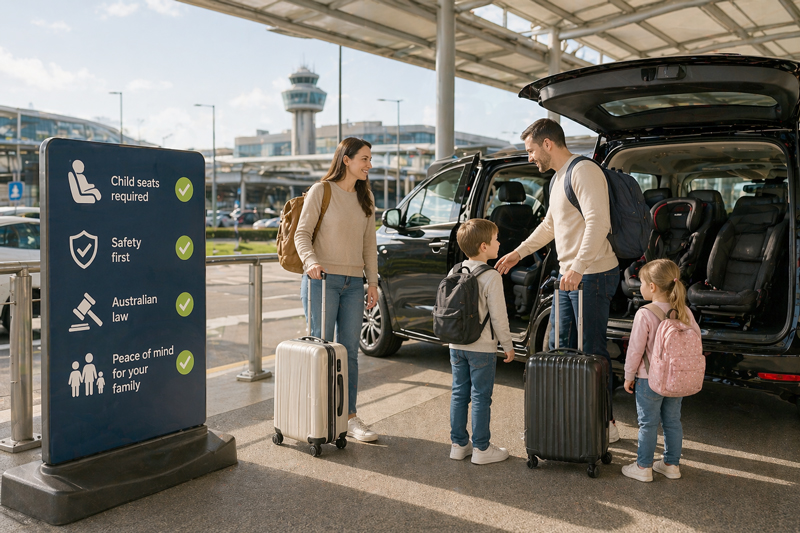
Flight tracking and airport pickup arrangements also matter
A child-seat transfer is not only about having the restraint inside the vehicle. Airport-specific handling can make a material difference when travelling with children.
Ram’s states that it monitors the supplied flight number for international arrivals and adjusts pickup timing when a flight is delayed.
Sydney Baby Seat Taxi also advertises real-time flight tracking, with the child seat already fitted for airport collection.
Bub Cabs asks customers to supply flight and passenger details and explicitly covers Sydney International Terminal T1 and Domestic Terminals T2 and T3.
Before travel, confirm:
-
Whether the operator monitors flight changes
-
Where you will meet the driver
-
Whether T1, T2 or T3 changes the pickup procedure
-
When you should contact the driver after collecting luggage
-
Whether the child restraint will already be installed
-
How delays are handled
These points are especially useful after an international arrival, when baggage collection, immigration and travelling with a pram can make the exact pickup time difficult to predict.
How far ahead should you reserve a child seat?
Advance booking is preferable because the operator needs both the correct restraint and a compatible vehicle.
Ram’s recommends approximately 24 hours' advance notice and states that same-day child-seat bookings depend on seat and vehicle availability.
Bub Cabs recommends booking as early as possible, particularly for airport trips, early-morning journeys, weekends and bookings involving several child seats.
Earlier booking becomes particularly useful when you need:
-
Two or three child restraints
-
A specific rear-facing restraint or infant capsule
-
Different restraint types for siblings
-
A minivan or Maxi Cab
-
Space for a full-size pram or portacot
-
An early-morning or late-night transfer
A confirmed booking should show that the child-seat requirement has been accepted rather than appearing only in an unconfirmed note.
Do Sydney taxis have to provide child seats?
No. NSW taxi rules include specific child-restraint exemptions, and an ordinary taxi should not be assumed to arrive with a child seat.
In NSW taxis:
-
Children under 6 months must use a rear-facing restraint
-
Children aged 6 to under 12 months must use an appropriate rear- or forward-facing restraint
-
Children over 12 months may use a properly adjusted seatbelt where the taxi exemption applies
-
A child restraint can be requested when booking or passengers can provide their own
-
Taxis are required to have a child-restraint anchorage point
Hire vehicles and rideshare vehicles follow the same child-restraint rules that apply to private vehicles rather than the taxi exemption.
This distinction is one reason a pre-booked airport service with a confirmed child restraint provides greater certainty for families than arriving at Sydney Airport and relying on whichever vehicle is immediately available.
Can you bring your own child seat?
Some operators allow customers to use their own child restraint, but the arrangement should be confirmed before the journey.
The key issue for visitors is compliance. NSW Government guidance states that an approved child restraint must meet AS/NZS 1754. A child seat approved only under an overseas standard should therefore not automatically be assumed to satisfy NSW requirements.
If you plan to bring your own restraint, confirm:
-
That the restraint is approved for use in Australia
-
That the transfer vehicle has the required anchorage or compatible installation system
-
Who will install it
-
Whether installation time affects the airport pickup arrangement
For many international families, having the operator provide the appropriate approved restraint can remove the need to carry a bulky seat through the airport.
How to choose between Sydney airport transfers with child seats
Instead of selecting a company only because it advertises a “baby seat,” compare the booking against the actual needs of your family.
Prioritise these questions:
-
Does the provider offer the correct restraint for every child?
-
Can all required restraints be installed at the same time?
-
Is the remaining vehicle capacity sufficient for adults, luggage and prams?
-
Does the operator need the child's age, weight or height before confirming the seat?
-
Is the child seat included in the fare or charged separately?
-
How much advance notice is required?
-
Will the restraint be fitted before pickup?
-
Does the provider use your flight and terminal details to coordinate the airport pickup?
-
Has the complete vehicle and restraint configuration been confirmed before payment or travel?
A provider that answers those questions clearly gives you more useful information than one that merely lists “child seats available.”
Sydney travellers have several pre-booked options for airport transfers with child seats, including Book Car Sydney, BabyGo Taxi, Ram’s Airport Transfers, Sydney Baby Seat Taxi, Bub Cabs and Prime Maxi Cabs. The important differences are the restraints each service offers, how many can be fitted together, whether seats attract an additional charge, and whether the vehicle can still accommodate the family's luggage and pram.
For one child, the main task is confirming the correct restraint. For families with two or three young children, vehicle configuration becomes equally important. Provide the children's ages and size information, passenger numbers, luggage and pram details, flight number and terminal before the booking is confirmed. That allows the operator to match the restraint, vehicle and airport pickup arrangement to the complete journey instead of treating the child seat as an isolated add-on.
Q&A about Airport Transfer With Child Seats
Can three child seats fit in one Sydney airport transfer?
Some providers advertise this capacity. BabyGo says its maxi taxi can carry up to three approved baby seats with luggage, Ram’s advertises up to three seats in a minivan and larger configurations in minibuses, and Prime Maxi Cabs advertises up to three child seats in its Maxi Cabs. The exact configuration should still be confirmed for the types of restraints, passenger count and luggage involved.
Are child seats free with Sydney airport transfers?
It depends on the provider. BabyGo and Ram’s currently advertise child restraints without an additional seat fee, while other services may quote the complete journey according to vehicle and seat requirements.
What if I do not know which child seat to request?
Provide the child's exact age and any size information requested by the operator. The provider can then confirm which approved restraint it proposes to supply. You should verify that confirmation before travel.
Does booking a 7-seater guarantee space for several child seats and luggage?
No. Nominal passenger capacity does not describe the complete usable configuration. Several child restraints occupy seating positions, while full-size prams and suitcases consume luggage space. Confirm the number and type of restraints together with all passengers and bulky luggage before choosing the vehicle.
Should I include my flight number when booking?
Yes when the provider requests it. Flight information allows an airport-transfer operator to coordinate the pickup and, where flight monitoring is offered, respond to delayed or early arrivals. Ram’s and Sydney Baby Seat Taxi specifically advertise flight tracking for airport transfers.
Latest Insights
- Is There a Free Bus from Sydney Domestic to International?
- Can You Walk from Domestic to International at Sydney Airport?
- How Far Apart Are Sydney Airport’s International and Domestic Terminals?
- How Long Does a Domestic to International Transfer Take at Sydney Airport?
- Is There a Free Shuttle at Sydney Airport?
- Airport Transfer With Luggage
