


Booking Info Airport Pickup
- Essential information for a Sydney airport pickup booking
- Flight details are the most important airport-specific information
- Provide the complete destination
- Give an accurate passenger count
- Describe your luggage realistically
- Use the arriving passenger’s name and contact details
- Specify the required service or vehicle type
- Declare special requirements before the booking is confirmed
- Which booking details can affect the quote?
- How should airport pickup timing be entered?
- Check the waiting-time and flight-delay policy
- Sydney Airport pickup location information
- A booking request is not always a confirmed reservation
- What to check before submitting the booking
- What to verify after the booking is confirmed
- Update the booking if your travel details change
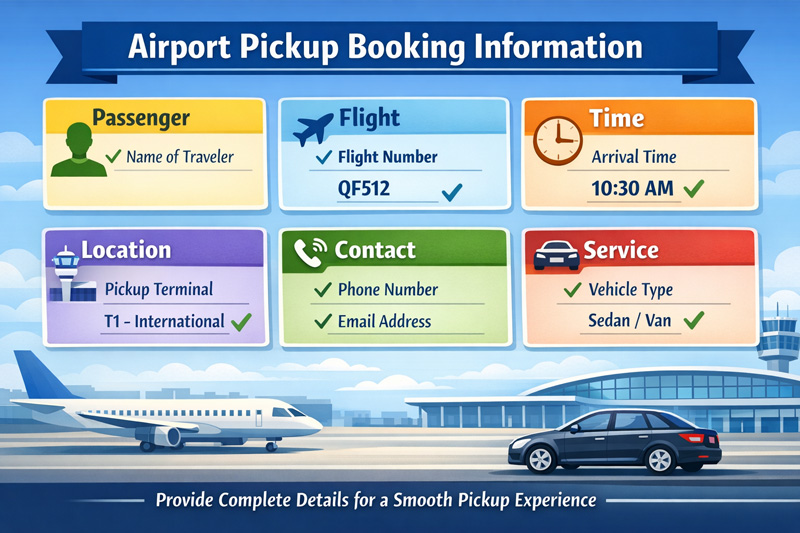
At minimum, prepare the lead passenger’s name, a working mobile number and email address, flight number, local Sydney arrival date, destination, number of passengers, and luggage details. If relevant, also provide the arrival terminal, child-seat requirements, accessibility needs, oversized baggage, extra stops, meet-and-greet preference, or preferred vehicle type.
Some details do more than help the driver find you. Your destination, passenger and luggage requirements, vehicle choice, additional stops, timing, and special requests can also affect the vehicle allocated and the quoted fare. Before considering the booking complete, check that the provider has actually confirmed the reservation and review the final pickup, waiting-time, and fare instructions.
Essential information for a Sydney airport pickup booking
The exact booking form varies by provider, but most airport pickups require the same core information.
| Information | What to provide | Why it matters |
|---|---|---|
| Passenger details | Lead passenger’s full name | Identifies the person the driver is collecting |
| Contact details | Working mobile number and email address | Allows confirmations, pickup instructions and operational updates |
| Flight details | Flight number and Sydney arrival date | Connects the booking to the correct arriving flight |
| Terminal | T1, T2 or T3 when known | Helps determine the correct pickup arrangement |
| Destination | Full drop-off address, hotel or venue | Establishes the route and may affect the quote |
| Passenger count | Total number of adults and children | Determines required seating capacity |
| Luggage | Number and type of bags | Helps determine whether the vehicle has enough storage space |
| Service or vehicle preference | Private/shared service, sedan, SUV, people mover or other option where offered | Helps match the booking to the required service and capacity |
| Special requirements | Child seats, accessibility needs, oversized luggage, meet-and-greet or extra stops | May affect equipment, vehicle allocation, timing or price |
Treat these fields as connected rather than independent. Four passengers with only cabin bags may fit a different vehicle from four passengers carrying several large suitcases, a stroller and sporting equipment.
Flight details are the most important airport-specific information
Flight number
Provide the complete arriving flight number exactly as shown on the passenger’s itinerary.
The flight number is more useful than an arrival time alone because it identifies the specific aircraft movement associated with the booking. Where the transfer provider offers flight monitoring, it can also help the operator respond to an early or delayed arrival.
Do not provide only a time such as “7:30 pm” if the flight number is available. Multiple flights can arrive around the same time, while scheduled arrival times can change before the aircraft lands.
Sydney arrival date
Use the date the flight actually arrives in Sydney, not automatically the date on which the passenger departs.
This is particularly important for international and overnight travel. A passenger may leave another country on Monday but reach Sydney on Tuesday. Entering the departure date can result in the vehicle being scheduled on the wrong day.
Arrival terminal
Sydney Airport uses T1 for international services, while T2 and T3 handle domestic operations. If the terminal is known, include it in the booking.
Terminal information affects where the driver and passenger can meet. Airport pickup arrangements can also differ according to whether the service uses a designated pickup zone, an authorised transport area, or an indoor meet-and-greet arrangement.
If you are unsure of the terminal, provide the correct flight number and then verify the terminal shown in the booking confirmation.
Provide the complete destination
For an airport arrival transfer, “Sydney Airport” identifies the origin, but the operator also needs to know where the passenger is going.
Provide the full destination address whenever possible, including the street number, street name and suburb. If the destination is a hotel, business, apartment building, hospital or venue, adding the property name can make the destination easier to identify.
The destination matters because it can affect:
-
Route planning
-
Travel distance
-
Vehicle scheduling
-
Fare calculation
-
Whether extra stops need to be included
If you require more than one stop, disclose those stops when requesting the booking rather than asking for them only after pickup. Additional stops can affect both scheduling and the quoted fare.
Give an accurate passenger count
State how many people will actually travel in the vehicle, including children.
Passenger count affects the legal and practical seating capacity required. It also needs to be considered together with luggage. A vehicle may technically have enough passenger seats but still be unsuitable once baggage is loaded.
For group bookings, provide the complete passenger count rather than estimating downward to fit a preferred vehicle category.
If members of the same group arrive on different flights, tell the provider. Depending on the pickup arrangement, the operator may need the flight details for each arrival rather than a single flight number.
Describe your luggage realistically
Do not provide only the number of suitcases if some items are unusually large.
Useful luggage information can include:
-
Number of checked suitcases
-
Number of cabin or carry-on bags
-
Large or oversized cases
-
Prams or strollers
-
Wheelchairs or mobility aids
-
Golf bags
-
Surfboards
-
Bicycles or boxed equipment
-
Other bulky items
Luggage requirements can change the most suitable vehicle even when the passenger count stays the same.
For example, a standard passenger vehicle may accommodate a small group travelling light but may not have sufficient cargo capacity for the same group with several large suitcases and a stroller. Supplying realistic baggage details before confirmation reduces the risk of an unsuitable vehicle being assigned.
Use the arriving passenger’s name and contact details
Provide the full name of the lead passenger—the person the driver is actually expected to collect.
This distinction matters when a reservation is made by someone else. A family member, employer, travel coordinator or assistant may place the booking, but the operator still needs to know the identity of the arriving passenger.
You should also provide a mobile number that the passenger can access after landing in Sydney.
A working mobile number may be needed for:
-
Driver calls or text messages
-
Changes to the meeting point
-
Instructions after the flight arrives
-
Problems locating the passenger
-
Operational updates
An email address is commonly used for booking confirmation, receipts and detailed pickup instructions.
If the booking contact and travelling passenger are different people, make that clear rather than assuming the driver will know which person to contact.
Specify the required service or vehicle type
Not every provider uses the same service categories, but some booking systems ask you to select a service or vehicle before the reservation is confirmed.
Depending on the operator, choices may include:
-
Private transfer
-
Shared shuttle
-
Standard sedan
-
SUV
-
People mover or maxi vehicle
-
Chauffeur or premium vehicle
You do not need to research every available airport transport service simply to complete a pickup booking. The important point is to select the option that matches your passenger count, luggage and service requirements.
If you are unsure which vehicle is suitable, provide accurate passenger and luggage information and allow the operator to recommend the appropriate capacity.
Declare special requirements before the booking is confirmed
Requirements that affect equipment, capacity or pickup procedure should be mentioned during booking rather than after the driver arrives.
Child seats
If a child seat is required, state this clearly and provide the information requested by the provider, such as the child’s age or required seat type.
Do not assume every vehicle automatically carries an appropriate child restraint.
Wheelchair and mobility requirements
If a passenger needs wheelchair accessibility, assistance entering the vehicle, space for a mobility device or another accessibility arrangement, tell the provider in advance.
These requirements can affect which vehicle is suitable and how the pickup is organised.
Meet-and-greet service
If you want the driver to meet the passenger inside the terminal, select or request meet-and-greet service where available.
An indoor meeting arrangement makes accurate passenger names and flight information particularly important because the driver may identify the traveller using a name sign.
Oversized baggage and equipment
Items such as surfboards, bicycles, golf equipment, large mobility aids or an unusually high number of bags should be declared before vehicle allocation.
Extra stops
If the journey requires an additional hotel, residential or business stop, include it in the original request. It may change the route, journey time and quoted fare.
Which booking details can affect the quote?
Accurate booking information is important not only for pickup coordination but also for obtaining a reliable price.
Depending on the provider and service model, the quote can be affected by:
-
Pickup and destination locations
-
Travel distance
-
Vehicle type
-
Passenger capacity
-
Luggage requirements
-
Additional stops
-
Child seats or other requested equipment
-
Meet-and-greet arrangements
-
Waiting time
-
Airport access or parking charges
-
Tolls
-
After-hours or special scheduling conditions
-
Other optional services
You do not need to assume that every one of these creates an additional charge. Policies vary between providers.
Instead, check what the quoted price includes before confirming the booking. In particular, clarify whether airport fees, parking, tolls, normal flight-delay handling, waiting time and requested extras are already included or may be charged separately.
This is more reliable than comparing headline prices without checking what each quote actually covers.
How should airport pickup timing be entered?
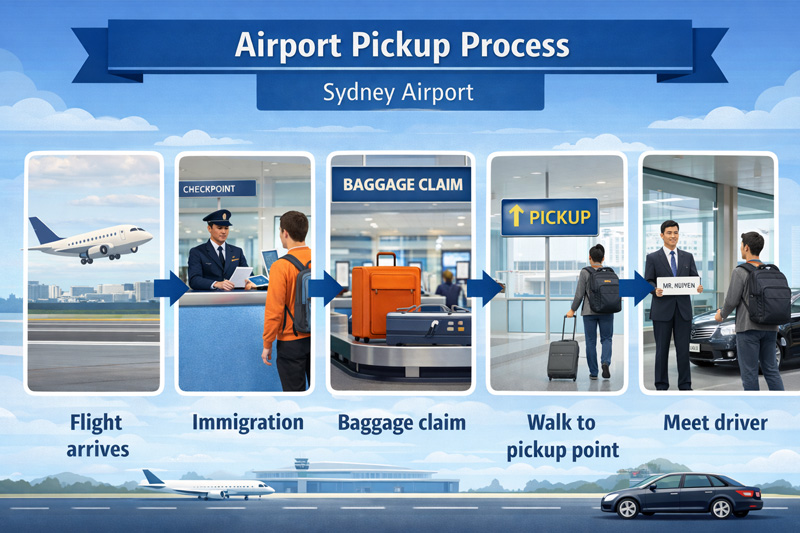
For an airport pickup, distinguish between the aircraft’s scheduled arrival time and the time the passenger may actually be ready to meet the driver.
After landing, passengers may still need time to:
-
Disembark
-
Walk through the terminal
-
Complete immigration where applicable
-
Collect checked baggage
-
Clear customs where applicable
-
Reach the designated meeting point
If the provider requests both a flight number and arrival time, supply the requested flight information rather than manually adding an arbitrary delay to the scheduled landing time.
A provider that monitors flights may use the flight number to adjust its operational timing. The exact treatment of time after landing, however, depends on the operator’s waiting and delay policy.
Check the waiting-time and flight-delay policy
Flight tracking and waiting time are related, but they are not the same thing.
Flight tracking can help the provider identify that an aircraft is early or delayed. The waiting-time policy determines how long the driver remains available after the relevant pickup period begins and when additional waiting charges may apply.
Policies differ between operators. Do not assume that every Sydney airport transfer includes the same number of free waiting minutes.
Before travelling, check:
-
When the included waiting period starts
-
How much waiting time is included
-
How normal flight delays are handled
-
Whether extended waiting creates additional charges
-
What happens if the passenger is delayed after landing
-
Who to contact if immigration or baggage collection takes unusually long
This is especially important for international arrivals, where the time between landing and reaching the pickup point can vary significantly.
Sydney Airport pickup location information
You generally do not need to invent a meeting point before making the reservation. First provide the correct flight, terminal and requested service type.
The actual pickup arrangement may differ between T1 International and T2/T3 Domestic and between different transport services.
Depending on the booking, the passenger may be directed to:
-
A designated external pickup area
-
A commercial transport pickup point
-
A rideshare-style collection area
-
An accessible pickup area
-
An arrivals-hall meet-and-greet location
After the booking is confirmed, follow the current instructions supplied by the provider. Do not rely solely on a pickup point remembered from a previous trip because airport access arrangements and service procedures can change.
A booking request is not always a confirmed reservation
Submitting an online form, requesting a quote or sending trip information does not necessarily mean that a vehicle has been confirmed.
Before relying on the transfer, check whether you have received an actual booking confirmation.
A confirmed reservation should normally make it clear that the provider has accepted the trip and should identify the relevant booking details. Depending on the service, this may include a booking reference, confirmed fare, payment status or other confirmation information.
This distinction is particularly important if you requested a quote manually rather than completing an instant-booking process.
Do not treat an automated message saying that your enquiry has been received as proof that the airport pickup itself has been accepted.
What to check before submitting the booking
Review all information together before submitting the reservation.
-
Confirm that the flight number matches the arriving flight
-
Use the actual Sydney arrival date
-
Check whether the arrival is at T1, T2 or T3 where known
-
Enter the complete destination
-
Count every passenger, including children
-
Provide realistic luggage quantities and identify oversized items
-
Select an appropriate service or vehicle option where required
-
Add child-seat, accessibility, meet-and-greet or other special requirements
-
Declare additional stops
-
Use contact details accessible to the arriving passenger
-
Check which booking details may affect the quote
The most important errors to catch at this stage are the wrong flight, wrong date, incorrect passenger count, insufficient luggage capacity and special requirements that have not been disclosed.
What to verify after the booking is confirmed
Once the provider confirms the reservation, review the confirmation rather than assuming the submitted information was accepted exactly as entered.
Check, where applicable:
-
Passenger name
-
Flight number
-
Arrival date
-
Terminal
-
Destination
-
Passenger count
-
Luggage requirements
-
Vehicle or service category
-
Child seat or accessibility request
-
Pickup or meeting instructions
-
Confirmed fare
-
What the fare includes and excludes
-
Waiting-time policy
-
Booking reference
-
Payment status or deposit requirements
-
Provider or driver contact method
-
Procedure for changes or delays
If an important detail differs from your itinerary or requirements, correct it before travel.
Update the booking if your travel details change
The information supplied at the time of booking is only useful while it remains accurate.
Contact the provider if any operational detail changes after the reservation has been confirmed, particularly:
-
Flight number
-
Arrival date
-
Arrival terminal
-
Destination
-
Passenger count
-
Luggage quantity or oversized items
-
Child-seat or accessibility requirements
-
Extra stops
-
The passenger’s working contact number
Do not assume that every change will automatically update just because the flight itself can be monitored.
Flight monitoring may help with a schedule delay for the same flight. It does not tell the transfer provider that you switched to a different flight, added passengers, changed hotels or are now carrying more luggage.
For a significant change, obtain confirmation that the updated information has been accepted.
Booking an airport pickup in Sydney is straightforward when the provider receives complete information from the beginning. The core details are the arriving passenger’s name and working contact information, flight number and Sydney arrival date, terminal where known, destination, passenger count, luggage requirements, and any special service needs.
For the most reliable booking, go one step further: select an appropriate vehicle or service where required, disclose details that can affect the quote, confirm what the fare includes, understand the waiting and delay policy, and make sure a booking request has actually become a confirmed reservation. If the flight, destination, passenger count, luggage or other important requirements change later, update the provider before pickup. These details give the operator what it needs to allocate the right vehicle, coordinate the arrival and provide clear instructions for meeting the driver at Sydney Airport.
Latest Insights
- Is There a Free Bus from Sydney Domestic to International?
- Can You Walk from Domestic to International at Sydney Airport?
- How Far Apart Are Sydney Airport’s International and Domestic Terminals?
- How Long Does a Domestic to International Transfer Take at Sydney Airport?
- Is There a Free Shuttle at Sydney Airport?
- Airport Transfer With Luggage
