


Choose Pickup Time Airport
- What is the best pickup time for airport transfer Sydney?
- How to choose airport drop off time before flight Sydney?
- How early should you schedule airport pickup after landing?
- What factors affect airport transfer timing Sydney?
- How to adjust pickup time for flight delays Sydney?
- What happens if pickup time is incorrect for airport transfer?
- Tips to choose the right pickup time for airport transfer Sydney
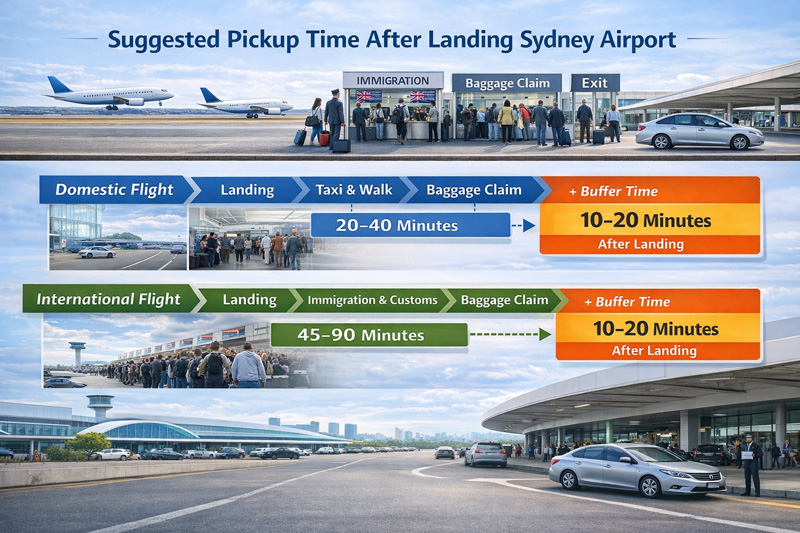
What is the best pickup time for airport transfer Sydney?
Choosing the best pickup time for an airport transfer in Sydney depends on how accurately you align your booking with your actual flight arrival process. It is not simply the landing time that matters, but the total time required for passengers to exit the airport and be ready for pickup. A well-calculated pickup time ensures a smooth experience, avoids unnecessary waiting fees, and improves overall travel efficiency.
Flight arrival time coordination
The most important factor is coordinating your pickup with your actual flight arrival time, not just the scheduled time. Flights can arrive early or be delayed, so relying solely on the original schedule can lead to mismatches.
For Sydney Airport transfers, the pickup time should reflect when passengers are expected to exit the terminal after landing. This includes taxiing, disembarking, and walking through the airport. Accurate coordination ensures the driver arrives at the right moment, minimizing waiting time and confusion.
Airport pickup time calculation
A practical way to calculate pickup time is to add estimated processing time after landing:
- Domestic flights: +20 to 40 minutes
- International flights: +45 to 90 minutes
This calculation accounts for passenger flow, airport procedures, and walking distance to the pickup zone.
For example:
If your flight lands at 10:00 AM (domestic), the ideal pickup time would be around 10:30 AM.
This structured approach helps avoid early driver arrival or late passenger readiness.
Buffer time after landing
Adding a buffer time is essential when choosing a pickup time. Even with accurate planning, unexpected delays can occur, such as:
- Long queues at immigration
- Delays at baggage claim
- Congestion inside the terminal
A buffer of 10–20 minutes provides flexibility and reduces stress for both passengers and drivers. It also prevents additional waiting charges if the driver arrives earlier than the passenger is ready.
Domestic vs international pickup differences
Pickup timing varies significantly between domestic and international flights due to different procedures:
- Domestic flights: Faster exit process, no immigration, shorter walking distances
- International flights: Immigration checks, customs clearance, longer processing time
Because of this, international pickups require more conservative timing and larger buffers. Failing to account for these differences is one of the most common mistakes when booking airport transfers in Sydney.
Real time flight tracking systems
Modern airport transfer services in Sydney often use real-time flight tracking systems. These systems automatically monitor your flight status and adjust the driver’s arrival time accordingly.
Benefits include:
- Automatic adjustment for delays or early arrivals
- Reduced need for manual updates
- Better coordination between driver and passenger
Choosing a provider with flight tracking significantly improves reliability and ensures your pickup time stays accurate even when your flight schedule changes.
How to choose airport drop off time before flight Sydney?
Selecting the correct drop-off time is just as important as choosing a pickup time. Arriving too early can waste time, while arriving too late increases the risk of missing your flight. The goal is to balance efficiency with enough buffer to handle unexpected delays.
Check in time requirements
Airlines recommend arriving at the airport within specific timeframes:
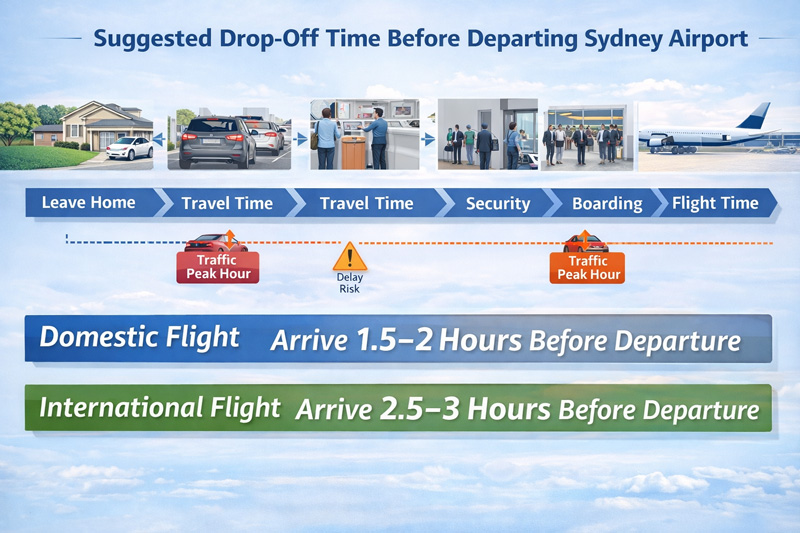
- Domestic flights: at least 1.5 to 2 hours before departure
- International flights: at least 2.5 to 3 hours before departure
Your drop-off time should be calculated backward from these requirements. This ensures you have enough time for check-in, baggage drop, and boarding procedures.
Travel time to sydney airport
Travel time to Sydney Airport varies depending on your location, distance, and route conditions. Factors to consider include:
- Distance from pickup location
- Typical travel duration
- Road conditions
It is important to use realistic estimates rather than ideal travel times. Always consider potential delays and avoid planning based on the shortest possible route time.
Peak hour traffic conditions
Sydney traffic can significantly impact travel time, especially during peak hours:
- Morning peak: 7:00 AM – 9:30 AM
- Evening peak: 4:00 PM – 7:00 PM
During these periods, travel time can increase by 30–50%. If your flight is scheduled during peak hours, you should leave earlier to avoid congestion-related delays.
Airport security waiting time
Security checks can vary depending on passenger volume, time of day, and airport congestion.
Key considerations include:
- Long queues during holidays or weekends
-
Additional screening for international flights
- Delays during busy travel periods
Factoring in security waiting time ensures you can pass through checkpoints without rushing or risking missed boarding.
Terminal specific timing
Sydney Airport has different terminals for domestic and international flights, each with its own layout and processing time:
- Domestic terminals: Faster access and shorter queues
- International terminal: Larger scale, longer processing time
Understanding your departure terminal helps refine your drop-off timing and ensures you arrive at the correct location with sufficient time to navigate the airport.
How early should you schedule airport pickup after landing?
Scheduling airport pickup after landing requires understanding the full post-arrival process. The time passengers need before reaching the pickup point varies depending on flight type, airport conditions, and individual circumstances. Setting the pickup too early can lead to unnecessary waiting charges, while setting it too late may cause delays or inconvenience. The key is to estimate each stage accurately.
Immigration clearance time
For international flights, immigration clearance is one of the most time-consuming steps. Processing time can range from 20 to 60 minutes, depending on:
- Passenger volume at arrival time
- Number of open immigration counters
- Security procedures and document checks
During peak arrival periods at Sydney Airport, queues can be longer, so it is important to allow sufficient time before scheduling pickup.
Baggage claim duration
After clearing immigration (or immediately after landing for domestic flights), passengers proceed to baggage claim.
Typical duration:
- Domestic flights: 10 to 20 minutes
- International flights: 20 to 40 minutes
Delays can occur due to slow baggage handling or high passenger volume. Travelers with oversized or special luggage may require additional time, which should be considered when setting pickup timing.
Customs processing time
For international arrivals, customs clearance follows baggage claim. This step can vary significantly depending on:
- Whether passengers have items to declare
- Random security checks
- Overall passenger flow
Customs processing usually takes 5 to 20 minutes, but it can be longer during busy periods. Skipping this estimate can result in unrealistic pickup timing.
Airport exit walking time
Even after completing all formalities, passengers still need time to walk from the terminal to the designated pickup area.
Key factors include:
- Terminal layout and size
- Distance to pickup zone
- Crowd density inside the airport
Walking time can range from 5 to 15 minutes, especially in large international terminals. This final step is often underestimated but plays a crucial role in accurate pickup scheduling.
Meet and greet service timing
If you book a meet and greet service, the driver typically waits inside the terminal with a name sign. In this case, pickup timing becomes more flexible because:
- The driver monitors your arrival
- The meeting point is clearly defined
- Coordination is easier even with delays
However, you still need to provide accurate flight details so the service can adjust timing accordingly. Meet and greet services are ideal for international travelers or first-time visitors to Sydney.
What factors affect airport transfer timing Sydney?
Airport transfer timing in Sydney is influenced by multiple external factors beyond your control. Understanding these variables helps you plan more accurately and avoid common timing mistakes.
Sydney traffic conditions
Traffic conditions in Sydney can fluctuate significantly depending on time of day, road usage, and urban congestion.
Key characteristics:
- Heavy traffic in central business districts
- Congestion on major routes դեպի Sydney Airport
- Unpredictable delays during busy periods
Even short distances can take longer than expected during high traffic periods, so always factor in realistic travel conditions.
Peak vs off peak travel time
Travel time varies greatly between peak and off-peak hours:
- Peak hours: slower movement, higher congestion
- Off-peak hours: smoother traffic, shorter travel time
During peak hours, journeys can take up to 30–50% longer than normal. Choosing the right departure time based on traffic patterns is essential for accurate airport transfer planning.
Weather impact on travel
Weather conditions can directly affect road safety and traffic flow.
Common impacts include:
- Rain reducing driving speed and visibility
- Storms causing road disruptions
- Increased congestion during adverse weather
In Sydney, even moderate rain can lead to slower traffic, so it is important to allow extra time during unfavorable weather conditions.
Road incidents and delays
Unexpected road incidents such as accidents, construction work, or lane closures can disrupt travel plans.
These incidents can:
- Cause sudden traffic congestion
- Force route changes
- Increase travel time unpredictably
Since these factors are difficult to predict, adding buffer time is the best way to minimize risk.
Airport congestion level
Airport congestion also plays a major role in transfer timing. This includes:
- High passenger volume during holidays
- Busy pickup and drop-off zones
- Limited parking or waiting areas
During peak travel seasons, both inside and outside the airport can become crowded, affecting how quickly passengers can be picked up or dropped off.
Understanding these conditions helps ensure a smoother airport transfer experience and reduces the risk of delays or missed connections.
How to adjust pickup time for flight delays Sydney?
Flight delays are common, and adjusting your airport transfer pickup time correctly is essential to avoid confusion, extra costs, or missed connections. A well-managed adjustment process ensures that your driver arrives at the right time, even when your flight schedule changes unexpectedly.
Flight delay tracking system
Many professional airport transfer services in Sydney use flight delay tracking systems that monitor your flight in real time.
These systems automatically detect:
- Delayed departures or arrivals
- Early landings
- Gate changes
When integrated properly, the pickup time is adjusted without requiring manual updates from the passenger. This significantly improves accuracy and reduces stress.
Driver real time updates
Drivers often receive real-time updates through dispatch systems or mobile apps. This allows them to:
- Adjust arrival time based on flight status
- Avoid unnecessary waiting at the airport
- Coordinate better with passengers
Real-time communication ensures that both the driver and passenger are aligned, even when schedules change suddenly.
Flexible pickup scheduling
Flexible scheduling is a key feature of reliable airport transfer services. It allows changes to pickup time without penalties when:
- Flights are delayed
- Arrival times shift unexpectedly
- Travel plans change
Choosing a provider that supports flexible adjustments ensures a smoother experience and avoids unnecessary charges.
Early arrival handling
Flights sometimes arrive earlier than scheduled. In such cases:
- Drivers may not yet be at the airport
- Passengers may need to wait briefly
A good transfer service will attempt to adjust quickly, but early arrivals are harder to manage than delays. Providing real-time updates or contacting the driver can help minimize waiting time.
Late arrival coordination
When flights are delayed, proper coordination becomes critical.
Best practices include:
- Ensuring your booking includes correct flight details
- Using services with automatic tracking
- Keeping communication open with the driver
Late arrival coordination helps prevent missed pickups and ensures the driver adjusts timing based on actual arrival rather than the original schedule.
What happens if pickup time is incorrect for airport transfer?
Setting the wrong pickup time can lead to several issues that affect both cost and convenience. Understanding these risks helps travelers avoid common mistakes when booking airport transfers in Sydney.
Driver waiting time issues
If the driver arrives too early and the passenger is not ready, waiting time becomes a problem.
This can lead to:
- Limited waiting periods
- Additional charges after free waiting time
- Driver availability conflicts
Accurate timing helps avoid unnecessary waiting complications.
No show airport transfer risk
If the pickup time is significantly incorrect, the booking may be marked as a no-show.
This can happen when:
- The passenger is not present at the agreed time
- Communication between driver and passenger fails
A no-show may result in losing the booking without refund, requiring a new reservation.
Extra charges for waiting
Most airport transfer services include a limited free waiting period. Beyond that, extra fees may apply.
Common scenarios include:
- Passenger delays after landing
- Incorrect pickup time selection
- Miscommunication about arrival time
These additional costs can be avoided by setting realistic pickup timing.
Missed flight risk
For drop-off services, incorrect timing can be more serious.
If you leave too late:
- You may encounter unexpected traffic delays
- You may not have enough time for check-in or security
This increases the risk of missing your flight, which can lead to higher costs and disrupted travel plans.
Rebooking airport transfer process
If the original pickup fails, you may need to rebook another transfer.
This process can involve:
- Finding a new available driver
- Paying higher last-minute prices
- Waiting longer for service
Rebooking is often less convenient and more expensive, making proper timing essential from the start.
Tips to choose the right pickup time for airport transfer Sydney
Choosing the right pickup time is a combination of planning, accurate information, and selecting the right service provider. Following these tips can help ensure a smooth and stress-free airport transfer experience.
Provide accurate flight details
Always provide complete and accurate flight information when booking, including:
- Flight number
- Arrival or departure time
- Terminal details
This allows the service provider to track your flight and adjust timing accordingly.
Use transfer service with tracking
Selecting a transfer service with flight tracking capability ensures:
- Automatic adjustment for delays
- Better coordination between driver and passenger
- Reduced risk of timing errors
This feature is especially important for international travel.
Confirm driver communication
Before your trip, confirm how you will communicate with the driver.
Important points include:
- Phone number or messaging app
- Meeting point instructions
- Backup contact options
Clear communication helps resolve timing issues quickly.
Check waiting time policy
Different providers offer different waiting time policies.
You should check:
- Free waiting duration
- Charges after the free period
- Conditions for delays
Understanding this policy helps avoid unexpected fees.
Choose reliable provider
A reliable airport transfer provider offers:
- Real-time tracking systems
- Professional drivers
- Clear communication
- Flexible scheduling
Choosing the right provider reduces risks and ensures a better overall experience.
Conclusion
Choosing the right pickup and drop-off time for airport transfers in Sydney is not just about the flight schedule - it requires understanding the full travel process, from landing procedures to traffic conditions. By factoring in immigration clearance, baggage handling, peak-hour traffic, and potential delays, you can set a precise and reliable timing that minimizes stress and avoids unnecessary costs.
A well-planned airport transfer ensures smoother coordination, better time management, and a more comfortable travel experience. Whether you are arriving or departing, the key is to combine accurate flight information with realistic timing and a reliable transfer service.
Q&A about Choose Pickup Time Airport
What is best pickup time after landing sydney?
The best pickup time is typically 20–40 minutes after domestic flights and 45–90 minutes after international flights, depending on airport procedures and passenger flow.
How early should I leave for airport sydney?
You should leave early enough to arrive at the airport 1.5–2 hours before domestic flights and 2.5–3 hours before international flights, including travel time and traffic conditions.
Do drivers track flight delays automatically?
Many professional airport transfer services in Sydney use flight tracking systems that automatically monitor delays and adjust pickup timing without requiring manual updates.
How long will driver wait at airport pickup?
Most drivers offer a free waiting period, typically ranging from 15 to 60 minutes depending on the service. Additional waiting time may incur extra charges.
Can I change pickup time after booking?
Yes, most services allow pickup time changes, especially if your flight is delayed. However, policies vary, so it is important to check with your provider in advance.
Latest Insights
- Is There a Free Bus from Sydney Domestic to International?
- Can You Walk from Domestic to International at Sydney Airport?
- How Far Apart Are Sydney Airport’s International and Domestic Terminals?
- How Long Does a Domestic to International Transfer Take at Sydney Airport?
- Is There a Free Shuttle at Sydney Airport?
- Airport Transfer With Luggage
