


Domestic vs International Pickup
- What is domestic vs international airport pickup Sydney?
- Where are pickup locations at domestic vs international terminals Sydney?
- What rules apply for domestic vs international airport pickup Sydney?
- How pickup process differs between domestic and international Sydney?
- Common problems in domestic vs international airport pickup Sydney
- Domestic vs international airport pickup Sydney comparison
- When to choose domestic vs international airport pickup Sydney?
- How to ensure smooth airport pickup domestic vs international Sydney?
- Summary domestic vs international airport pickup Sydney differences
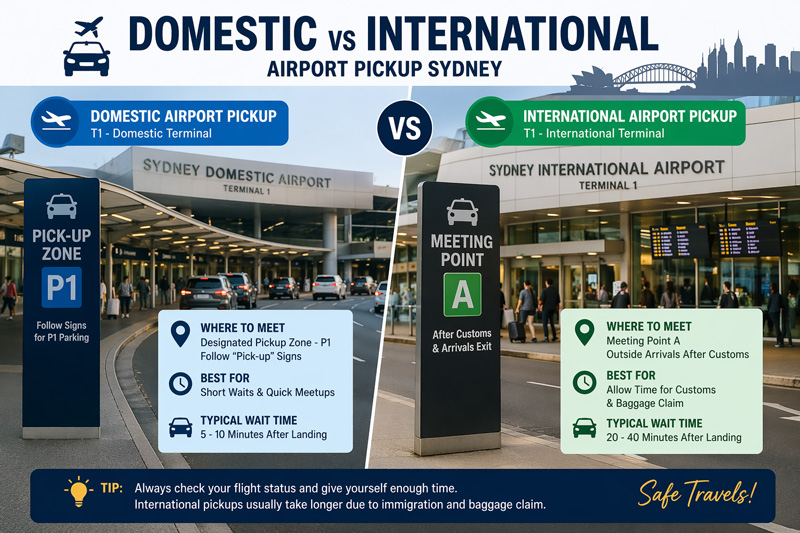
What is domestic vs international airport pickup Sydney?
Domestic vs international airport pickup in Sydney refers to the process of collecting arriving passengers from different terminals at Sydney Airport, depending on whether they are traveling on domestic or international flights. While both involve coordinating a driver and meeting a passenger after landing, the procedures, locations, timing, and regulations differ significantly due to airport layout, security controls, and passenger flow.
Understanding these differences helps avoid delays, confusion, and extra charges, especially for first-time travelers or those using private airport transfer services.
Sydney Airport domestic terminals T2 T3 pickup process
At Sydney Airport, domestic arrivals take place at Terminal 2 (T2) and Terminal 3 (T3). The pickup process is generally faster and more straightforward compared to international arrivals.
After landing, passengers typically:
- Disembark and proceed directly to baggage claim (if needed)
- Exit the terminal within a short time (usually 10–20 minutes after landing)
- Follow signs toward “Ground Transport” or “Pickup” areas
Drivers usually wait at:
- Express pickup zones (kerbside) for quick collection
- Short-term car parks if waiting is required
Key characteristics of domestic pickup:
- No immigration or customs clearance
- Short walking distance from gate to exit
- Strict no waiting rules at curbside (drivers must move quickly)
- Faster coordination between driver and passenger
Because of the limited waiting time, precise timing and real-time communication are critical for smooth pickup.
Sydney Airport international terminal T1 pickup process
International arrivals occur at Terminal 1 (T1), where the pickup process is more complex due to additional procedures.
After landing, passengers must:
- Go through immigration clearance
- Collect checked baggage
- Pass through customs inspection
- Exit into the public arrivals hall
This process can take 30–90 minutes, depending on flight volume and airport congestion.
Pickup options at T1 include:
- Arrivals hall meet and greet (common for chauffeur services)
- Designated pickup zones outside the terminal
- Public car parks for waiting vehicles
Key characteristics of international pickup:
- Longer and less predictable arrival time
- More structured meeting points
- Higher likelihood of waiting time charges
- Greater need for flight tracking and driver coordination
Many premium airport transfer services offer meet-and-greet service inside the terminal, where the driver waits with a name sign for easier identification.
Key differences between domestic and international pickup
The main differences between domestic and international airport pickup in Sydney lie in process complexity, timing, and coordination requirements.
Key distinctions include:
- Arrival process
- Domestic: Direct exit after landing
- International: Immigration + customs required
- Pickup timing
- Domestic: Fast and predictable
- International: Delayed and variable
- Pickup location
- Domestic: Kerbside or express zones
- International: Arrivals hall or designated pickup areas
- Driver coordination
- Domestic: Quick communication needed
- International: Flight tracking is essential
- Waiting rules
- Domestic: Strict no waiting at curbside
- International: More flexible but may incur fees
In short, domestic pickup is faster and simpler, while international pickup requires more planning, patience, and coordination.
Where are pickup locations at domestic vs international terminals Sydney?
Pickup locations at Sydney Airport vary significantly between domestic and international terminals. Each terminal has its own traffic system, designated zones, and rules that both drivers and passengers must follow.
Knowing the correct pickup location helps prevent confusion, delays, and unnecessary charges.
Domestic terminal pickup zones and curbside rules
At T2 and T3 domestic terminals, pickup locations are designed for quick turnover and high traffic flow.
Main pickup options include:
- Kerbside express pickup zones
- Located directly outside arrivals
- Designed for immediate pickup only
- Drivers cannot wait or park
- Short-term car parks
- Suitable for drivers arriving early
- Allow waiting until passenger is ready
- Require parking fees
Important curbside rules:
- No stopping unless the passenger is ready
- Drivers must remain with the vehicle
- Vehicles must move immediately after pickup
Failure to follow these rules can result in fines or being directed away by airport staff.
International terminal pickup zones and meeting points
At Terminal 1 international, pickup is more structured due to higher passenger volume and security control.
Main pickup options include:
- Arrivals hall meeting point
- Used for meet-and-greet services
- Ideal for first-time travelers or VIP passengers
- Designated pickup zones outside T1
- Clearly marked areas for passenger collection
- Require coordination before arrival
- Public car parks
- Suitable for longer waiting times
- Common for private vehicles
Compared to domestic terminals, international pickup:
- Allows more time for coordination
- Requires clearer communication on meeting location
- Often involves walking from terminal to pickup point
Airport signage navigation and passenger guidance
Sydney Airport provides extensive signage and navigation systems to guide passengers to the correct pickup areas.
Common signs include:
- Ground Transport
- Pickup / Drop-off
- Ride Share / Taxi zones
Passengers can rely on:
- Overhead directional signs throughout terminals
- Information desks for assistance
- Maps or instructions provided by transfer services
For best results:
- Follow signage immediately after exiting baggage claim
- Confirm pickup instructions before arrival
- Stay in contact with the driver via phone or messaging
Clear navigation combined with proper coordination ensures a smooth and stress-free airport pickup experience at both domestic and international terminals.
What rules apply for domestic vs international airport pickup Sydney?
Airport pickup rules at Sydney Airport vary significantly between domestic and international terminals. These regulations are designed to manage traffic flow, ensure passenger safety, and prevent congestion in high-traffic areas. Understanding these rules is essential to avoid fines, delays, or failed pickups.
Time limits and no waiting regulations domestic terminals
At domestic terminals T2 and T3, pickup rules are strict due to high vehicle turnover and limited curbside space.
Key rules include:
- No waiting at curbside pickup zones
Drivers can only stop if the passenger is ready and waiting - Immediate departure required
Vehicles must leave immediately after passenger boarding - No unattended vehicles allowed
Drivers must remain inside the vehicle at all times - Short stopping window (usually 1–2 minutes)
If the passenger is not ready:
- Drivers must circle the terminal or
- Use short-term parking instead of blocking the pickup lane
Failure to comply may result in:
- Traffic enforcement warnings
- Fines issued by airport authorities
- Being directed away by airport traffic controllers
These strict rules make timing and communication critical for domestic pickups.
International terminal pickup restrictions and procedures
At Terminal 1 international, pickup regulations are more structured but less rushed compared to domestic terminals.
Key procedures include:
- Designated pickup areas only
Vehicles must use official pickup zones or car parks - Controlled stopping and waiting
Limited waiting is allowed but must follow traffic instructions - Meet-and-greet allowed inside arrivals hall
Common for chauffeur or private transfer services - Security and traffic monitoring
Vehicles are monitored for compliance and duration
Additional considerations:
- Longer passenger processing time (immigration + customs)
- Higher likelihood of waiting fees if using private transfer services
- More flexibility compared to domestic curbside rules
Drivers often rely on:
- Flight tracking systems
- Real-time communication with passengers
- Pre-arranged meeting instructions
Airport traffic flow and enforcement differences
Traffic management differs between domestic and international terminals due to infrastructure and passenger volume.
Domestic terminals:
- High-frequency short stops
- Rapid vehicle movement required
- Strict enforcement of no-waiting rules
International terminal:
- Slower traffic flow due to longer pickup times
- Structured lanes and designated waiting zones
- More controlled but flexible enforcement
Airport authorities use:
- Traffic wardens and patrol officers
- CCTV monitoring systems
- Signage and lane control
Overall, domestic pickup prioritizes speed and turnover, while international pickup prioritizes control and coordination.

How pickup process differs between domestic and international Sydney?
The pickup process at Sydney Airport differs significantly between domestic and international flights due to variations in passenger flow, timing, and coordination requirements.
Passenger arrival flow domestic vs international flights
Passenger movement after landing is the biggest difference between domestic and international pickup.
Domestic arrival flow:
- Passengers exit aircraft and proceed directly to baggage claim
- No immigration or customs clearance
- Exit terminal quickly (often within 10–20 minutes)
International arrival flow:
- Immigration clearance required
- Baggage collection and customs screening
- Exit time can vary from 30 to 90 minutes or more
Impact on pickup:
- Domestic pickups are predictable and fast
- International pickups require flexible timing and patience
Driver coordination and communication differences
Driver coordination plays a crucial role in successful airport pickup, and the approach differs between domestic and international terminals.
Domestic pickup coordination:
- Requires precise timing
- Drivers often arrive only when passenger is ready
- Quick phone or message confirmation is enough
International pickup coordination:
- Requires ongoing communication
- Drivers track flight status and delays
- Meeting instructions must be clearly defined (inside or outside terminal)
Common coordination methods:
- Mobile phone calls or messaging apps
- Flight tracking systems
- Pre-booked service instructions
Professional airport transfer services often provide:
- Real-time updates
- Clear pickup instructions
- Backup coordination plans
Waiting time and pickup timing considerations
Timing is one of the most critical factors in airport pickup, especially when comparing domestic and international terminals.
Domestic timing considerations:
- Minimal waiting allowed
- Drivers must synchronize arrival with passenger exit
- Early arrival may require circling or parking
International timing considerations:
- Built-in waiting time is common (e.g. 30–60 minutes free waiting)
- Delays are expected due to immigration and baggage processing
- Flexible scheduling is necessary
Key timing strategies:
- Provide accurate flight details when booking
- Add buffer time for unexpected delays
- Maintain active communication between driver and passenger
In summary:
- Domestic pickup requires precision and speed
- International pickup requires flexibility and coordination
Understanding these differences helps ensure a smoother, stress-free airport pickup experience in Sydney.
Common problems in domestic vs international airport pickup Sydney
Airport pickup at Sydney Airport can become stressful if key differences between domestic and international terminals are not clearly understood. Most issues arise from poor planning, incorrect assumptions, or lack of coordination.
Confusion about pickup location and terminal differences
One of the most common problems is misunderstanding where the pickup should happen.
Typical issues include:
- Passengers going to the wrong terminal (T1 vs T2/T3)
- Drivers waiting at domestic curbside while passenger exits international terminal
- Confusion between pickup zones, ride share areas, and taxi ranks
Why this happens:
- Sydney Airport has multiple terminals located apart
- Domestic and international pickup systems are completely different
- Lack of clear pre-arranged instructions
How to avoid:
- Always confirm terminal (T1, T2, or T3) before arrival
- Share exact pickup location details (zone, level, or meeting point)
- Use maps or screenshots provided by transfer services
Miscommunication between driver and passenger
Communication breakdown is another major cause of failed or delayed pickups.
Common scenarios:
- Passenger cannot contact driver after landing
- Driver arrives but cannot locate passenger
- Language barriers or unclear instructions
Domestic vs international impact:
- Domestic: timing-sensitive, even small delays cause missed pickup
- International: larger terminals increase difficulty in finding each other
Solutions:
- Ensure both parties have correct phone numbers
- Use messaging apps or SMS for real-time updates
- Pre-agree on a simple and clear meeting point
Flight delay and timing mismatch problems
Flight delays or early arrivals can disrupt pickup timing significantly.
Typical problems:
- Driver arrives too early and cannot wait at curbside
- Passenger exits later than expected due to delays
- Extra waiting charges from private transfer services
Differences:
- Domestic flights: smaller delays but stricter pickup timing
- International flights: longer delays but more flexible waiting policies
Best practices:
- Use services with flight tracking capability
- Add buffer time when planning pickup
- Inform driver immediately of any delay or schedule change
Domestic vs international airport pickup Sydney comparison
Comparing domestic and international airport pickup helps travelers choose the most suitable option based on convenience, cost, and service expectations.
Convenience and accessibility comparison
Domestic pickup:
- Faster and more direct
- Short walking distance to pickup zones
- Simple navigation
International pickup:
- More complex due to immigration and customs
- Larger terminal and longer walking distance
- Requires clearer coordination
Conclusion:
- Domestic pickup is more convenient for quick exits
- International pickup requires more effort but offers structured meeting options
Cost and potential extra charges comparison
Cost differences often depend on waiting time, parking, and service type.
Domestic pickup:
- Lower base cost in most cases
- Minimal waiting allowed, reducing extra fees
- Possible parking fees if driver arrives early
International pickup:
- Higher cost due to longer service time
- Waiting fees may apply after free waiting period
- Additional charges for meet-and-greet services
Key insight:
- International pickup has higher risk of extra charges due to unpredictable timing
Service experience and reliability differences
Service quality can vary depending on terminal complexity and provider.
Domestic pickup:
- Quick and efficient
- Less room for error but more time pressure
International pickup:
- More structured and service-oriented
- Often includes premium options like chauffeur meet-and-greet
Reliability factors:
- Communication quality
- Driver experience
- Use of tracking and coordination systems
When to choose domestic vs international airport pickup Sydney?
Choosing the right pickup approach depends on travel type, passenger needs, and overall convenience.
Best choice for domestic travelers short haul flights
Domestic airport pickup is ideal for:
- Short business trips
- Frequent travelers familiar with the airport
- Passengers without heavy luggage
Advantages:
- Fast exit and quick pickup
- Lower cost and minimal coordination
- Efficient for time-sensitive schedules
Best choice for international travelers long haul flights
International airport pickup is best suited for:
- Long-haul travelers experiencing fatigue or jet lag
- First-time visitors unfamiliar with Sydney Airport
- Passengers with multiple or heavy luggage
Advantages:
- Meet-and-greet assistance
- More flexible timing
- Less stress navigating complex arrival procedures
Choosing based on travel purpose and passenger type
Different traveler profiles require different pickup strategies:
- Business travelers
Prefer reliability, punctuality, and professional service - Families and groups
Need space, comfort, and luggage assistance - First-time travelers
Benefit from guided pickup and clear instructions - Budget travelers
May prioritize cost over convenience
The best choice depends on balancing cost, comfort, and convenience.
How to ensure smooth airport pickup domestic vs international Sydney?
A smooth airport pickup experience requires planning, accurate information, and effective coordination.
Providing accurate flight and terminal information
Always provide:
- Correct flight number
- Arrival time
- Terminal (T1, T2, or T3)
Why it matters:
- Enables flight tracking
- Prevents pickup at wrong location
- Improves timing accuracy
Planning pickup timing and communication strategy
Effective timing strategy includes:
- Estimating exit time based on flight type
- Adding buffer time for delays
- Keeping communication active
Best practices:
- Notify driver when landing
- Update driver after baggage collection
- Confirm exact pickup moment
Choosing reliable airport transfer service provider
A reliable provider ensures:
- Professional drivers
- Clear pickup instructions
- Transparent pricing
- Real-time support
What to look for:
- Positive reviews and reputation
- Flight tracking capability
- Defined waiting policies
- Clear communication channels
Summary domestic vs international airport pickup Sydney differences
Understanding the differences between domestic and international airport pickup allows travelers to plan effectively and avoid unnecessary stress.
Key differences recap for quick decision making
- Domestic pickup is faster, simpler, and time-sensitive
- International pickup is slower, more complex, but flexible
- Domestic requires precise timing
- International requires coordination and patience
Best recommendation based on traveler needs
- Choose domestic pickup strategy if you want speed and efficiency
- Choose international pickup strategy if you need support and flexibility
- Use professional airport transfer services for reliability and convenience
In all cases, preparation and communication are the key factors that determine a successful airport pickup experience in Sydney.
Conclusion
Choosing between domestic and international airport pickup in Sydney is not just about location—it is about understanding how the entire process works from arrival to pickup.
Domestic pickup is ideal for travelers who prioritize speed, efficiency, and minimal coordination. It works best when timing is precise and communication is clear. On the other hand, international pickup requires more planning, flexibility, and patience due to immigration procedures, longer processing times, and more structured pickup systems.
To ensure a smooth experience, travelers should always provide accurate flight details, confirm pickup locations in advance, and maintain active communication with their driver. Selecting a reliable airport transfer service can significantly reduce stress, especially for international arrivals or first-time visitors.
Ultimately, the best choice depends on your travel scenario. If you value convenience and quick exit, domestic pickup is the better option. If you need support, flexibility, and a guided experience, international pickup is the smarter choice.
Latest Insights
- Is There a Free Bus from Sydney Domestic to International?
- Can You Walk from Domestic to International at Sydney Airport?
- How Far Apart Are Sydney Airport’s International and Domestic Terminals?
- How Long Does a Domestic to International Transfer Take at Sydney Airport?
- Is There a Free Shuttle at Sydney Airport?
- Airport Transfer With Luggage
