


Private Transfer vs Shuttle
- Private transfer vs shuttle Sydney at a glance
- How private transfers and shared shuttles work
- Which costs less: private transfer or shuttle?
- Which is faster from Sydney Airport?
- Sydney Airport terminal and meeting-point details matter
- Does door-to-door always mean the vehicle stops at the entrance?
- Luggage can change the better choice
- Which is more convenient?
- Comfort and privacy
- Arrival and departure create different priorities
- Does trip distance change the decision?
- Which option suits different travellers?
- Is a private transfer safer than a shuttle?
- How flight delays should be handled
- How to decide between a private transfer and shuttle
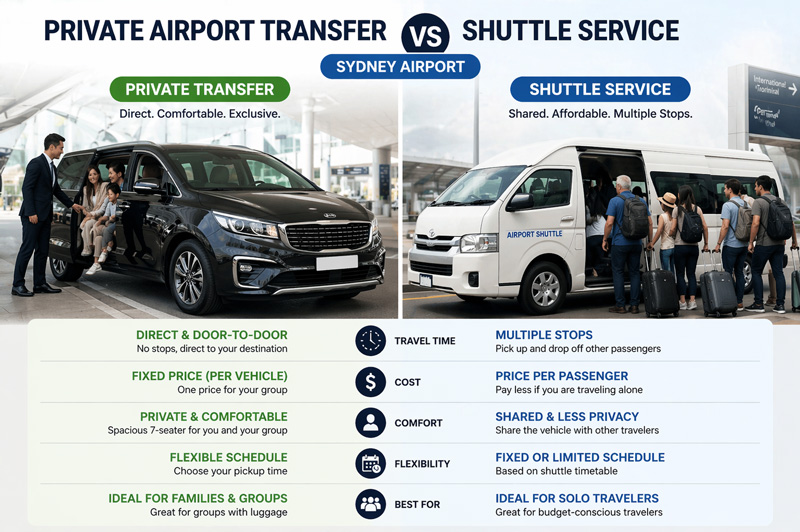
For a meaningful comparison, determine whether the quoted service is actually shared or exclusive, how departures are organised, where it picks up and drops off, and whether other passengers can add stops to your journey.
Once the service type is clear, the main trade-off is straightforward: a private transfer gives your booking greater control over the vehicle and route, while a shared shuttle spreads transport capacity and cost across multiple passengers.
Private transfer vs shuttle Sydney at a glance
| Factor | Private airport transfer | Shared airport shuttle |
|---|---|---|
| Vehicle use | Reserved for your booking | Shared with other passengers |
| Route | Normally direct to the booked destination | May include other pickups and drop-offs |
| Pricing | Commonly quoted for the booking or vehicle | Commonly charged per passenger |
| Departure | Arranged around the booking | May use scheduled or coordinated departures |
| Journey time | No passenger-related detours | Can include waiting and additional stops |
| Privacy | Exclusive passenger space | Shared passenger space |
| Luggage | Capacity can be matched to the booked vehicle | Storage is shared and limits may apply |
| Group travel | One vehicle fare can be divided among the party | Per-passenger fares accumulate as group size increases |
| Coordination | One booking and meeting arrangement | Individual seats may depend on the shuttle system |
| Best fit | Travellers prioritising directness and control | Travellers prioritising a lower individual fare |
These are typical service characteristics rather than guarantees. Operators differ in pricing, waiting policies, luggage rules, pickup arrangements, operating hours, and service areas.
How private transfers and shared shuttles work
Private airport transfer
A private airport transfer reserves a vehicle for one passenger or travelling party. The booking normally specifies the airport terminal, destination, pickup arrangement, passenger count, and expected luggage.
Because unrelated passengers are not added, the vehicle can normally proceed directly between the agreed pickup point and destination. Depending on the operator and product booked, services may also include flight monitoring, a nominated meeting point, luggage assistance, or a vehicle selected for the size of the party.
Private does not necessarily mean limousine or luxury transport. The vehicle may be a sedan, SUV, people mover, van, or another type appropriate for the number of passengers and their luggage.
Shared airport shuttle
A shared shuttle sells capacity to several passenger bookings. Departures may follow a timetable, use designated pickup points, serve hotels, or be organised around passengers travelling in similar directions.
Sharing can reduce the cost for an individual passenger, but the journey is no longer structured around one booking. Waiting for departure and serving other passengers may add time before and during the trip.
Before comparing prices, confirm:
-
Whether the shuttle is genuinely shared
-
Whether departures are scheduled or coordinated
-
Whether pickup is from the terminal, a meeting point, or another location
-
Whether the service goes to the exact destination
-
Whether other passenger stops can be added
-
How luggage capacity is allocated
Which costs less: private transfer or shuttle?
A shared shuttle often has the lower starting cost for one passenger because the fare is commonly sold per seat. A private transfer usually has a higher initial price because one booking reserves the vehicle.
The comparison can change as the travelling party grows.
A useful calculation is:
Shared shuttle total = fare per passenger × number of passengers
For a private transfer, compare the quoted vehicle or booking fare with the number of people sharing it:
Private cost per traveller = private vehicle fare ÷ number of passengers
For example, if four shuttle tickets together cost close to the price of one suitable private vehicle, the decision is no longer only about headline price. The direct route, luggage capacity, pickup arrangement, privacy, and potential waiting time also become important.
This does not mean a private transfer automatically becomes cheaper for a group. Vehicle size, destination, time, and operator pricing can all change the result.
Compare the total payable fare
Check whether each quote includes:
-
Airport-related charges
-
Road tolls
-
Waiting time
-
Additional stops
-
Oversized or excess luggage
-
Child restraints where required
-
Late-night or special-time charges
-
Changes associated with delayed or rescheduled flights
A low advertised fare is only useful when it represents the service you actually need.
Which is faster from Sydney Airport?
A private transfer normally has the simpler journey structure because it does not need to serve unrelated passengers.
For a shared shuttle, total journey time can be considered as:
Waiting before departure + road travel time + passenger-related detours
The first extra component may occur when the traveller waits for a scheduled departure or for other passengers. The second can occur when the vehicle makes additional pickups or drop-offs.
The actual difference is not fixed. A shuttle passenger who departs quickly and is one of the first drop-offs may experience only a small delay. Someone who waits for departure and is later in the drop-off sequence may spend considerably longer travelling.
Traffic affects both services. A private transfer removes passenger-related waiting and stops; it does not remove Sydney congestion.
Peak-hour travel
During busy periods, both private vehicles and shuttles can encounter the same road congestion.
The difference is that a shared journey may combine traffic delay with shuttle-specific delays such as waiting and intermediate stops. This makes the total arrival time less straightforward to estimate.
For time-sensitive travel, compare not only expected driving time but also the service's departure process and possible stop pattern.
Sydney Airport terminal and meeting-point details matter
A promise of “airport pickup” is not enough to determine how convenient the service will be.
Sydney Airport passengers should confirm the terminal associated with their flight and the operator's exact meeting instructions. International and domestic flights can involve different terminal arrangements, and individual transfer providers may use particular meeting points or contact procedures.
Before travelling, confirm:
-
The terminal used by your flight
-
The exact meeting location
-
Whether the driver or shuttle waits inside or outside the terminal area
-
How the operator identifies the passenger
-
Who to contact if the passenger cannot find the vehicle
-
What happens if the flight arrives earlier or later than expected
Clear pickup instructions can matter as much as whether the service is private or shared.
Does door-to-door always mean the vehicle stops at the entrance?
Not necessarily.
A private transfer can commonly be booked to a specific address, while some shared services also provide hotel or address-based drop-offs. However, vehicle access, legal stopping restrictions, loading zones, building entrances, or property access can affect the exact pickup or drop-off point.
For apartments, hotels, event venues, narrow-access properties, or locations with restricted vehicle entry, confirm where the vehicle can legally and practically stop.
The relevant question is therefore not simply “Is it door-to-door?” but:
Where exactly will the passenger meet or leave the vehicle?

Luggage can change the better choice
Passenger capacity and luggage capacity are not the same thing.
A vehicle may legally carry the number of passengers booked while still lacking practical storage for all their baggage.
Four passengers travelling with cabin bags require much less space than four passengers carrying large suitcases, a stroller, and sporting equipment.
Private transfers make it easier to select a vehicle around a known luggage load. Shared shuttle storage is divided among passengers and may be subject to operator limits.
Tell the provider in advance about:
-
Multiple large suitcases
-
Prams or strollers
-
Wheelchairs or mobility equipment
-
Golf bags
-
Surfboards
-
Bicycles
-
Large musical instruments
-
Other oversized equipment
Paying for a passenger seat should not be assumed to guarantee space for unusual or oversized luggage.
Which is more convenient?
Private transfers generally provide greater control over timing, destination, passenger space, and the overall journey.
That can matter when a traveller has a fixed schedule, several bags, young children, multiple passengers to coordinate, or an address that is not conveniently served by a shuttle.
A shared shuttle requires the passenger to work with the provider's operating model. That may involve a scheduled departure, designated pickup point, wider pickup window, or additional stops.
Neither arrangement is automatically inconvenient. A shuttle serving the right destination at the right time may be simple and economical. The difference becomes more important when the trip has little tolerance for waiting or detours.
Comfort and privacy
The most consistent comfort difference is not whether one category always uses better vehicles. It is control of the passenger space.
With a private transfer, only the booked party occupies the passenger area. This gives travellers more control over seating within the selected vehicle, conversation, cabin interruptions, and the effects of other passengers entering or leaving.
With a shared shuttle, unrelated travellers use the same vehicle, so there is less control over seating, noise, stops, and luggage storage.
Vehicle age, seating quality, climate control, cleanliness, and maintenance should be evaluated at operator level rather than assumed from the words “private” or “shuttle”.
Arrival and departure create different priorities
The same traveller may reasonably choose differently depending on whether the journey is an airport arrival or departure.
Arriving at Sydney Airport
Arrival timing can be uncertain because the passenger may need to complete immigration, collect baggage, or deal with a flight arriving earlier or later than scheduled.
Useful questions include:
-
Does the service monitor flight changes
-
How long will the driver or shuttle wait
-
Does the passenger need to contact the operator after landing
-
What happens if baggage collection takes longer than expected
-
Are waiting charges possible
A private transfer may provide more control after landing, but the actual benefit depends on the operator's delay and waiting policy.
Departing for Sydney Airport
For a departure, the main concern changes from flight-arrival uncertainty to reaching the terminal with an adequate time margin.
With a shared shuttle, allow for:
-
The pickup window
-
Possible collection of other passengers
-
Additional drop-offs or routing
-
Road traffic
-
The airline's required check-in or boarding timing
A private transfer eliminates shared-passenger stops, but traffic and departure planning still need to be considered.
Does trip distance change the decision?
It can.
For a short journey, a small amount of shuttle waiting or one additional stop may be an acceptable trade for a lower fare.
As the base trip becomes longer, it becomes more important to understand the shuttle's stop pattern. Extra pickups or drop-offs can add more uncertainty to an already longer journey.
This does not mean long-distance travel automatically requires a private transfer. Instead, ask:
-
How many additional stops can be made
-
How far those stops may deviate from the direct route
-
Whether the service has a defined route
-
Whether the saving justifies the potential additional time
Distance affects the value of directness, not just the fare.
Which option suits different travellers?
Solo traveller
A shared shuttle can make financial sense for one passenger travelling light, with a flexible schedule and a destination served conveniently by the service.
A private transfer becomes more attractive when the passenger values a direct journey, has an inconvenient destination, travels with substantial luggage, or wants a vehicle arranged specifically around the booking.
Couple
For two passengers, compare the combined price of two shuttle tickets with the private fare.
The shuttle may remain cheaper, but the difference may be smaller than it first appears when only one shuttle fare is considered.
Family with children
A private vehicle can simplify keeping the family together, managing bags and strollers, and travelling without passenger-related stops.
Confirm child-restraint requirements and availability before booking rather than assuming an appropriate restraint is automatically provided.
Group
For a group, compare the cost of all shuttle seats with the fare for a vehicle large enough for both passengers and luggage.
One private vehicle can also simplify:
-
Headcounts
-
Meeting-point communication
-
Luggage coordination
-
Keeping the party together
-
Arrival at one destination at the same time
For a larger party, however, one large vehicle is not automatically the best arrangement. Compare one larger vehicle with two or more smaller vehicles if luggage volume, vehicle availability, or property access may create practical constraints.
Business traveller
A direct journey and exclusive passenger space can be useful when timing, privacy, phone calls, or the ability to continue working during the trip matters more than obtaining the lowest individual fare.
Budget-conscious traveller
A shared shuttle is worth considering when the individual saving is meaningful and the traveller is comfortable with the pickup process, timetable, shared space, and possible additional stops.
Is a private transfer safer than a shuttle?
The service category alone does not establish which option is safer.
A private vehicle normally carries only the booked party and follows a more direct journey, but that does not demonstrate that every private operator has better drivers, vehicles, maintenance, or insurance than every shuttle provider.
For either option, assess the provider and booking conditions.
Check:
-
Whether the provider legitimately offers passenger transport
-
Whether the booked vehicle is appropriate for the passenger count
-
Whether luggage capacity is adequate
-
Whether child or accessibility needs can be accommodated
-
Whether pickup and contact procedures are clearly documented
-
Whether important booking conditions are provided before payment
Safety-related quality should be verified at operator level rather than assumed from the transport format.
How flight delays should be handled
“Flight tracking” by itself does not explain what will happen after a delay.
Before booking an airport pickup, determine:
-
Whether the provider monitors flight arrival information
-
Whether pickup time is adjusted automatically
-
How much waiting time is included
-
Whether extra waiting can incur a charge
-
Whether the passenger must contact the provider
-
What happens after a major delay or flight change
-
What the no-show policy considers a missed pickup
This is particularly important for arrivals where the actual time a passenger reaches the pickup point can differ from the aircraft's landing time.
How to decide between a private transfer and shuttle
Use the details of the actual journey instead of assuming one service type is universally better.
-
Identify whether the shuttle is genuinely shared or privately reserved
-
Calculate the total transport cost for everyone travelling
-
Compare what each quoted fare actually includes
-
Check the exact Sydney Airport terminal and meeting point
-
Ask about scheduled departure times and pickup windows
-
Confirm whether other passenger stops can be made
-
Estimate total journey time including waiting and detours
-
Declare all luggage and oversized items before booking
-
Confirm the exact destination and vehicle access point
-
Check what happens after a flight delay
-
Confirm child, accessibility, or special-equipment requirements
-
For groups, compare both passenger coordination and vehicle capacity
The better service is the one whose total cost, total journey time, capacity, and operating conditions best match the trip.
For most travellers, choosing between a private airport transfer vs shuttle Sydney is not simply a choice between expensive and cheap transport.
A shared shuttle can provide better value for a solo or budget-conscious traveller when its schedule, route, luggage allowance, and additional stops fit the journey. A private transfer becomes more attractive when direct travel, predictable pickup, exclusive passenger space, luggage capacity, or group coordination justify the additional cost.
Compare the full fare for the travelling party, not one advertised seat price. Then compare the complete journey rather than driving time alone: airport meeting arrangements, waiting, possible stops, traffic, luggage, destination access, and delay policies can all affect which option suits the trip.
Q&A about Private Transfer vs Shuttle
Is an airport shuttle always cheaper than a private transfer in Sydney?
No. A shared shuttle often has a lower individual fare, but its cost is commonly charged per passenger. Families and groups should compare the combined cost of all shuttle seats with the price of one appropriately sized private vehicle.
Does a private airport transfer always have a fixed price?
Not necessarily. Many pre-booked services provide a quoted fare, but inclusions and additional charges vary by operator. Check airport charges, tolls, waiting time, additional stops, luggage conditions, and other possible fees before booking.
How much longer can a shared shuttle take?
There is no universal time difference. It depends on how long the passenger waits before departure, how many other passengers are being served, where those passengers are dropped off, the route, and current traffic.
Does a Sydney Airport shuttle go directly to my hotel?
It depends on the service. Some shuttles serve hotels or nominated addresses, while others operate to designated stops or along particular routes. Confirm the actual drop-off point before paying.
What happens if my flight is delayed?
Policies vary. Check whether the provider monitors flight changes, adjusts pickup automatically, includes waiting time, requires the passenger to make contact, or applies additional charges after a specified period.
Which option is better with a lot of luggage?
A private transfer can make it easier to select a vehicle around the entire group's luggage load. Shared shuttle storage is divided among passengers and may have item limits. In either case, provide full luggage details before booking.
Which is better for a family: private transfer or shuttle?
A private transfer often provides the simpler journey when a family wants to stay together, travel directly, and carry several bags or a stroller. The final choice should still account for total price, suitable vehicle capacity, child-restraint requirements, and the family's schedule.
Is a private transfer better for a group?
It can be, particularly when the private fare is competitive with the combined price of several shuttle seats and the group values travelling together. For a large party, also compare whether one large vehicle or several smaller vehicles better suit the luggage load and destination access.
Should I choose differently for an airport arrival and departure?
Possibly. On arrival, flight delays, baggage collection, and meeting the vehicle can create uncertainty. For a departure, the main issue is protecting enough time for traffic, pickup windows, possible shuttle stops, and airport check-in.
How early should I book airport transport in Sydney?
Book early enough to secure the required vehicle and confirm the terminal, meeting point, luggage, pickup time, and any special requirements. Availability varies by date, operator, group size, and vehicle type, so no single booking period applies to every service.
Latest Insights
- Is There a Free Bus from Sydney Domestic to International?
- Can You Walk from Domestic to International at Sydney Airport?
- How Far Apart Are Sydney Airport’s International and Domestic Terminals?
- How Long Does a Domestic to International Transfer Take at Sydney Airport?
- Is There a Free Shuttle at Sydney Airport?
- Airport Transfer With Luggage
