


Sedan SUV Or Van Transfer
- Sedan vs SUV vs van airport transfer: quick comparison
- Choose a sedan when your group and luggage are both small
- Choose an SUV when you need more flexibility without a full van
- Choose a van when passengers and luggage start competing for space
- Count luggage as carefully as passengers
- Consider child seats and accessibility separately from luggage
- How comfort, privacy, and trip length affect the choice
- How price changes between a sedan, SUV, and van
- Which vehicle fits common airport transfer situations?
- What to tell the airport transfer provider before booking
- Update the booking if your passenger or luggage count changes
- The simplest way to make the final choice
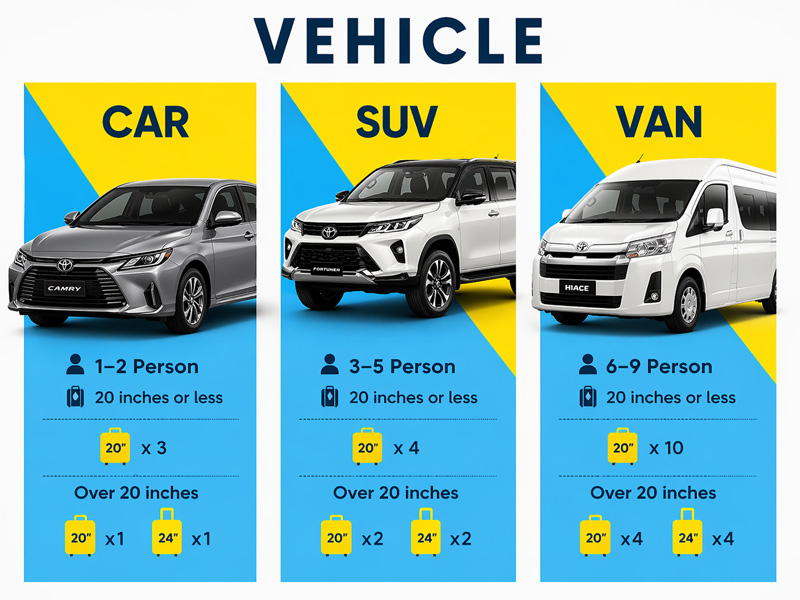
For most bookings, start with the number of passengers and the complete luggage load. Then consider child-seat requirements, ease of entry, journey length, privacy, comfort, and total trip cost. A sedan keeps a small transfer efficient, an SUV creates extra room without moving to a full group vehicle, and a van keeps larger parties and their luggage together.
Sedan vs SUV vs van airport transfer: quick comparison
The practical differences become clearer when passenger space, luggage, comfort, and special requirements are considered together.
| Factor | Sedan | SUV | Van |
|---|---|---|---|
| Typical passenger range | 1–3 | 3–5 | 6–11 or more, depending on vehicle |
| Luggage capacity | Light to moderate | Moderate to large | Large |
| Best suited to | Solo travelers, couples, business travelers | Families, small groups, extra luggage | Larger families, groups, luggage-heavy trips |
| Cabin space | Compact and private | More passenger room | Maximum group space |
| Privacy and environment | Quiet, private, professional | Spacious and private | More group-oriented |
| Seating position | Standard | Typically higher | Varies by model |
| Typical price position | Lower | Mid-range | Higher total fare |
| Main limitation | Boot space can become restrictive | Capacity varies substantially by model | More vehicle than a small party may need |
These figures are planning ranges rather than universal limits. The exact number of passengers and bags depends on the specific sedan, SUV, or van used by the transfer provider. Confirm the actual vehicle capacity before booking, especially when your group is close to the stated limit.
Choose a sedan when your group and luggage are both small
A sedan works best when the transfer does not require substantial passenger or cargo space. It is usually the simplest choice for a solo traveler, a couple, or a small party carrying ordinary luggage.
Sedan airport transfer advantages
Sedans generally provide the lowest vehicle cost of the three categories while still offering a private, comfortable transfer. Their smaller footprint also makes loading and departure straightforward when only a few bags are involved.
For business travel, a sedan can offer a quiet, private cabin and a professional arrival without paying for space that will not be used. A traveler carrying one suitcase and a laptop bag, for example, normally gains little practical benefit from moving to a van.
When a sedan becomes too small
Passenger count alone can make a sedan look adequate even when its luggage compartment is not. Three travelers with several large checked bags may need more cargo space despite having enough seats.
Bulky items also change the calculation quickly. A stroller, golf bag, mobility equipment, large equipment case, or multiple cabin bags can consume the space that would otherwise hold ordinary suitcases.
Child seats matter as well. A child may count as one passenger, but the seat itself uses cabin width and can reduce how comfortably adults fit beside it.
If the luggage or seating arrangement would require bags in the passenger area or leave almost no margin for additional items, move up to an SUV or van.
Choose an SUV when you need more flexibility without a full van
An SUV occupies the middle ground between a sedan and a van. It can provide more seating, cargo room, and personal space while remaining practical for a small family or group.
SUVs work well for families and luggage-heavy small groups
An SUV becomes useful when a sedan is close to its practical limit. A family traveling with checked suitcases and a stroller, or several adults carrying both large and cabin bags, may benefit from the additional cargo flexibility.
The extra cabin space can also matter when passengers will spend longer in the vehicle. More room between passengers can make a longer transfer more comfortable, particularly after a long flight.
An SUV may also appeal to passengers who prefer a higher seating position. However, ease of entry is personal and depends on the specific vehicle, so travelers with mobility requirements should confirm suitability rather than assuming an SUV will automatically be easier to board.
An SUV is not automatically larger in every useful way
Do not assume that the word “SUV” guarantees a particular luggage capacity. Compact, medium, and full-size SUVs have different seating layouts and cargo areas. Using every available passenger seat can also reduce the practical space available for bags.
For that reason, booking “an SUV” without describing your luggage can still result in a vehicle mismatch. Give the provider the passenger total, number and type of bags, and any child-seat or mobility requirements so the actual vehicle can be matched to the trip.
Choose a van when passengers and luggage start competing for space
A van is designed for transfers where keeping a larger party together matters more than minimizing vehicle size. It is usually the practical option for groups, larger families, corporate teams, or travelers carrying substantial luggage.
Vans reduce the need to split a group
Once a party becomes too large for one SUV, booking a van can be simpler than arranging several smaller vehicles. Everyone can leave the airport together, follow one pickup arrangement, and reach the destination as one group.
This becomes especially useful when travelers are arriving on the same flight, staying at the same accommodation, or traveling to the same event.
Families may need a van before their passenger count suggests it
Children often add equipment as well as passengers. Suitcases, cabin bags, strollers, child seats, backpacks, and other travel gear can use a significant amount of space.
A family of four with light luggage may fit comfortably in an SUV, while the same four people with several checked bags, two child seats, and a large stroller may require a van. The deciding factor is the combined space requirement, not simply the number four.
Child seats should therefore be treated as part of the capacity calculation rather than as an afterthought. They can reduce usable seating width and may change which vehicle category remains comfortable.
A van can also improve group cost efficiency
A van normally costs more in total than a sedan, but total fare and cost per passenger are different measures. When one van can replace two or more smaller vehicles, the larger vehicle may reduce the amount each traveler effectively pays while also simplifying the transfer.
The comparison should therefore be between the complete cost of transporting the whole group, not just the advertised price of one sedan versus one van.
Count luggage as carefully as passengers
Luggage is one of the most common reasons a vehicle that looks large enough on paper becomes impractical at pickup.
Count checked suitcases and cabin bags separately, then identify anything that does not pack like a normal suitcase. Strollers, golf clubs, surfboards, wheelchairs, musical instruments, large equipment cases, and similar items can use disproportionate cargo space.
A vehicle's maximum seating capacity should not automatically be treated as its comfortable airport-transfer capacity when every traveler also has luggage.
When you are close to the limit, a little unused space is usually more useful than trying to use every available seat and every part of the luggage compartment.

Consider child seats and accessibility separately from luggage
Some travel requirements affect usable passenger space rather than cargo space.
A child seat can reduce the amount of seating width available to other passengers, even when the nominal passenger count still appears to fit. Multiple child seats can make the difference between a suitable SUV and a van.
Mobility requirements also need separate consideration. A folded wheelchair may affect luggage capacity, while a passenger who requires easier boarding, additional doorway clearance, or a particular seating arrangement may need a specific vehicle configuration.
Tell the transfer provider about these requirements before the vehicle is assigned. Vehicle category alone does not confirm accessibility.
How comfort, privacy, and trip length affect the choice
Capacity should normally be resolved first, but comfort becomes more important as the transfer gets longer.
For a short trip with one or two travelers, paying for a larger vehicle solely for additional space may provide little practical value. A sedan can handle the transfer without unnecessary capacity.
For a longer journey, passengers may value more legroom and separation between seats. An SUV can provide that margin for a small group, while a van can prevent a larger party from spending an extended journey in a tightly packed cabin.
Privacy also matters in some situations. A sedan can suit a solo executive or couple wanting a quiet cabin, while an SUV may offer the same private environment with additional space. A van is more practical for keeping a larger group together, but its cabin is naturally more group-oriented.
The purpose of the trip therefore matters alongside capacity. A business traveler may prioritize privacy and professional presentation, while a family arriving after a long flight may place more value on room for children and travel equipment.
How price changes between a sedan, SUV, and van
Vehicle size usually affects the transfer price because larger vehicles provide more passenger and cargo capacity. A sedan generally sits at the lower end, an SUV in the middle, and a van at the higher end of the total vehicle fare.
That does not mean the smallest vehicle is always the cheapest solution for the entire booking. If choosing a sedan requires a second vehicle for passengers or luggage, the combined fare can exceed the cost of booking one larger vehicle.
The useful comparison is the total transfer cost for the whole booking. Depending on the provider, that may include the vehicle class plus applicable airport access or parking fees, tolls, waiting time, child-seat charges, extra stops, or meet-and-greet services.
Compare the final quoted price for the complete transfer rather than choosing on vehicle category alone.
Which vehicle fits common airport transfer situations?
| Travel situation | Likely starting point | Why |
|---|---|---|
| One traveler with one suitcase | Sedan | No need for additional capacity |
| Couple with normal holiday luggage | Sedan | Usually enough seating and luggage room |
| Couple with bulky or multiple bags | SUV | Additional cargo flexibility |
| Small family with checked bags | SUV | More cabin and luggage space |
| Family with child seats, stroller, and substantial luggage | SUV or van | Seating equipment and luggage can reduce usable space quickly |
| Group of six or more | Van | Keeps passengers together in one vehicle |
| Business traveler with light luggage | Sedan | Private and space-efficient |
| Small corporate team with luggage | SUV | More room without using a group vehicle |
| Larger corporate or event group | Van | Simplifies group coordination |
| Passenger with mobility or access requirements | Confirm specific vehicle | Suitability depends on entry height, seating layout, and equipment |
| Group close to a vehicle's capacity limit | Larger category | Provides margin for luggage and comfort |
These are starting points rather than guaranteed vehicle assignments. The actual fleet configuration should decide the final booking.
What to tell the airport transfer provider before booking
The most useful booking information is a complete description of what the vehicle must carry and accommodate:
-
Number of adults and children
-
Number of checked suitcases
-
Number of cabin bags
-
Number of child seats required
-
Strollers or prams
-
Mobility aids or accessibility requirements
-
Sports equipment or oversized items
-
Any planned additional passenger pickup or stop
Also provide the pickup point and destination because journey length can affect how much cabin space you want.
When the booking sits between two vehicle categories, ask the provider to confirm that the proposed vehicle can accommodate both the passengers and the declared luggage. That is more reliable than choosing solely from a generic capacity label.
Update the booking if your passenger or luggage count changes
A vehicle that was suitable when you booked may no longer be suitable if the travel party changes.
An additional passenger, checked suitcase, stroller, child seat, wheelchair, or bulky item can move the booking into another vehicle category. If your requirements change, tell the provider before pickup so there is time to confirm a larger vehicle if necessary.
This is especially important when the original booking was already close to the stated passenger or luggage limit.
The simplest way to make the final choice
Use the smallest vehicle that can comfortably accommodate the complete travel requirement—not just the passenger count.
A sedan usually covers solo travelers, couples, and light-luggage trips. An SUV provides the extra margin needed by families, small groups, travelers with more baggage, or passengers wanting additional cabin space. A van becomes the stronger option when a larger group, multiple child seats, bulky equipment, or substantial luggage would put pressure on the capacity of an SUV.
Do not upgrade purely because a larger vehicle sounds more comfortable, and do not choose a smaller one simply because its seat count technically matches the group.
A practical airport-transfer decision should account for:
-
Passenger count
-
Checked and cabin luggage
-
Bulky equipment or strollers
-
Child seats
-
Mobility and access requirements
-
Journey length, privacy, and comfort
-
Total cost of transporting the whole group
For an airport transfer, the right vehicle is the one that carries everyone and their belongings comfortably without paying for unnecessary capacity. Start with a sedan for a small party with manageable bags, move to an SUV when additional passenger or cargo room is required, and choose a van when keeping a larger or luggage-heavy group together becomes the priority.
Confirm the actual vehicle capacity before booking, particularly when your passenger count is near the limit or when you have child seats, strollers, mobility equipment, sports gear, or oversized luggage. If your requirements change after booking, update the provider before pickup so the vehicle can be reassessed.
Latest Insights
- Is There a Free Bus from Sydney Domestic to International?
- Can You Walk from Domestic to International at Sydney Airport?
- How Far Apart Are Sydney Airport’s International and Domestic Terminals?
- How Long Does a Domestic to International Transfer Take at Sydney Airport?
- Is There a Free Shuttle at Sydney Airport?
- Airport Transfer With Luggage
