


Terminal 1 Transfer Guide
- How a Sydney Airport Terminal 1 transfer works after arrival
- How to get from Terminal 1 to Terminal 2 or Terminal 3
- Can you walk from Terminal 1 to Terminal 2 or Terminal 3?
- How much time does a Terminal 1 transfer really take?
- Which terminal transfer option should you choose?
- Terminal 1 pickup for private airport transfers
- When a private transfer can be more practical
- Common Sydney Airport Terminal 1 transfer mistakes
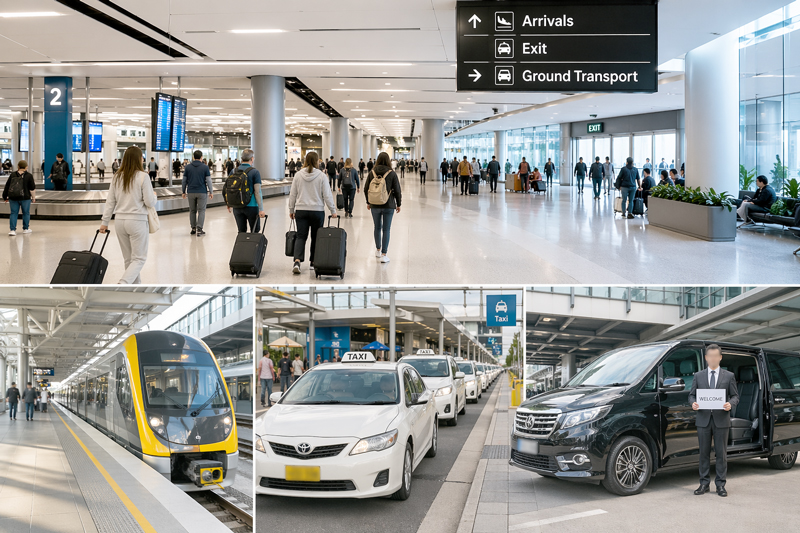
The same arrival process affects passengers using a private airport transfer, taxi or rideshare. A driver cannot collect an international passenger immediately when the aircraft lands because the passenger still needs to reach the public arrivals area. The practical pickup time therefore depends on immigration, baggage delivery, customs and biosecurity rather than scheduled landing time alone.
How a Sydney Airport Terminal 1 transfer works after arrival
For an international arrival connecting to a domestic flight, the normal sequence is:
-
Follow Arrivals signs after leaving the aircraft
-
Complete passport control
-
Collect checked baggage
-
Complete customs and biosecurity procedures
-
Enter the public arrivals area at T1
-
Use the appropriate transfer option to T2 or T3
-
Recheck baggage or complete check-in when required
-
Pass through domestic security
-
Proceed to the departure gate
The important distinction is that the advertised bus, train or taxi journey represents only the movement between terminal precincts. It does not include the time required to process an international arrival or prepare for the onward domestic flight.
Do you need to collect your baggage at Terminal 1?
International passengers connecting to a domestic flight must collect their checked baggage after passport control and take it through the required customs and biosecurity process.
What happens to the bag after that depends on the airline, ticket and connection arrangement. Some eligible passengers can recheck baggage at an airline transfer facility, while others may need to take their bags to the domestic terminal and complete the normal bag-drop process.
Check with the operating airline before travel rather than assuming the bag will automatically move from an international flight to a domestic flight.
Airline transfer and public terminal transfer are different services
An airline transfer service and Sydney Airport's public Terminal Transfer Bus are not the same thing.
The public Terminal Transfer Bus is available for moving between the international and domestic precincts during its operating hours. Airline transfer services are connection-specific and are available only to eligible passengers under the airline's own rules.
Passengers connecting with airlines such as Qantas or Virgin Australia may be eligible for an airline transfer service, but eligibility should be confirmed from the flight itinerary or directly with the airline.
How to get from Terminal 1 to Terminal 2 or Terminal 3
Passengers have several ways to travel between T1 and the domestic terminals. The right option depends on connection time, cost, luggage, operating hours and airline eligibility.
Free Terminal Transfer Bus
Sydney Airport's complimentary Terminal Transfer Bus connects T1 with T2 and T3.
The service currently operates approximately every 15 minutes between 5:30 am and 10:30 pm, and the trip itself takes about 10 minutes.
At T1, the transfer bus departs from the Arrivals level outside Arrival Hall B. Follow signs for the domestic terminal transfer.
The service is useful when:
-
You have enough connection time to allow for the waiting interval
-
You want to avoid paying for the train
-
You are transferring during the published operating period
Do not treat the 10-minute journey as the complete transfer time. Reaching the bus stop, waiting for the next service and continuing through the domestic terminal all add time.
Airport Link train
The Airport Link train connects International Airport station at T1 with Domestic Airport station serving T2 and T3.
The rail journey between the two airport stations takes only a few minutes, with frequent services operating from early morning until around midnight.
The train is a paid option, but it can be useful when predictable journey time matters. Road congestion does not affect the rail journey, although passengers still need to allow time to reach the station, board a service and walk from Domestic Airport station to the correct terminal.
Fares and airport station charges can change, so check the current Airport Link or Transport for NSW fare before travelling rather than relying on an older published price.
Route 420 public bus
Route 420 also serves Sydney International Airport and the domestic terminal precinct.
It can provide a lower-cost public transport alternative, but it operates as part of the normal public bus network rather than as a dedicated flight-connection service. Waiting time, scheduled stops and road traffic therefore make it less predictable than the train for passengers with a tight connection.
It is most suitable when:
-
Cost is a higher priority than transfer speed
-
The connection is not time-sensitive
-
The passenger is comfortable using Sydney's public transport network
Taxi and rideshare
Taxi and rideshare services can be used between T1 and T2/T3.
A road transfer can be convenient for passengers with several bags, families or groups because luggage stays with the passenger in one vehicle. The trade-off is that journey time can vary with airport traffic.
A short road journey between the terminal precincts can still take longer overall if the passenger needs to wait for a vehicle or locate the correct pickup area.
Airline-operated transfer service
Eligible connecting passengers may have access to a dedicated airline transfer process.
For example, an eligible international-to-domestic connection can involve:
-
Collecting checked baggage after the international flight
-
Clearing customs and biosecurity
-
Following signs to the airline's domestic transfer facility
-
Rechecking baggage
-
Completing any required screening
-
Taking the airline transfer service to the domestic terminal
This can reduce unnecessary movement through the public terminal system, but it should not be assumed to apply to every passenger or every booking.
Can you walk from Terminal 1 to Terminal 2 or Terminal 3?
No. T1 and the domestic terminal precinct are separated by airport infrastructure, and passengers should not attempt to walk between them.
Use one of the approved transfer methods:
-
Terminal Transfer Bus
-
Airport Link train
-
Route 420 bus
-
Taxi
-
Rideshare
-
Eligible airline transfer service
T2 and T3 are different because the two domestic terminals are located beside each other. Passengers can walk between T2 and T3 using the pedestrian route through the domestic precinct.
How much time does a Terminal 1 transfer really take?
The actual connection time should not be confused with the vehicle journey between terminals.
A useful way to think about an international-to-domestic transfer is:
Total connection time = international arrival processing + baggage collection + customs/biosecurity + waiting for terminal transport + terminal journey + domestic check-in or bag drop + security + walk to the gate
Any of those stages can become the longest part of the connection.
Why a two-minute train does not mean a two-minute transfer
The Airport Link journey between the airport stations is very short, but a passenger still has to:
-
Finish the international arrival process
-
Walk to International Airport station
-
Wait for and board the train
-
Exit at Domestic Airport station
-
Walk to T2 or T3
-
Complete any remaining airline procedures
-
Pass through security
-
Reach the departure gate
Similarly, a 10-minute terminal bus journey does not mean that 10 minutes is enough to make a connection.
Same booking versus separate tickets
Whether the flights are on one protected itinerary or separate tickets can materially affect what happens if the inbound flight is delayed.
With a through booking, the airline or ticketing carrier can advise how baggage, connection handling and rebooking apply to that itinerary.
With separate tickets, the passenger may be responsible for meeting the second airline's check-in and boarding deadlines independently. A delayed first flight may therefore have more serious consequences because the onward airline may treat the second journey as a separate booking.
Before relying on a short connection, confirm:
-
Whether both flights are on the same booking
-
Which domestic terminal the onward flight uses
-
When check-in and bag drop close
-
Whether baggage can be rechecked at T1
-
Whether an airline transfer service is available
-
What the airline's procedure is if the inbound flight arrives late
Allow extra time for late or disrupted transfers
Transfer options do not all operate 24 hours a day.
T1 and the domestic terminals have overnight closure periods, while the free terminal bus and train have defined operating hours. A late international arrival can therefore change which transfer options remain available.
Passengers with an early-morning or late-night connection should check current terminal and transport operating times before travel.
Which terminal transfer option should you choose?
The best option depends on the conditions of the connection rather than on journey time alone.
| Transfer option | Cost | Predictability | Luggage convenience | Most useful when |
|---|---|---|---|---|
| Terminal Transfer Bus | Free | Moderate | Good | You have enough time to wait for the next bus |
| Airport Link train | Paid | High | Moderate | Predictable terminal-to-terminal travel matters |
| Route 420 bus | Low-cost | Lower | Moderate | Budget matters more than connection speed |
| Taxi or rideshare | Paid | Traffic-dependent | High | Travelling with several bags or as a group |
| Airline transfer service | Depends on eligibility | High when available | High | Your itinerary qualifies for the airline's connection process |
A passenger with a comfortable connection may reasonably choose the free terminal bus. Someone with several suitcases may prefer a direct vehicle. A passenger concerned about road congestion may prefer the train.
The important decision is not simply which service is fastest while moving. It is which option provides enough margin for the entire connection.
Terminal 1 pickup for private airport transfers
Passengers who are leaving the airport rather than connecting to another flight can use a pre-booked private transfer from T1.
The transfer normally starts only after the passenger has:
-
Completed passport control
-
Collected checked baggage
-
Cleared customs and biosecurity
-
Entered the public arrivals area
-
Followed the operator's meeting instructions
This distinction matters for booking and driver waiting time. A flight may land at 8:00 am while the passenger does not become available for pickup until considerably later.
How a meet-and-greet transfer normally works
A pre-booked airport transfer may use a meet-and-greet or designated pickup process.
A typical workflow is:
-
The operator receives the flight number with the booking
-
The driver monitors the flight's arrival status when that service is provided
-
The passenger completes the international arrival process
-
The passenger and driver meet at the agreed T1 meeting point
-
The driver assists with luggage when included in the booking
-
They proceed to the designated vehicle pickup area
-
The passenger travels directly to the booked destination
The exact meeting point varies by transfer provider and vehicle category. Do not assume every chauffeur or private-transfer vehicle can wait immediately outside the arrivals doors.
Why pickup instructions matter
Sydney Airport separates different vehicle types into designated pickup areas.
Depending on the service, a passenger may need to use:
-
A public pickup area
-
A taxi rank
-
A designated rideshare zone
-
A commercial or pre-booked transport area
-
A nearby car park or meeting point specified by the operator
The booking confirmation should therefore identify where the passenger and driver will meet.
A useful transfer booking should include:
-
Passenger name
-
Flight number
-
Arrival date
-
Mobile contact details
-
Number of passengers
-
Luggage requirements
-
Any child-seat or accessibility requirements
-
Agreed meeting instructions
Public passenger pickup at T1
Sydney Airport provides a designated public pickup area for private vehicles.
The current arrangement allows one entry per calendar day with up to 15 minutes free, with charges applying for a longer stay.
Because international processing time is difficult to predict, the passenger should contact the driver after clearing or approaching the end of the arrival process rather than asking the driver to enter the pickup area as soon as the aircraft lands.
Taxi and rideshare pickup
Taxis use designated airport taxi ranks.
Rideshare services also have dedicated pickup arrangements at T1. Passengers should follow the green rideshare signs and the instructions shown in the provider's app rather than waiting at an ordinary passenger kerb.
UberX currently uses Rank C near Arrival Hall B with a PIN-based matching process.
When a private transfer can be more practical
A pre-booked private transfer does not make the immigration or customs process faster, but it changes what happens after the passenger becomes landside.
It can be useful when:
-
Travelling with several suitcases
-
Travelling with children or a group
-
Requiring a particular vehicle size
-
Going directly to an address rather than another airport terminal
-
Wanting pickup arrangements confirmed before arrival
-
Needing specific assistance that has been agreed with the operator
The main value is coordination and door-to-door transport rather than reducing mandatory airport processing time.
Road traffic remains a factor. During congested periods, a direct car may be more comfortable but less predictable in journey time than rail.
Common Sydney Airport Terminal 1 transfer mistakes
Counting only the bus, train or driving time
The terminal journey is only one part of an international-to-domestic connection. Immigration, baggage, biosecurity, check-in, security and walking time also matter.
Trying to walk from T1 to the domestic terminals
T1 cannot be reached from T2/T3 by a normal pedestrian connection. Use an approved transport option.
Assuming checked baggage moves automatically
International-to-domestic passengers need to collect their checked baggage before customs. The airline determines how it is rechecked for the onward flight.
Confusing the free terminal bus with an airline transfer
The public Terminal Transfer Bus is a general airport service. Airline-operated connection services have their own eligibility requirements and procedures.
Booking a tight self-transfer on separate tickets
A connection that looks possible based on scheduled arrival and departure times may leave no practical margin for immigration, baggage, terminal movement or check-in deadlines.
Sending a pickup driver in when the aircraft lands
International passengers can spend significant time between landing and reaching the public arrivals area. Coordinate pickup around passenger readiness, not only the flight's scheduled arrival.
Going to the wrong pickup area
Private cars, taxis, rideshare vehicles and commercial transfer operators do not necessarily use the same collection point. Follow the airport signage and the booking provider's instructions.
A Sydney Airport Terminal 1 transfer is easiest to manage when the journey is treated as a sequence rather than a single terminal-to-terminal trip. International passengers first complete passport control, baggage collection and customs/biosecurity, then move to their domestic terminal or designated ground-transport pickup point.
For a flight connection, choose the terminal transport method only after considering the complete connection time, baggage procedure, operating hours and whether the flights are on the same booking. For a private airport transfer, confirm the meeting point and coordinate pickup around the time the passenger actually exits into the public arrivals area rather than the aircraft's landing time.
Q&A about Terminal 1 Transfer Guide
What should I do if I need mobility assistance during a terminal transfer?
Contact the airline before travel and confirm what assistance is available for the specific connection. Airport kerbside and terminal assistance does not automatically replace an airline's connection assistance, so arrangements should be made in advance.
What if my international flight arrives after the Terminal Transfer Bus stops operating?
Check the current train, taxi and rideshare options for the arrival time. Because terminal and transport operating hours can change, verify the available service before relying on a late-night connection.
Can a private transfer driver wait at the T1 arrivals kerb until I clear customs?
Not generally as an unrestricted waiting arrangement. Sydney Airport controls curbside and commercial-vehicle access, so drivers should use the designated pickup, holding or parking arrangement that applies to their vehicle and booking type.
What happens if my checked bag is delayed and I have a domestic connection?
Report the missing baggage to the relevant airline or ground handler and immediately tell the onward airline about the connection. The appropriate next step depends on the airlines, ticket arrangement and remaining connection time.
Latest Insights
- Is There a Free Bus from Sydney Domestic to International?
- Can You Walk from Domestic to International at Sydney Airport?
- How Far Apart Are Sydney Airport’s International and Domestic Terminals?
- How Long Does a Domestic to International Transfer Take at Sydney Airport?
- Is There a Free Shuttle at Sydney Airport?
- Airport Transfer With Luggage
