


Terminal 2 Transfer Guide
- How a Sydney Airport Terminal 2 transfer works
- Transferring from Terminal 2 to Terminal 3
- Transferring from Terminal 2 to Terminal 1 International
- What happens to checked baggage during a transfer?
- Domestic-to-international and international-to-domestic transfers are different
- Same-ticket and separate-ticket transfers
- How much time should you allow for a Terminal 2 transfer?
- Choosing the right Terminal 2 transfer option
- Meeting a pre-booked airport transfer at Terminal 2
- Common mistakes when transferring at Terminal 2
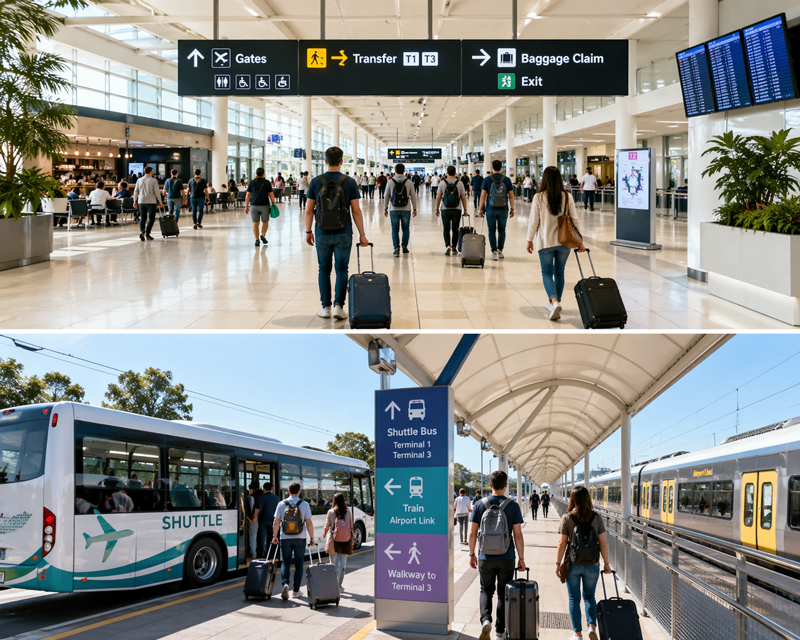
Terminal 2 is part of Sydney Airport’s domestic precinct. Terminal 3 is nearby and connected to T2 by a landside pedestrian route, while Terminal 1 International is in a separate precinct and cannot be reached on foot.
Do not rely only on the airline name or flight-number prefix when identifying your next terminal. Codeshare flights can be marketed by one airline but operated by another, and the operating carrier determines where the flight is handled. Sydney Airport is also continuing Terminal 2 redevelopment work during 2026, so temporary airline and check-in arrangements can change. Check the terminal shown for your specific flight on the day of travel.
How a Sydney Airport Terminal 2 transfer works
After your aircraft arrives at T2, the transfer process normally follows this sequence:
-
Leave the aircraft and follow signs toward Arrivals
-
Check your onward flight terminal on your boarding pass, airline app, or airport display
-
Go to baggage claim if your checked luggage has not been transferred through
-
Collect your baggage when required
-
Follow signs for T3, T1, terminal transport, or your pre-booked pickup
-
Travel to the correct terminal
-
Complete check-in or bag drop again if required
-
Pass through the security and border procedures applicable to your next flight
-
Check the latest gate information and proceed to your departure gate
The process may be much shorter when your baggage is checked through and your airline has arranged the connection. It may be substantially longer when you are travelling on separate tickets and must collect baggage, change terminals, and check in again.
Check the operating airline, not just the flight code
A flight carrying a Qantas, Virgin Australia, or another airline code is not always operated by that airline. With codeshare services, the operating carrier can determine the terminal.
Before starting your transfer, check:
-
The operating airline
-
The departure terminal
-
Current flight information
-
Any airline instructions for connecting passengers
This is especially important during temporary terminal changes associated with T2 redevelopment.
Current Terminal 2 changes
Terminal assignments should not be treated as permanent during the current upgrade period.
Virgin Australia and Jetstar continue to use T2 for departures, while some regional airline operations have temporarily changed terminal arrangements. For example, passengers may encounter flights that arrive at T2 but depart from T3.
Always use your current flight information rather than relying on an older airport guide or a previous trip.
Transferring from Terminal 2 to Terminal 3
T2 and T3 are within Sydney Airport’s domestic terminal precinct and can be reached from each other on foot.
The walk itself generally takes about 5–7 minutes, depending on your starting point and walking speed.
Step-by-step T2 to T3 transfer
For a connection from T2 to T3:
-
Follow signs from your arrival gate toward Arrivals
-
Collect checked baggage if it has not been transferred automatically
-
Exit into the landside terminal area
-
Follow pedestrian signs toward T3
-
Walk via the designated domestic-terminal route
-
Enter T3
-
Complete check-in or bag drop if required
-
Pass through security before proceeding to your gate
The important point is that the T2–T3 route is landside. It is not an airside gate-to-gate connection.
Even when the physical walk takes only a few minutes, passengers may still need to leave the secure area and pass through departure procedures again.
When walking between T2 and T3 may be less convenient
Walking is normally the simplest option, but the short distance does not make it equally practical for everyone.
Allow additional time or seek assistance if you are travelling with:
-
Several or oversized bags
-
Young children
-
A stroller
-
Reduced mobility
-
A passenger requiring assistance
Weather, construction routing, and busy terminal conditions can also make the real journey longer than the basic walking time suggests.
Passengers needing mobility or connection assistance should arrange support with their airline in advance.
Transferring from Terminal 2 to Terminal 1 International
Terminal 1 is physically separated from the T2/T3 domestic precinct.
You cannot walk from T2 to T1.
Passengers moving from T2 to an international flight at T1 normally use one of these options:
-
Free Terminal Transfer Bus
-
Airport Link train
-
Taxi
-
Rideshare
The best option depends on your connection time, baggage, mobility needs, and whether you are willing to pay for a faster or more direct alternative.
Free Terminal Transfer Bus
Sydney Airport’s complimentary Terminal Transfer Bus provides a no-cost connection between the domestic and international terminals.
The current service operates approximately every 15 minutes between 05:30 and 22:30, and the road journey between the domestic and international precincts takes about 10 minutes in normal conditions.
For a T2-to-T1 connection:
-
Arrive at T2
-
Collect baggage if it is not checked through
-
Follow signs to the Arrivals level
-
Exit the terminal and locate the Terminal Transfer Bus stop
-
Board the bus to T1 International
-
Enter T1
-
Check in or drop bags if required
-
Complete international departure processing and security
-
Continue to your gate
The 10-minute bus journey is only the transport portion of the connection. Waiting for the bus and completing international departure formalities must be added separately.
Airport Link train
The Airport Link train connects Domestic Airport station, serving T2 and T3, with International Airport station, serving T1.
The train journey between the stations itself is only a few minutes, making rail useful when passengers want to avoid road traffic. However, the train is a paid terminal-transfer option.
Your total transfer time must also include:
-
Walking from T2 to Domestic Airport station
-
Waiting for the next train
-
Leaving International Airport station
-
Reaching the correct check-in area at T1
A two-minute train journey should therefore never be treated as a two-minute terminal connection.
Taxi and rideshare
Taxi and rideshare services can also transport passengers from T2 to T1.
They can be useful for:
-
Families
-
Passengers carrying multiple bags
-
People who prefer door-to-door transport
-
Travellers who find the train or bus less convenient
Journey time is traffic-dependent, and passengers should use the designated airport pickup areas.
What happens to checked baggage during a transfer?
Baggage handling is one of the most important parts of a Sydney Airport Terminal 2 transfer.
Do not assume your bag will automatically be transferred just because the flights appear on the same itinerary.
Before departure, confirm whether your baggage is:
-
Checked through to your final destination
-
Tagged only to Sydney
-
Required to be collected and checked in again
The correct process depends on the airlines, ticket arrangement, connection direction, and destination.
Domestic to international: T2 to T1
If you arrive domestically at T2 and connect to an international flight from T1, ask at your original departure airport whether your checked bag has been tagged through to the international destination.
If it has not been checked through:
-
Collect the bag at T2
-
Take it with you to T1
-
Check it in for the international flight
-
Complete the remaining international departure process
Even when baggage is checked through, passengers should follow any connection instructions provided by their airline.
International to domestic: T1 to T2
The reverse journey involves additional arrival procedures.
Passengers arriving internationally normally need to complete the applicable Australian arrival formalities and collect checked baggage before continuing to a domestic terminal.
Depending on the airline and connection arrangement, the process can include:
-
Immigration processing
-
Baggage reclaim
-
Customs and biosecurity
-
Baggage recheck
-
Terminal transfer
-
Domestic security screening
This is why an international-to-domestic transfer usually requires more processing than simply travelling between the terminals.
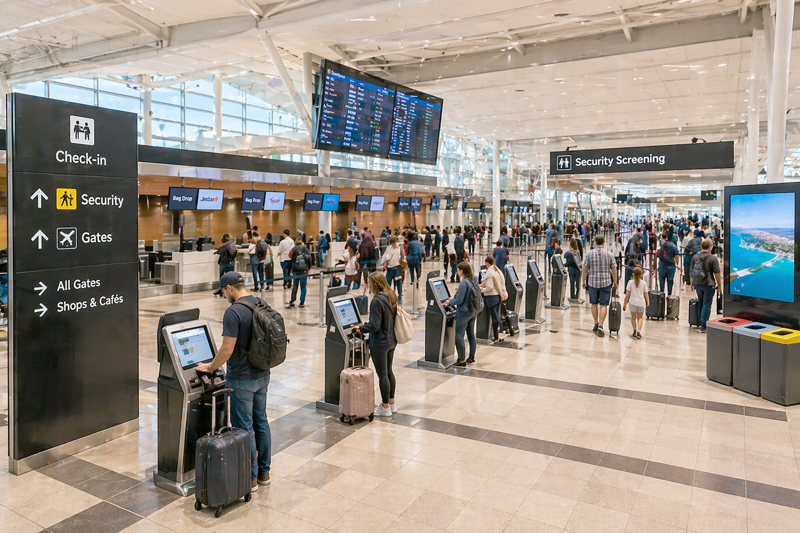
Domestic-to-international and international-to-domestic transfers are different
Terminal transfer times should not be considered symmetrical.
| Connection | Main transfer tasks |
|---|---|
| T2 domestic → T3 domestic | Landside walk, baggage/check-in if required, security |
| T2 domestic → T1 international | Terminal transport, possible baggage recheck, international check-in, security and departure formalities |
| T1 international → T2 domestic | Immigration, baggage reclaim, customs/biosecurity, baggage recheck where required, terminal transport, domestic security |
The transport between buildings may be short, but the procedures surrounding that transport can determine whether a connection is comfortable or risky.
Same-ticket and separate-ticket transfers
A connection booked as one protected itinerary is different from two flights purchased separately.
Same-ticket or through connection
When flights are issued as part of one itinerary, the airlines may coordinate baggage handling and connection procedures. Depending on the carriers involved, checked bags may be tagged through and connection assistance may be available when disruptions occur.
You should still confirm the exact procedure because airline arrangements differ.
Separate tickets
With separate bookings, you may need to:
-
Collect all checked baggage
-
Leave the arrivals area
-
Transfer independently
-
Check in for the second flight
-
Meet the second airline’s bag-drop and check-in deadlines
-
Clear security again
If the first flight is delayed, the second airline may not treat the missed flight as a protected connection.
For this reason, separate-ticket passengers should allow considerably more buffer than someone following a coordinated through-connection procedure.
How much time should you allow for a Terminal 2 transfer?
Do not calculate your connection using only the published walking, bus, or train time.
Your real connection can include:
-
Aircraft disembarkation
-
Walking to Arrivals
-
Waiting for checked baggage
-
Baggage collection
-
Walking to the transfer point
-
Waiting for a bus or train
-
Inter-terminal travel
-
Check-in
-
Bag drop
-
Security screening
-
Immigration or other international procedures
-
Walking to the departure gate
-
Airline boarding deadlines
For example, a five-minute walk from T2 to T3 does not mean a 10-minute flight connection is practical. Likewise, a roughly 10-minute bus journey from T2 to T1 says very little about the total time required to reach an international gate.
Use your airline’s minimum connection requirements and check-in deadlines as the primary planning reference.
When flights are on separate tickets, add additional buffer because you may need to complete the entire arrival-and-departure process independently.
Choosing the right Terminal 2 transfer option
| Transfer | Approximate transport time | Cost | Best suited to | Main limitation |
|---|---|---|---|---|
| T2 → T3 walk | About 5–7 minutes | Free | Most domestic T2/T3 transfers | Landside route; less convenient with heavy baggage or mobility limitations |
| T2 → T1 Terminal Transfer Bus | About 10 minutes plus waiting | Free | Travellers wanting a no-cost terminal transfer | Waiting time and operating hours must be considered |
| T2 → T1 Airport Link train | A few minutes on the train | Paid | Travellers prioritising a short, traffic-independent transport leg | Station access, waiting and fare add to the total journey |
| T2 → T1 taxi or rideshare | Traffic-dependent | Paid | Families, groups and passengers with several bags | Road traffic and higher cost |
The fastest vehicle does not always produce the fastest complete connection.
Choose based on the entire passenger journey, not just the time spent moving between terminals.
Meeting a pre-booked airport transfer at Terminal 2
“Airport transfer” can also refer to a pre-booked car, chauffeur, shuttle, minibus, or private pickup rather than a flight connection.
If a driver or transfer operator is meeting you after arrival at T2, the normal process is:
-
Leave the aircraft and follow signs to Arrivals
-
Collect checked baggage
-
Check the pickup instructions supplied by your transfer provider
-
Proceed to the designated meeting or pickup area
-
Contact the operator if instructed
-
Identify the correct driver or vehicle before departing
Do not assume every private-transfer company uses the same meeting point. Sydney Airport uses designated collection areas for different commercial transport services, and operators may provide their own instructions.
If you have booked a transfer in advance, keep the operator’s phone number and pickup instructions available before landing.
This is especially useful if your arrival is delayed or construction temporarily changes pedestrian routes around T2.
Common mistakes when transferring at Terminal 2
Assuming all Sydney Airport terminals are connected internally
T2 and T3 can be reached on foot, but T1 International is separate and requires transport.
Trying to find a walking route to T1 wastes valuable connection time.
Looking only at the airline brand
Codeshare flights can create confusion because the airline shown on the ticket may not be the airline operating the aircraft.
Check both the operating airline and the departure terminal.
Using outdated terminal information
T2 redevelopment and temporary airline movements mean an old guide, screenshot, or previous travel experience may no longer reflect current operations.
Check current flight information on the day you travel.
Assuming baggage transfers automatically
Baggage arrangements vary.
Confirm whether your bag is checked through before leaving your original airport.
Treating transport time as total connection time
A 5-minute walk, 10-minute bus ride, or short train journey does not include baggage, check-in, security, immigration, or gate walking time.
Planning separate tickets like a protected connection
Separate-ticket passengers may have to complete the entire transfer independently and can face greater consequences if the first flight is delayed.
Allow additional time.
Ignoring the transfer-bus operating window
The free terminal bus does not operate continuously for 24 hours.
If your transfer falls outside its current operating period, plan another option.
A Sydney Airport Terminal 2 transfer is straightforward when you treat it as a sequence rather than simply a journey between two buildings.
First, confirm the actual departure terminal and operating airline. Next, determine whether you must collect your baggage. Then choose the appropriate route: walk landside to T3, or use the bus, train, taxi, or rideshare for T1. Finally, allow enough time for every process that happens before and after the physical terminal transfer.
For passengers arriving at T2 for a pre-booked ground transfer, collect your luggage and follow the pickup instructions issued by your operator rather than assuming every service meets passengers in the same place.
The most common transfer problems come from relying on outdated terminal information, assuming baggage is transferred automatically, confusing a short transport journey with the full connection time, or failing to account for the additional steps involved with international flights and separate tickets.
Latest Insights
- Is There a Free Bus from Sydney Domestic to International?
- Can You Walk from Domestic to International at Sydney Airport?
- How Far Apart Are Sydney Airport’s International and Domestic Terminals?
- How Long Does a Domestic to International Transfer Take at Sydney Airport?
- Is There a Free Shuttle at Sydney Airport?
- Airport Transfer With Luggage
