


Terminal 3 Transfer Guide
- What is terminal 3 transfer at sydney airport?
- Terminal 3 layout and navigation overview
- Step by step terminal 3 transfer process
- Transfer options between terminal 2 and terminal 3
- Transfer time and distance between terminals
- Common mistakes when transferring at terminal 3
- Tips for smooth terminal 3 transfer experience
- Terminal 3 transfer vs other transport options
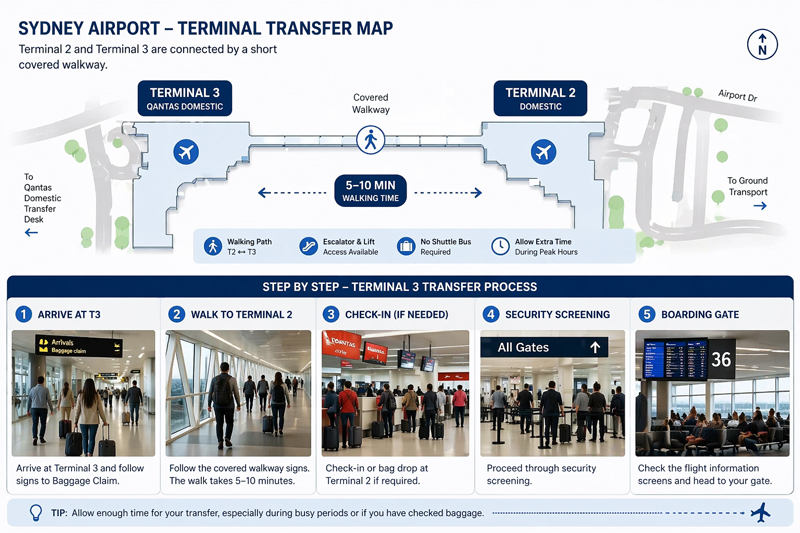
What is terminal 3 transfer at sydney airport?
Sydney Airport overview and terminal system
Sydney Airport is the busiest airport in Australia and operates with a multi-terminal system designed to handle both domestic and international traffic efficiently. The airport consists of three main terminals:
- Terminal 1 (T1): International flights
- Terminal 2 (T2): Domestic flights (multiple airlines)
- Terminal 3 (T3): Domestic flights (primarily Qantas)
Each terminal is physically separated, meaning passengers often need to transfer between terminals depending on their airline, flight route, or connection type. Terminal transfers are a normal part of the passenger journey at Sydney Airport, especially for domestic connections.
Terminal 3 transfer refers specifically to the process of moving to, from, or within T3 when connecting flights, changing airlines, or navigating the airport.
Sydney Airport Terminal 3 role in domestic flights
Sydney Airport Terminal 3 plays a dedicated role in handling domestic flights, mainly operated by Qantas. It is designed for high-frequency domestic routes such as Sydney to Melbourne, Brisbane, and other major cities.
Key characteristics of Terminal 3 include:
- Fast passenger processing for domestic travelers
- Streamlined security and boarding procedures
- High flight frequency and short turnaround times
- Strong integration with Qantas domestic operations
Because of this specialization, Terminal 3 is optimized for efficiency rather than complexity, making it easier to navigate compared to larger international terminals.
Relationship between Terminal 2 and Terminal 3
Terminal 2 and Terminal 3 are both domestic terminals and are located very close to each other. They form the core of Sydney Airport’s domestic travel zone.
Key relationship points:
- Distance: Approximately 5–10 minutes walking time
- Connectivity: Direct pedestrian paths between terminals
- Function split:
- T2 serves multiple domestic airlines
- T3 primarily serves Qantas
This close proximity means that most transfers between T2 and T3 are quick and do not require shuttle buses or long transit times. However, passengers still need to plan carefully, especially during peak hours or when carrying luggage.
Who needs to transfer at terminal 3?
Passengers who typically need to transfer at Terminal 3 include:
- Travelers connecting from a T2 domestic flight to a Qantas flight in T3
- Passengers arriving at T3 and connecting to another domestic destination
- Travelers switching airlines within the domestic network
- Business travelers with tight schedules between major city routes
- First-time visitors unfamiliar with Sydney Airport layout
In general, anyone whose journey involves Qantas domestic flights or a change between domestic terminals may need to complete a Terminal 3 transfer.
When terminal 3 transfer is required?
Terminal 3 transfer is required in several common travel scenarios:
- Domestic to domestic connection between different airlines (T2 ↔ T3)
- Arrival at T3 with a connecting flight departing from T2
- Separate flight bookings requiring terminal change
- Missed or rescheduled flights requiring re-routing
- Luggage collection and re-check between flights
Understanding when a transfer is necessary helps travelers avoid delays, missed flights, and unnecessary stress.
Terminal 3 layout and navigation overview
Terminal 3 arrivals and departures zones
Terminal 3 is divided into two main functional areas:
- Arrivals zone:
- Located on the ground level
- Includes baggage claim and passenger exit points
- Access to transport and walking paths to other terminals
- Departures zone:
- Located on the upper level
- Includes check-in counters, security screening, and boarding gates
The separation of arrivals and departures helps streamline passenger flow and reduces congestion.
Airport signage and navigation system
Sydney Airport uses a clear and standardized signage system to guide passengers efficiently.
Key features include:
- Color-coded directional signs for terminals and gates
- Overhead signs indicating walking routes and exits
- Real-time flight information display screens
- Multilingual support for international travelers
Signs for “Terminal 2”, “Terminal 3”, and “Domestic Transfer” are prominently displayed, making navigation relatively straightforward even for first-time visitors.
Walking paths between terminals
One of the biggest advantages of Sydney Airport is the short walking distance between T2 and T3.
Walking path highlights:
- Clearly marked pedestrian routes
- Safe and accessible walkways
- No need for shuttle in most cases
- Average walking time: 5–10 minutes
This makes terminal transfer quick and convenient, especially for passengers without heavy luggage.
Transfer connection points and exits
Transfer routes between terminals are accessible through designated exits and connection points.
Important elements:
- Exit signs leading to “Domestic Transfers”
- Clearly marked pathways connecting T2 and T3
- Access points near arrivals areas
- Entry points near departures check-in zones
Passengers should always follow official signage rather than relying solely on memory or assumptions.
Common navigation challenges for first time travelers
Despite the relatively simple layout, first-time travelers may face several challenges:
- Confusing Terminal 2 and Terminal 3 due to similar functions
- Underestimating walking time during busy periods
- Not checking departure terminal in advance
- Carrying heavy luggage without planning transfer time
- Missing directional signs due to rushing
To avoid these issues, travelers should always:
- Check flight details carefully
- Allow buffer time for transfers
- Follow airport signage step by step
Step by step terminal 3 transfer process
Arrival at terminal 3 domestic flights
When you arrive at Sydney Airport Terminal 3, you will exit the aircraft directly into the arrivals corridor. Follow the clearly marked “Arrivals” signs, which guide you toward the baggage claim area or the terminal exit.
Typical arrival flow includes:
- Disembarking from the aircraft
- Walking through arrival corridors
- Checking flight information screens if you have a connection
- Following signs for “Baggage Claim” or “Domestic Transfer”
If your journey ends at Terminal 3, you can proceed directly to the exit. However, if you have a connecting flight, you should immediately confirm your next departure terminal.
Baggage claim and transfer requirements
Baggage handling depends on your booking type and airline policy, especially with Qantas flights.
Key scenarios include:
- Through-checked baggage:
- Your luggage is automatically transferred to your next flight
- No need to collect baggage at Terminal 3
- Self-transfer or separate bookings:
- You must collect your luggage at baggage claim
- Re-check baggage at the next terminal
- Mixed airline connections (T3 ↔ T2):
- Often require baggage collection and re-check
Always verify your baggage status before traveling to avoid delays during transfer.
Moving between terminal 2 and terminal 3
Terminal 2 and Terminal 3 are located within walking distance at Sydney Airport, making transfers relatively simple.
Transfer steps:
- Exit Terminal 3 arrivals area
- Follow signs for “Terminal 2” or “Domestic Transfer”
- Use the designated pedestrian walkway
- Arrive at Terminal 2 entrance within 5–10 minutes
The route is well-marked and suitable for most passengers. However, those with heavy luggage or limited mobility may consider alternative transport options.
Security check and re-entry process
If you leave Terminal 3 and enter another terminal (such as T2), you will need to go through security screening again.
Security process includes:
- Presenting your boarding pass
- Passing through baggage screening
- Personal security checks
Important notes:
- Allow extra time for security queues during peak hours
- Ensure liquids and restricted items comply with regulations
- Keep travel documents easily accessible
Re-entry into the departure area is only permitted after completing all security checks.
Final boarding preparation steps
Once inside the departure terminal, complete the final steps before boarding:
- Check departure screens for gate information
- Proceed to the correct boarding gate
- Prepare your boarding pass and identification
- Listen for boarding announcements
For domestic flights, boarding typically begins 20–30 minutes before departure. Arriving early at the gate ensures a smooth transition onto your flight.
Transfer options between terminal 2 and terminal 3
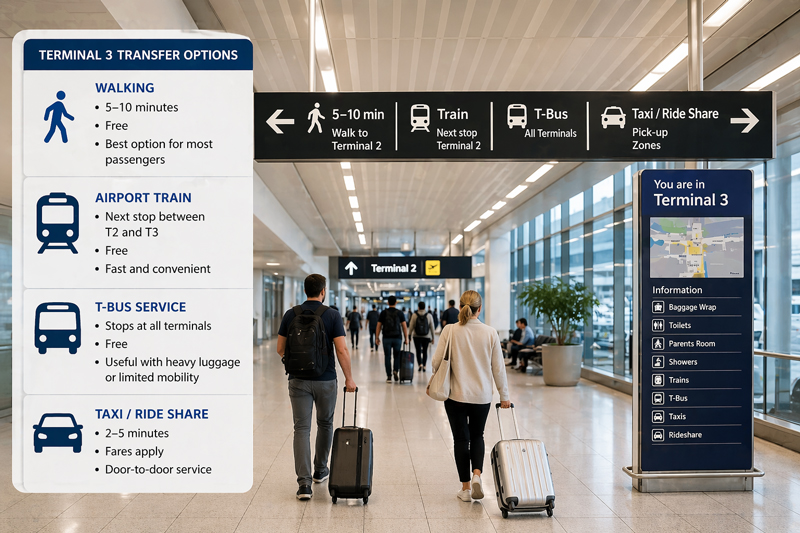
Sydney Airport Shuttle Bus usage and schedule
Sydney Airport Shuttle Bus provides a transfer option between terminals, although it is less commonly used for T2–T3 due to the short distance.
Key points:
- Operates between terminals at scheduled intervals
- Suitable for passengers with heavy luggage
- May require waiting time depending on schedule
- Travel time slightly longer than walking due to stops
Passengers should check availability and timing if considering this option.
Walking transfer between terminal 2 and terminal 3
Walking is the most popular and efficient transfer method between T2 and T3.
Advantages:
- Fastest option in most situations
- No waiting time
- Clearly marked pedestrian pathways
- Free of charge
Estimated walking time is approximately 5–10 minutes, making it ideal for passengers with tight connections.
Taxi and rideshare transfer options
Taxi and rideshare services are available at Sydney Airport, but they are rarely necessary for transfers between T2 and T3.
Considerations:
- Short distance may not justify the cost
- Additional waiting time for vehicle pickup
- Traffic conditions may affect travel time
- Suitable for passengers with mobility needs or excessive luggage
This option is generally used only when walking is not feasible.
Private airport transfer services
Private airport transfer services offer a premium and comfortable option for passengers who prefer convenience.
Typical features:
- Door-to-door service between terminals
- Professional drivers and meet-and-greet service
- Assistance with luggage
- Pre-booked scheduling for reliability
While not necessary for short transfers, this option is valuable for business travelers, families, or those seeking a stress-free experience.
Fastest transfer method comparison
Choosing the fastest transfer method depends on your situation.
General comparison:
- Walking:
- Fastest and most reliable for most passengers
- Ideal for light luggage and normal conditions
- Shuttle bus:
- Slower due to waiting time
- Useful for heavy luggage
- Taxi/rideshare:
- Not efficient for short distances
- Can be affected by traffic
- Private transfer:
- Most comfortable but not the fastest for T2–T3
- Best for convenience rather than speed
In most cases, walking remains the best balance of speed, simplicity, and reliability for Terminal 3 transfers.
Transfer time and distance between terminals
Average transfer time terminal 2 to terminal 3
At Sydney Airport, the average transfer time between Terminal 2 (T2) and Terminal 3 (T3) is relatively short due to their close proximity.
Typical transfer time:
- Walking: 5–10 minutes
- With luggage or slow pace: 10–15 minutes
- During busy periods: up to 15–20 minutes
This makes Sydney Airport one of the more efficient airports for domestic terminal transfers. However, actual time may vary depending on passenger flow and personal pace.
Walking distance between terminals
The walking distance between T2 and T3 is approximately 250–500 meters, depending on the exact route taken.
Key characteristics:
- Flat and accessible pathways
- Clearly marked pedestrian routes
- Suitable for most travelers without assistance
Because of this short distance, walking remains the most practical and commonly used transfer method.
Peak hour transfer time impact
During peak travel hours, transfer time can increase due to congestion.
Factors affecting peak time delays:
- High passenger volume from multiple flights
- Congestion at terminal exits and entrances
- Security screening queues at the next terminal
- Slower walking pace in crowded areas
Peak hours typically occur in the morning (business travel) and late afternoon. Travelers should allow extra buffer time during these periods.
Flight delay and connection risk
Flight delays can significantly impact terminal transfers, especially for tight connections.
Common risks include:
- Reduced time between connecting flights
- Increased stress and rushed movement between terminals
- Higher chance of missing boarding gates
- Baggage transfer complications
Passengers with short layovers should monitor flight updates and be prepared to move quickly upon arrival.
Recommended transfer time planning
To ensure a smooth transfer, proper time planning is essential.
Recommended minimum connection time:
- Same airline with through-check baggage: 45–60 minutes
- Different airlines or self-transfer: 60–90 minutes
- Peak hours or with luggage: 90+ minutes
Planning extra time provides a safety buffer for delays, navigation, and unexpected issues.
Common mistakes when transferring at terminal 3
Confusing terminal 2 and terminal 3 locations
One of the most common mistakes is confusing T2 and T3 due to their similar roles as domestic terminals.
This can lead to:
- Going to the wrong terminal
- Wasting time correcting the mistake
- Missing flights due to delays
Always confirm your departure terminal before moving.
Underestimating transfer time
Many travelers assume the transfer will be instant due to the short distance.
Common issues include:
- Not accounting for walking time
- Ignoring security check queues
- Underestimating crowd conditions
Even short distances require proper time planning.
Missing shuttle or transfer options
Some passengers are unaware of available transfer options such as shuttle services or alternative routes.
This may result in:
- Choosing a slower or less suitable method
- Increased fatigue when carrying heavy luggage
- Unnecessary delays
Understanding all available options helps optimize your transfer.
Not checking baggage transfer requirements
Baggage handling is a critical part of terminal transfers.
Mistakes include:
- Assuming baggage will be transferred automatically
- Forgetting to collect and re-check luggage
- Missing baggage cut-off times
Always verify baggage requirements with your airline, especially when switching between T2 and Sydney Airport Terminal 3.
Last minute transfer stress situations
Leaving the transfer until the last minute often leads to unnecessary stress.
Typical consequences:
- Rushing through terminals
- Missing important signage
- Increased risk of missing flights
Early preparation is key to avoiding these situations.
Tips for smooth terminal 3 transfer experience
Planning transfer time in advance
Before your trip, check your itinerary and calculate the time needed for transfer.
Best practices:
- Review terminal information for each flight
- Allow buffer time for delays and security checks
- Avoid tight connections when possible
Planning ahead reduces uncertainty and stress.
Using airport maps and signage effectively
Sydney Airport provides clear navigation tools to assist passengers.
Tips for effective navigation:
- Follow overhead directional signs
- Use airport maps (digital or printed)
- Check flight information screens regularly
Relying on official guidance ensures accurate movement between terminals.
Choosing the fastest transfer option
Selecting the right transfer method can save time.
General recommendations:
- Walking: best for speed and simplicity
- Shuttle: suitable for heavy luggage
- Private transfer: ideal for comfort and assistance
Choose based on your personal needs and situation.
Handling luggage during transfer
Luggage can significantly affect your transfer experience.
Helpful tips:
- Use lightweight or easy-to-carry bags
- Consider luggage assistance if needed
- Confirm baggage transfer status in advance
Efficient luggage handling improves mobility and reduces delays.
Travel tips for first time passengers
First-time travelers at Sydney Airport should take extra precautions.
Key advice:
- Arrive early and stay calm
- Double-check terminal and gate information
- Follow signage step by step
- Ask airport staff if unsure
These simple steps can greatly improve your overall experience.
Terminal 3 transfer vs other transport options
Terminal transfer vs taxi within airport
Using a taxi for terminal transfer is generally unnecessary due to the short distance.
Comparison:
- Taxi: higher cost, waiting time required
- Walking: free, faster, and more direct
Taxi is only recommended in special cases such as mobility limitations.
Terminal transfer vs rideshare options
Rideshare services offer flexibility but are not ideal for short transfers.
Considerations:
- Pickup and drop-off coordination required
- Possible delays due to traffic
- Additional cost compared to walking
For most travelers, walking remains more efficient.
Shuttle vs walking comparison
Sydney Airport Shuttle Bus provides an alternative to walking.
Comparison:
- Walking: fastest and always available
- Shuttle: useful for heavy luggage but may involve waiting
Choosing between the two depends on convenience versus speed.
Cost vs convenience analysis
Different transfer methods offer varying levels of cost and convenience.
Overview:
- Walking: no cost, high convenience for short distance
- Shuttle: low cost, moderate convenience
- Taxi/rideshare: higher cost, limited advantage
- Private transfer: highest cost, maximum comfort
Travelers should balance budget with comfort and time efficiency.
Best option based on travel needs
The best transfer option depends on individual circumstances.
Recommendations:
- Solo travelers: walking is ideal
- Families with luggage: consider shuttle or private transfer
- Business travelers: prioritize speed and reliability
- Elderly or mobility-limited passengers: assisted transport options
Choosing the right method ensures a smoother and more efficient transfer.
Conclusion
Transferring at Terminal 3 in Sydney Airport is one of the most straightforward airport transfer experiences thanks to the short distance between terminals and clear navigation systems. However, smooth transfers still depend on preparation, including understanding baggage requirements, allowing enough time for security checks, and choosing the right transfer method.
For most travelers, walking remains the fastest and most reliable option, while alternative transport methods are useful in specific situations such as heavy luggage or mobility limitations. By planning ahead and following the guidance in this terminal 3 transfer guide, passengers can significantly reduce stress, avoid common mistakes, and ensure a seamless connection between flights.
Q&A about Terminal 3 Transfer Guide
How to transfer at sydney airport terminal 3?
Follow these steps:
- Arrive at Terminal 3
- Confirm your next terminal
- Walk or use transfer options to reach T2 if needed
- Complete security checks
- Proceed to your boarding gate
How long does terminal transfer take sydney airport?
Transfer time typically ranges from 5 to 15 minutes when walking between T2 and T3, depending on pace and crowd conditions.
Is there shuttle between terminals sydney airport?
Yes, Sydney Airport Shuttle Bus operates between terminals, but it is less commonly used for T2–T3 due to the short walking distance.
What is fastest way to transfer terminal 3 sydney?
Walking is the fastest and most efficient method for transferring between Terminal 2 and Terminal 3 in most situations.
Can I walk between terminal 2 and terminal 3?
Yes, passengers can easily walk between T2 and T3 using clearly marked pedestrian pathways, with an average walking time of 5–10 minutes.
Latest Insights
- Is There a Free Bus from Sydney Domestic to International?
- Can You Walk from Domestic to International at Sydney Airport?
- How Far Apart Are Sydney Airport’s International and Domestic Terminals?
- How Long Does a Domestic to International Transfer Take at Sydney Airport?
- Is There a Free Shuttle at Sydney Airport?
- Airport Transfer With Luggage
