


Transfer Cost Factors
- Pricing model determines which cost factors can change the fare
- Distance, destination, and route establish the basic journey cost
- Route choice can change tolls, distance, and travel time
- Vehicle class affects both capacity and service level
- Passenger and luggage requirements can change the vehicle needed
- Sydney Airport pickup arrangements can form part of the transfer cost
- Waiting time and flight timing can affect the final amount
- Traffic, travel time, and demand do not affect every transfer equally
- Late-night, weekend, holiday, and last-minute travel depend on provider rules
- Optional services and booking conditions can add to the total cost
- Fare inclusions can matter as much as the headline price
- Sydney Airport's CBD taxi fixed fare is a special case
- How to estimate a Sydney airport transfer cost accurately
The most useful way to understand a quote is to ask four questions: what factor is being charged, how it changes the price, under what conditions it applies, and whether it is already included in the quoted fare.
This distinction matters because factors such as traffic, peak demand, airport access, tolls, and waiting do not affect every service in the same way. A fixed-price transfer may absorb costs that would increase a metered or variable fare.
Pricing model determines which cost factors can change the fare
Before comparing prices, identify how each service calculates its fare. The pricing model determines whether factors such as traffic, time, distance, and demand can change the amount eventually paid.
Fixed-price transfers
A fixed-price airport transfer establishes an agreed fare before travel. The provider may calculate that quote using the destination, expected distance, vehicle category, airport pickup costs, expected tolls, passenger requirements, and other booking details.
If the quoted fare is genuinely fixed and the booking conditions do not specify additional variable charges, ordinary traffic congestion does not necessarily increase the final amount.
However, "fixed price" does not automatically mean "all inclusive." A fixed quote can still exclude tolls, airport access fees, excess waiting, additional stops, or requested extras.
The important comparison is therefore:
Fixed fare + excluded charges = expected total cost
rather than comparing the headline fixed fare alone.
Metered and time-distance pricing
Metered pricing can respond directly to the distance travelled and time spent on the journey. Traffic congestion can therefore increase the fare even if the origin and destination remain unchanged.
NSW booked point-to-point transport providers can calculate upfront estimates using distance, expected journey time, a set amount, or a combination of methods. They must provide an upfront fare estimate before a booked journey begins.
Dynamic pricing
Some services adjust quotes according to current demand and vehicle availability. In this model, identical journeys booked at different times can have different prices even before the trip begins.
Peak periods therefore matter most when the service uses demand-responsive pricing. They should not be treated as a universal surcharge applying to every Sydney airport transfer.
Per-vehicle vs per-passenger pricing
A second pricing distinction is the unit being charged.
Private airport transfers are commonly priced for the vehicle or journey, while shared transport can be priced per passenger.
This changes group economics. A higher-capacity private vehicle may have a higher total fare but a lower effective cost per passenger when several travellers share it. With per-passenger pricing, adding another traveller can increase the total directly without requiring a vehicle upgrade.
When comparing transfer options for a group, check both:
-
Total booking cost
-
Effective cost per passenger
Distance, destination, and route establish the basic journey cost
Distance is one of the strongest airport transfer cost factors in Sydney. A transfer to a nearby suburb generally requires fewer resources than a trip to outer Sydney or a regional destination.
Providers can account for distance using several structures:
-
Kilometres travelled
-
Destination or suburb zones
-
Published route prices
-
Distance bands
-
Minimum or base fares
-
Custom fixed quotes
This is why airport transfer pricing is not always a simple calculation of kilometres multiplied by one constant rate.
Short and long trips may not have the same cost per kilometre
A short transfer can be subject to a base or minimum charge designed to cover vehicle dispatch, driver time, airport access, and other fixed operating costs.
As distance increases, those fixed costs are spread across a longer trip. The total fare can therefore rise while the effective cost per kilometre changes.
This does not mean every Sydney private transfer becomes cheaper per kilometre over longer distances. It means travellers should not assume pricing is perfectly linear.
Exact destination matters more than a general area
Quotes are more accurate when they use an exact pickup and destination rather than labels such as "Sydney CBD" or "Western Sydney."
Properties within the same broad area may require different routes, additional driving, toll roads, or more travel time.
For an accurate estimate, the provider should therefore have the actual pickup and drop-off locations before confirming the fare.
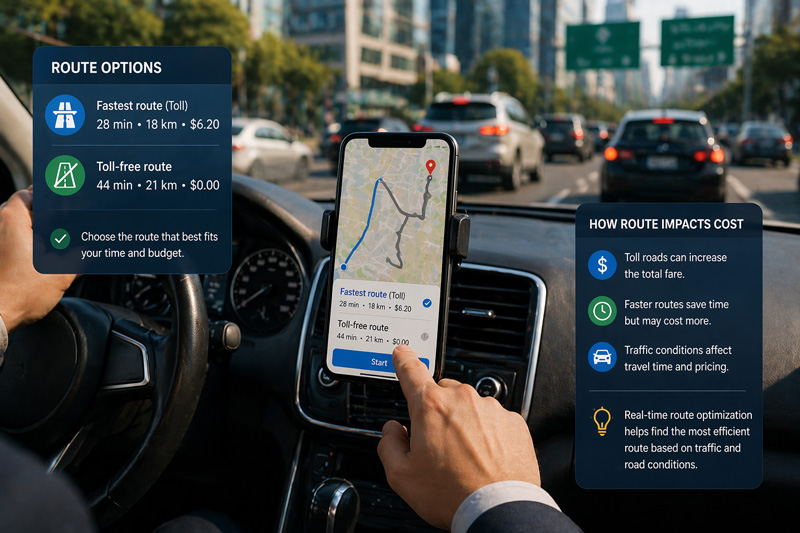
Route choice can change tolls, distance, and travel time
The fastest route and the lowest-cost route are not always the same.
A Sydney transfer may use toll roads to reduce travel time. An alternative route may avoid a toll but increase the distance or duration of the journey.
The cost effect depends on the pricing model.
With an all-inclusive fixed fare, anticipated tolls may already be built into the quote. With another provider, tolls may be added separately. Under a metered or variable model, taking a longer toll-free route can reduce one charge while increasing distance or travel time.
Real-time rerouting can also alter the actual route because of congestion, accidents, or road closures. That operational change matters financially mainly when the fare can vary with distance, time, or toll usage.
When comparing quotes, check whether tolls are:
-
Included in the fare
-
Added separately
-
Passed through at actual cost
-
Dependent on the route taken
Vehicle class affects both capacity and service level
Vehicle type is another major airport transfer cost factor because different vehicles have different capacity, operating costs, and service levels.
A standard sedan will usually be priced differently from an SUV, people mover, minibus, premium sedan, or chauffeur vehicle.
The difference is not solely about the number of seats.
Capacity can trigger a higher vehicle tier
The relevant limit is the combination of passengers and luggage.
A vehicle may technically accommodate the number of passengers in a booking but still be unsuitable once their luggage is considered. If the total requirement exceeds usable capacity, the booking may need to move into a larger vehicle category.
For example, an extra passenger does not necessarily create an individual passenger surcharge. Instead, that passenger may push the booking past the capacity threshold of the originally selected vehicle.
The fare then changes because the vehicle tier changes.
Service class can affect price even when capacity is similar
A premium sedan and a standard sedan may carry a similar number of passengers but still have different rates.
Higher prices can reflect differences such as:
-
Vehicle category
-
Premium interior or amenities
-
Chauffeur service
-
Meet-and-greet arrangements
-
Additional service inclusions
Vehicle pricing should therefore be evaluated on both capacity and service class.
Passenger and luggage requirements can change the vehicle needed
Passenger count affects price mainly when it determines the transport configuration required.
A small group may fit into one standard vehicle. A larger group may require a people mover, minibus, or multiple vehicles.
Sharing one larger vehicle can sometimes reduce the effective cost per traveller compared with arranging several separate transfers, although the larger vehicle will usually have a higher booking price.
Luggage is a capacity issue, not simply a bag-count surcharge
Standard luggage may already be covered by the selected vehicle's normal capacity.
Costs can change when the booking includes:
-
Multiple large suitcases
-
Surfboards
-
Bicycles
-
Golf equipment
-
Sporting equipment
-
Bulky mobility equipment
-
Other oversized items
These items can require a larger vehicle, luggage trailer, extra handling, or a different booking arrangement.
The most useful question is therefore not only "How many bags are allowed?" but:
Can this vehicle safely accommodate all passengers and their luggage at the same time?
Providing accurate luggage information before booking reduces the risk of a vehicle upgrade or operational problem at pickup.
Sydney Airport pickup arrangements can form part of the transfer cost
Airport pickup involves costs and procedures that do not necessarily apply to an ordinary street pickup.
Sydney Airport uses dedicated facilities for commercial passenger pickups. Registered commercial vehicles using relevant Ground Transport Zones are subject to access charges, while ordinary passenger drop-offs outside the departure terminals do not use the same fee structure.
This means the airport component of a quote can depend on:
-
Vehicle category
-
Pickup location
-
Domestic or international terminal arrangements
-
Time spent in the applicable pickup facility
-
Provider pickup procedure
Sydney Airport's current commercial vehicle schedule also uses different access-fee structures according to vehicle type and time spent in certain zones.
Pickup and drop-off are not necessarily priced identically
A journey to Sydney Airport and the reverse journey from Sydney Airport may cover essentially the same road distance but involve different airport access arrangements.
For that reason, travellers should not assume that a return journey must always have exactly the same price as the outbound journey.
Airport access fees may be visible or built into the quote
Providers can handle airport-related costs differently.
They may:
-
Include airport access in an all-inclusive fare
-
Build the cost into a fixed price without listing it separately
-
Add an airport fee to the base price
This is another reason a low advertised base fare is not necessarily the lowest final fare.
Waiting time and flight timing can affect the final amount
Airport arrivals create uncertainty because landing time is not the same as passenger pickup time.
After an aircraft arrives, passengers may still need to clear immigration, collect baggage, retrieve oversized items, or travel from the gate to the meeting point.
Many private transfer services therefore define an included waiting allowance.
The important variables are:
-
When waiting time begins
-
How much waiting time is included
-
Whether the provider monitors the flight
-
How flight delays affect the scheduled pickup
-
What happens when the included allowance expires
Flight delay and passenger delay are different
Flight tracking can allow the pickup schedule to follow the aircraft rather than its original timetable. Several Sydney transfer providers advertise flight monitoring together with an included arrival waiting period, illustrating why both features should be checked when comparing apparently similar fixed fares.
That is different from unlimited waiting.
Once a flight has arrived, a provider may start a separate waiting allowance for the passenger to reach the pickup point. Additional waiting beyond that allowance can be chargeable under the booking conditions.
A useful quote comparison should therefore consider the included waiting value, not merely the base fare.
Traffic, travel time, and demand do not affect every transfer equally
Traffic is frequently described as an airport transfer cost factor, but its actual effect depends on how the fare is calculated.
Traffic matters directly to variable fares
When a fare depends on journey time, congestion can increase the amount charged because the vehicle spends longer completing the trip.
It can also influence an initial quote when the provider estimates expected journey duration before booking.
Traffic may not change a confirmed fixed fare
For a properly fixed trip price, normal congestion may instead be a risk already absorbed into the quote.
A fixed-price provider can therefore charge the same agreed amount even if the journey takes longer than expected, subject to the provider's booking conditions.
High demand affects some services more than others
A dynamically priced service may increase its quote when demand exceeds available supply.
A fixed-price provider may not increase an already confirmed fare. High demand can still affect whether the desired vehicle or pickup time remains available.
This is why demand can affect both price and availability, but not necessarily in the same way.
Late-night, weekend, holiday, and last-minute travel depend on provider rules
There is no universal rule that every Sydney airport transfer costs more at night, on weekends, or on public holidays.
Some pricing systems apply time-based rates or peak pricing. Others advertise fixed rates without night or surge increases.
Similarly, booking early does not automatically guarantee a lower fare.
Advance booking can be particularly valuable for securing:
-
Larger vehicles
-
Minibuses
-
Premium vehicles
-
Child restraints
-
Accessible transport
-
Luggage trailers
-
Multiple coordinated vehicles
A provider using a stable fixed-price schedule may charge the same base fare whether the booking is made well in advance or closer to travel, while another provider may quote differently according to availability.
Booking timing should therefore be treated as a provider-dependent price or availability factor, not a universal discount rule.
Optional services and booking conditions can add to the total cost
The journey itself is not the only potential source of charges.
Depending on the operator and booking terms, additional costs can relate to:
-
Meet-and-greet service
-
Child seats or capsules
-
Extra pickup or drop-off points
-
Excess waiting
-
Luggage trailers
-
Oversized equipment
-
Premium vehicle upgrades
-
Special vehicle requirements
-
Card or payment surcharges
Some providers include several of these items in their standard fare, while others price them separately.
Cancellation, changes, and no-shows are also cost factors
The amount ultimately spent on an airport transfer can also be affected by what happens after booking.
Cancellation, late changes, and passenger no-shows may trigger charges according to the provider's terms. These are not part of the normal journey fare, but they are part of the booking's potential total cost.
Before paying, check:
-
Cancellation deadline
-
Cancellation fee
-
Change policy
-
No-show definition
-
No-show charge
-
Procedure when a flight schedule changes
This becomes particularly important for premium, specialist, or high-capacity vehicles that have been reserved specifically for the booking.
Fare inclusions can matter as much as the headline price
Two airport transfer quotes cannot be compared reliably until their inclusions are normalised.
For example:
Quote A: Lower base price + tolls + airport fee + waiting charge
Quote B: Higher fixed price with those costs already included
Quote B can still produce a lower final amount.
Current Sydney operators illustrate this difference clearly: some advertise fixed airport fares that already incorporate items such as tolls, airport costs, GST, flight monitoring, or a defined waiting allowance.
The inclusion structure is therefore itself an important airport transfer cost factor.
Sydney Airport's CBD taxi fixed fare is a special case
Travellers researching Sydney airport transport may encounter the current fixed-fare arrangement for taxis travelling from Sydney Airport to the designated CBD area.
Since 3 November 2025, eligible non-booked taxi trips from Sydney Airport directly to the designated CBD area use a fixed fare: $60 for a standard or wheelchair-accessible taxi and $80 for a qualifying or requested maxi-taxi. The fixed fares include applicable taxes, fees, levies, and road tolls, apart from permitted payment or cleaning charges.
This arrangement should not be used as the general pricing rule for private airport transfers.
Sydney Airport specifically distinguishes the fixed taxi trial from booked passenger services such as rideshare and airport transfers, where the passenger pays the fare quoted and agreed at booking.
The example demonstrates an important principle: service category and pricing model must be identified before comparing airport transport prices.
How to estimate a Sydney airport transfer cost accurately
A useful estimate requires more than entering a destination into a generic distance calculator.
Give each provider the same booking information so the quotes are comparable.
Provide the inputs that actually determine the booking
For the most accurate quote, specify:
-
Exact pickup address
-
Exact destination
-
Airport terminal
-
Travel date
-
Pickup time or flight number
-
Number of passengers
-
Number and type of bags
-
Oversized items
-
Required vehicle category
-
Child-seat requirements
-
Extra stops
-
Accessibility or special vehicle requirements
Online quote tools can be useful when they collect these variables rather than estimating price from distance alone.
Compare the complete quote, not the base fare
For each quote, check the following:
| Cost component | What to verify |
|---|---|
| Journey | Exact origin and destination |
| Pricing basis | Fixed, metered, dynamic, per vehicle, or per passenger |
| Vehicle | Class and simultaneous passenger/luggage capacity |
| Airport access | Included or additional |
| Tolls | Included or added separately |
| Waiting | Included allowance and excess rate |
| Flight delay | Whether flight tracking adjusts pickup timing |
| Luggage | Standard capacity and oversized-item rules |
| Extra stops | Included or charged separately |
| Optional services | Child seats, meet-and-greet, trailer, premium vehicle |
| Cancellation | Deadline and applicable charge |
| No-show | Definition and fee |
| Payment | Card, booking, or payment surcharge |
| Final price | Whether the quoted amount can still vary |
For booked taxi and hire-vehicle services in NSW, booking service providers must provide an upfront fare estimate before the journey starts and explain how the fare may vary.
The best comparison is therefore not:
Which provider shows the lowest starting price?
It is:
What is the expected total payable amount for the exact passengers, luggage, route, terminal, vehicle, and service conditions required?
Airport transfer costs in Sydney are shaped by several interacting factors rather than one simple distance rate. Distance and destination establish much of the underlying journey requirement, while the pricing model determines how strongly travel time, traffic, demand, and route changes affect the fare.
Vehicle class becomes important when passenger and luggage capacity crosses a vehicle threshold or when a premium service category is selected. Sydney Airport access arrangements, tolls, waiting allowances, optional services, payment charges, cancellation conditions, and no-show rules can further change the effective total.
For a meaningful comparison, travellers should evaluate the complete quoted cost and its inclusions, not the headline fare alone. A slightly higher all-inclusive fixed price can cost less overall than a lower base fare once airport access, tolls, waiting, vehicle upgrades, and other charges are added.
Latest Insights
- Is There a Free Bus from Sydney Domestic to International?
- Can You Walk from Domestic to International at Sydney Airport?
- How Far Apart Are Sydney Airport’s International and Domestic Terminals?
- How Long Does a Domestic to International Transfer Take at Sydney Airport?
- Is There a Free Shuttle at Sydney Airport?
- Airport Transfer With Luggage
