


What Transport Options Serve Sydney Airport's International Terminal?
- Which transport options serve Terminal 1?
- Taking the train from Sydney International Airport
- Public buses at the international terminal
- Taxis, Uber and other rideshare services
- Shuttles, private transfers and rental cars
- Travelling between T1 and the domestic terminals
- Choosing the right journey to or from T1
- Which transport option should you choose?
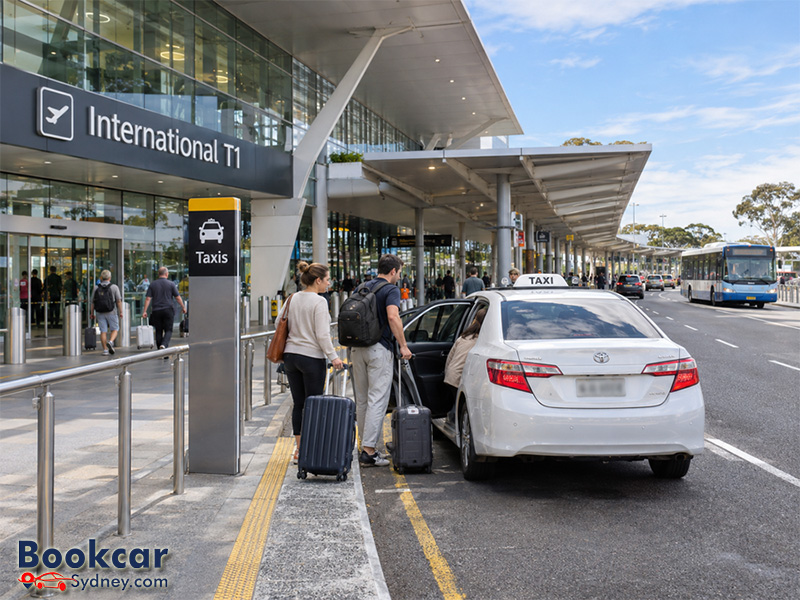
Which transport options serve Terminal 1?
T1 is Sydney Airport’s international terminal. It has its own rail station, public bus stops and designated pick-up areas for taxis and app-based rides. Hotel shuttles, pre-booked private vehicles and rental cars provide alternatives for travellers who do not want to use public transport.
|
Option |
Where to start at T1 |
Best suited to |
|
T8 airport train |
International Airport Station, accessed from T1 |
Central Sydney and train connections |
|
Public buses |
Signed stops outside the terminal |
Mascot, Burwood, nearby suburbs and overnight connections |
|
Taxi |
Official taxi rank outside Arrivals |
Direct journeys without an app or pre-booking |
|
Uber and other rideshare |
App-designated Uber ranks or Priority Pick-up Zone |
Door-to-door travel with an app-based fare |
|
Shuttle or private transfer |
Operator’s confirmed pick-up point |
Hotel stops, groups or a pre-arranged arrival |
|
Rental car |
Car hire counters in the Arrivals area |
Multi-stop journeys beyond the airport |
The train is usually the simplest public-transport choice for central Sydney. A taxi, rideshare or pre-booked transfer is more convenient if your final address is not close to a station. Compare the full cost for your party, particularly when several people are travelling together.
Taking the train from Sydney International Airport
International Airport Station is underneath T1 on the T8 Airport & South Line. From the Arrivals level, leave through Exit A, turn right and continue towards the end of the terminal for station access. A lift or escalator is also available near Check-in Desk A. Follow the train symbols rather than the signs for taxis or passenger pick-up.
Airport trains connect T1 with Central and the City Circle, where you can change for other Sydney services. Sydney Airport describes the rail journey into the city as approximately 13 minutes, with trains generally running about every 10 minutes; actual services vary by time of day and during trackwork.
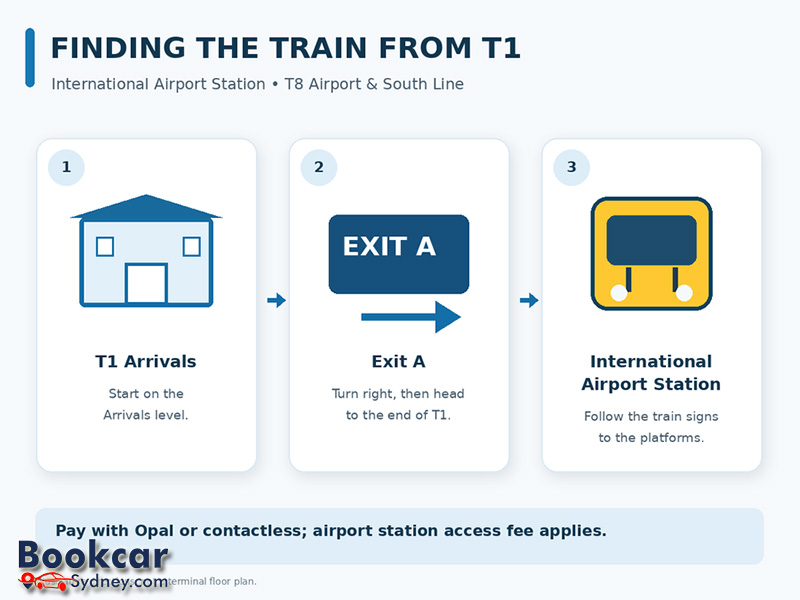
Train tickets and the station access fee
Use an Opal card or an eligible contactless bank card or digital wallet, and tap on and off with the same payment method. The airport station charges an access fee on top of the standard train fare. Transport for NSW currently lists the adult station access fee as A$18.61 for an Opal or contactless journey. Single-trip tickets use a different fee, and concession arrangements also differ. Check your complete fare before travelling.
For exact services, current fares and disruption alerts, use the Transport for NSW Trip Planner.
Public buses at the international terminal
Route 420 serves T1 and T2/T3, running between Mascot Station and Burwood via Rockdale and Campsie. It is useful for destinations along that corridor, or for changing to other public transport at Mascot and elsewhere. It is not a direct daytime express bus from T1 to central Sydney. Route 350 serves the domestic precinct rather than T1, so do not assume it stops at the international terminal.
For late-night travel, route N20 operates between Riverwood and the city via T1. Transport for NSW identifies it as the overnight option serving the international terminal, broadly between midnight and 4 am. Check the exact direction and departure time before setting off.
The T1 bus stop changed on 9 June 2026. The current stop, identified as Sydney Airport, Terminal 1 International (stop 202077), is about a two-minute walk south of the former stop and serves routes 420 and N20. Follow current signs rather than an older airport map.
Bus fares use the Opal or contactless system and do not attract the airport train station access fee. That can make a bus economical, although routes and transfers may take longer than a direct train journey.
Taxis, Uber and other rideshare services
Taxis from the official rank
Taxi ranks are outside T1 Arrivals. Follow the taxi signs and join the managed queue; supervisors are generally available at busy times. A taxi offers direct service without needing mobile data or a pre-arranged driver.
For taxi-rank journeys to the designated Sydney CBD trial area, the published fixed fare is A$60 for a standard taxi, including wheelchair-accessible taxis, or A$80 for a maxi taxi when requested or used by five or more passengers. These fares apply only to eligible airport-to-CBD trips, not every Sydney destination. They include taxes, tolls and levies; payment surcharges or applicable cleaning fees may be additional. Outside the trial area, the fare is calculated under the usual meter rules.
Uber pick-up locations at T1
UberX uses Rank C, about 20 metres outside Arrivals Hall B. After requesting the ride, the app supplies a six-digit PIN to give to the first available driver at the designated UberX zone. Uber XL, Green and premium services use allocated cars at Rank B rather than the UberX PIN queue. Other rideshare operators collect passengers from the signed Priority Pick-up Zone. Follow your booking app’s live instructions, particularly if service arrangements change.
Rideshare fares depend on demand, destination and vehicle type, so the app’s quote is more useful than a generic airport-to-city estimate. If you need a larger vehicle or accessible transport, confirm its availability before travelling.
Shuttles, private transfers and rental cars
Airport shuttle services are available for travellers who prefer a shared or scheduled ride. Sydney Airport lists DART Express Shuttle as a T1 service to selected central Sydney stops, including Central, Hyde Park, Kings Cross, Darling Harbour and The Rocks. A shuttle may involve a fixed timetable and multiple drop-offs, so check its destination list, baggage allowance, pick-up instructions and total price before booking.
A pre-booked private transfer is worth comparing when you are arriving with children, large bags, a group or a particular hotel address. Ask the operator exactly where the driver will meet you after customs, whether waiting time is included, and what happens if the flight is delayed. Child restraints and larger vehicles should be confirmed in advance.
Car rental counters are located in the international Arrivals area. Hiring a car makes more sense for multiple destinations or trips outside central Sydney than for a simple one-way ride to a CBD hotel. Factor in parking, tolls and driving conditions.
Airport transport operators and current service links are available on the Sydney Airport transport options page.
Travelling between T1 and the domestic terminals
International T1 and Domestic T2/T3 are separate terminal precincts, and Sydney Airport advises that walking between them is not possible. For a connection, allow time for immigration, baggage collection, customs and the next airline’s check-in requirements before choosing ground transport.
The airport’s complimentary Terminal Transfer Bus links T1 with T2/T3, generally every 15 minutes between 5:30 am and 10:30 pm. The journey takes approximately 10 minutes. At T1, follow the T2 Domestic Transfer signs to the Arrivals-level stop outside Hall B. The T8 train also connects the airport stations in about two minutes, but it is not free: a train fare and applicable airport station charge apply. Route 420 and taxis are other possibilities.
Some Qantas and Virgin Australia itineraries may qualify for an airline transfer service. Confirm eligibility and baggage arrangements with your airline rather than relying on a terminal transfer that may not be included with your ticket.
Choosing the right journey to or from T1
- For a city-centre address near a station, compare the T8 train’s fare and walking distance with a direct car journey.
- For a suburban destination on route 420, check the bus timetable before paying the airport rail access fee.
- For a late-night arrival, compare the N20 timetable with a taxi or booked ride; do not assume trains run all night.
- For several passengers, substantial luggage or a mobility requirement, compare the total group fare and vehicle suitability.
- When heading to T1 for departure, confirm you are going to the international terminal, not T2 or T3, and allow time for traffic or service changes.
Accessible pick-up and drop-off facilities are available at T1, and taxi supervisors can assist with arrangements for wheelchair-accessible vehicles. Where specialised help is needed, pre-book when possible and confirm the exact meeting point.
Drivers dropping off departing passengers can use the T1 Departures-level kerb, but Sydney Airport asks them to stop for no more than one minute and remain with the vehicle. Anyone planning to park and accompany a passenger inside should use a suitable car park rather than the drop-off lane.
Which transport option should you choose?
For most travellers heading to central Sydney, the T8 train is the most straightforward public-transport route. Route 420 is useful for its specific suburban corridor, while N20 provides an overnight bus option. Taxis and rideshare services offer direct journeys, and shuttles or booked transfers can reduce the uncertainty of arranging a ride after a long flight. Check live schedules and the complete fare—especially the airport rail access charge—before setting off.
